
August 25, 2025 by University of Hawaii at Manoa
Collected at: https://phys.org/news/2025-08-statistical-mechanics-method-machines-complex.html
A study by University of Hawaiʻi researchers is advancing how we learn the laws that govern complex systems—from predator-prey relationships to traffic patterns in cities to how populations grow and shift—using artificial intelligence (AI) and physics.
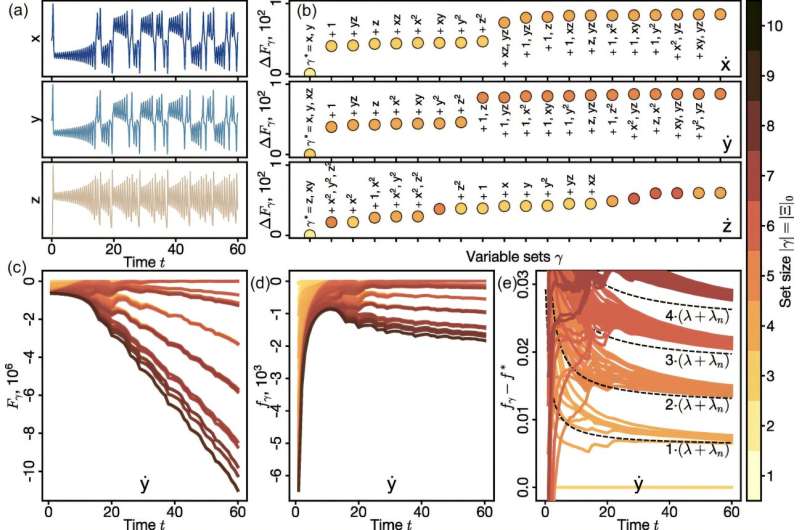
The research, published in Physical Review Research, introduces a new method based on statistical mechanics to improve the discovery of equations directly from noisy real-world data. Statistical mechanics is a branch of physics that explains how collective behavior emerges from individual particles, such as how the random motion of gas molecules leads to predictable changes in pressure and temperature.
In this new work, statistical mechanics is used to understand how different mathematical models “compete” when trying to explain a system. This matters because many scientific fields rely on understanding how systems change over time, whether tracking disease spread, analyzing climate change or predicting the stock market. But real-world data is often messy, and traditional AI models can be unreliable when the data gets noisy or incomplete.
The new approach helps separate useful information from irrelevant noise, giving researchers more confidence that a discovered equation actually reflects reality.
“This work not only pushes the boundaries of how we use AI and physics to understand complex systems, but also highlights the cutting-edge research happening right here in Hawaiʻi,” said Andrei A. Klishin, the study’s lead author and assistant professor in the UH Mānoa Department of Mechanical Engineering.
“It shows that UH is a place where fundamental science meets real-world impact—something that’s incredibly important for training the next generation of thinkers and innovators in our state.”
When more is less
The study shows when collecting more data won’t help, an insight that can save time and resources. By borrowing tools such as “free energy” and the “partition function” from physics, the method identifies when a model is likely to fail due to complexity or lack of data.
It also estimates how much uncertainty is in the result, a key factor when making real-world decisions based on data. This UH-led innovation could impact everything from engineering and ecology to economics and medicine, where understanding the rules behind data can lead to better predictions, smarter decisions and deeper insights into how our world works.
More information: Andrei A. Klishin et al, Statistical mechanics of dynamical system identification, Physical Review Research (2025). DOI: 10.1103/4d98-tdlp
Journal information: Physical Review Research
Leave a Reply