
August 25, 2025 by Pohang University of Science and Technology
Collected at: https://techxplore.com/news/2025-08-hydrogen-solar-oxide-material-carbon.html
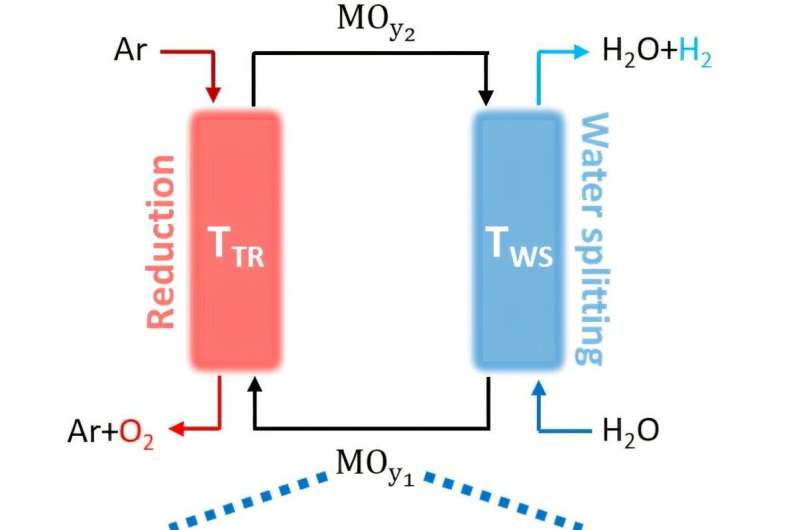
A research team from POSTECH and Seoul National University (SNU) has discovered a novel oxide material that can produce large quantities of clean hydrogen using only heat, without carbon emissions. The discovery, enabled by a new high-throughput computational screening method, was recently published in Advanced Science.
The team, led by Professor Hyungyu Jin and Dr. Dongkyu Lee from POSTECH in collaboration with Professor In-Ho Jung and Dr. Joonhyun Nam from SNU, identified (MgMnCo)0.65Fe0.35Oy as a highly efficient hydrogen-generating oxide. By combining thermodynamic databases with accelerated simulations, they were able to analyze more than 1,000 material conditions in just 24 hours—over 7,000 times faster than conventional approaches, which typically required at least a full week to investigate a single condition.
After screening promising candidates computationally, experimental validation confirmed that the new material achieves world-leading performance in hydrogen yield and thermal conversion efficiency.
Beyond hydrogen production, the methodology can be applied to other industries requiring efficient redox materials, such as methane reforming for hydrogen extraction from natural gas, battery recycling for recovering valuable metals from waste batteries, and metal oxidation-reduction processes in steel manufacturing.
“This research dramatically reduces the timeline for discovering hydrogen production materials, bringing commercialization significantly closer,” said Professor Jin of POSTECH.
Professor Jung of SNU added, “This is an excellent example of how computational scientific databases can rapidly identify complex oxide materials that would be difficult to design using AI alone, demonstrating the power of interdisciplinary collaboration.”
More information: Dongkyu Lee et al, Discovery of Novel Ferrites for Thermochemical H2 Production Cycle via High‐Throughput Thermodynamic Screening, Advanced Science (2025). DOI: 10.1002/advs.202501846
Journal information: Advanced Science


Leave a Reply