
August 25, 2025 by Kosala Herath and Malin Premaratne
Collected at: https://techxplore.com/news/2025-08-terahertz-quantum-free-multi-core.html
For decades, computing followed a simple rule: Smaller transistors made chips faster, cheaper, and more capable. As Moore’s law slows, a different limit has come into focus. The challenge is no longer only computation; modern processors and accelerators are throttled by interconnection.
And even if large-scale quantum computers ever materialize, they would still require dense forests of control, readout and error-correction links. Each added connection increases delay, heat and energy waste until the wiring itself becomes the bottleneck.
So we asked a simple but radical question: What if chips could talk to each other without wires at all?
From wires to waves
Instead of crisscrossing copper interconnects, imagine chips exchanging information using beams of terahertz (THz) waves. These frequencies are thousands of times higher than Wi-Fi and can carry enormous amounts of data at near light-speed. But turning this vision into reality is nontrivial: chip-scale THz links face interference, noise, and strict power budgets.
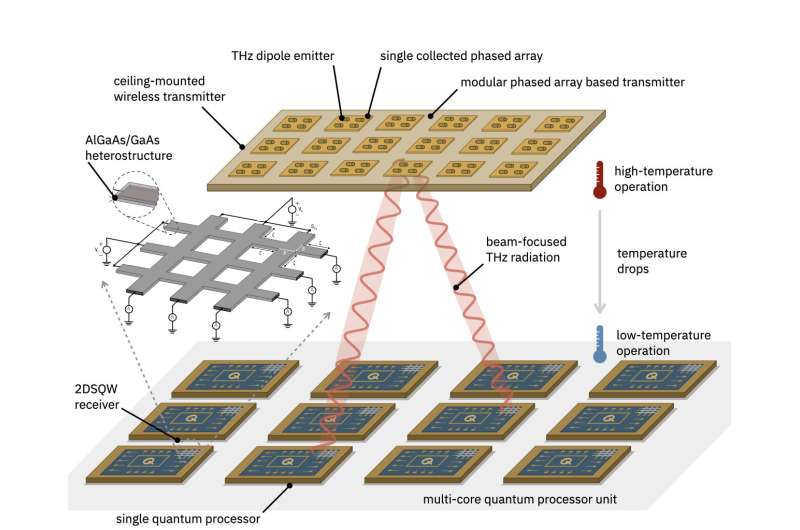
Our recent work published in Advanced Photonics Research addresses these limits with a two-part architecture: a transmitter that sculpts energy with extreme precision and a nanoscale receiver that filters noise at the physics level, before bulky post-processing would normally begin.
A modular phased array transmitter
On the transmit side, we designed a modular phased array (MPA) for the THz band. Traditional phased arrays mainly steer beams; ours also concentrates them into tightly focused, three-dimensional energy packets in the near field, ideal for short, chip-to-chip links.
A dual-carrier configuration suppresses unwanted grating lobes, the ghost beams that waste power and cause crosstalk, and helps mitigate polarization mismatch between transmitter and receiver. The result is a transmitter that delivers both precision and resilience, crucial in dense multi-core environments.
A Floquet-engineered receiver
The receiver is where the design becomes truly unconventional. Rather than relying on heavy digital signal processing, we use Floquet engineering, periodically dressing electrons with an applied electromagnetic field to reshape their response. Our prototype uses a two-dimensional semiconductor quantum well (2DSQW) whose electrons respond directly to incoming THz radiation.
By tuning the time-periodic field, we tailor the material’s effective conductivity so the receiver naturally emphasizes the desired signal while suppressing noise. The device geometry supports spatial modulation as well: information can be encoded in distinct current-flow patterns across the receiver, making the link compact, sensitive, and inherently robust to interference.
Applications in classical and quantum computing
For classical processors, this architecture offers a path to higher bandwidth and lower energy per bit by pulling long, resistive wires off the critical path. For quantum computing, we take a cautious view: Practical large-scale machines may take a long time to emerge, and even if they do, they will still face interconnect constraints. Current low-qubit systems operate at cryogenic temperatures, where each control line adds heat and noise.
In that limited context, our framework keeps the transmitter warm while the receiver remains cold, preserving thermal isolation better than cables. A wireless link could modestly reduce control-line density and thermal load in small testbeds, but it does not solve the harder scaling and error-correction problems; at best, it mitigates one slice of the wiring bottleneck.
A platform for the post-Moore era
The broader significance is architectural: moving from a world limited by metal to one orchestrated by waves. By uniting a near-field THz phased-array transmitter with a Floquet-engineered nano-receiver, the system attacks noise where it begins and shapes energy where it matters.
The same principles scale outward to optical-wireless links inside racks or rooms, where phased arrays within phased arrays can sculpt multiple simultaneous beams for efficient, greener connectivity, a direction highlighted in accessible research features.
Taken together, these advances sketch a credible path to processors, classical and quantum, that are faster, cooler, and dramatically more scalable.
This story is part of Science X Dialog, where researchers can report findings from their published research articles. Visit this page for information about Science X Dialog and how to participate.
More information: Kosala Herath et al, Floquet‐Engineered Noise‐Resilient Terahertz Receiver with Modular Phased Array Architecture for Scalable Chip‐Scale Communication, Advanced Photonics Research (2025). DOI: 10.1002/adpr.202500079


An impressive share, I just given this onto a colleague who was doing a little analysis on this. And he in fact bought me breakfast because I found it for him.. smile. So let me reword that: Thnx for the treat! But yeah Thnkx for spending the time to discuss this, I feel strongly about it and love reading more on this topic. If possible, as you become expertise, would you mind updating your blog with more details? It is highly helpful for me. Big thumb up for this blog post!


Leave a Reply