
By University of Innsbruck August 23, 2025
Collected at: https://scitechdaily.com/quantum-internet-breakthrough-scientists-build-scalable-network-node-with-light-and-ions/
The new interface paves the way for connecting quantum devices.
Quantum networks are often described as the next stage of the internet. Instead of transferring ordinary digital information in bits, they use photons to carry quantum information. This approach could make communication virtually unbreakable, connect faraway quantum computers into one powerful system, and enable sensing technologies capable of measuring time and environmental conditions with extraordinary precision.
For this kind of network to work, researchers must develop quantum network nodes that can both store quantum information and exchange it through light particles. In a recent breakthrough, a team led by Ben Lanyon at the Department of Experimental Physics, University of Innsbruck, demonstrated such a node by using a chain of ten calcium ions inside a prototype quantum computer.
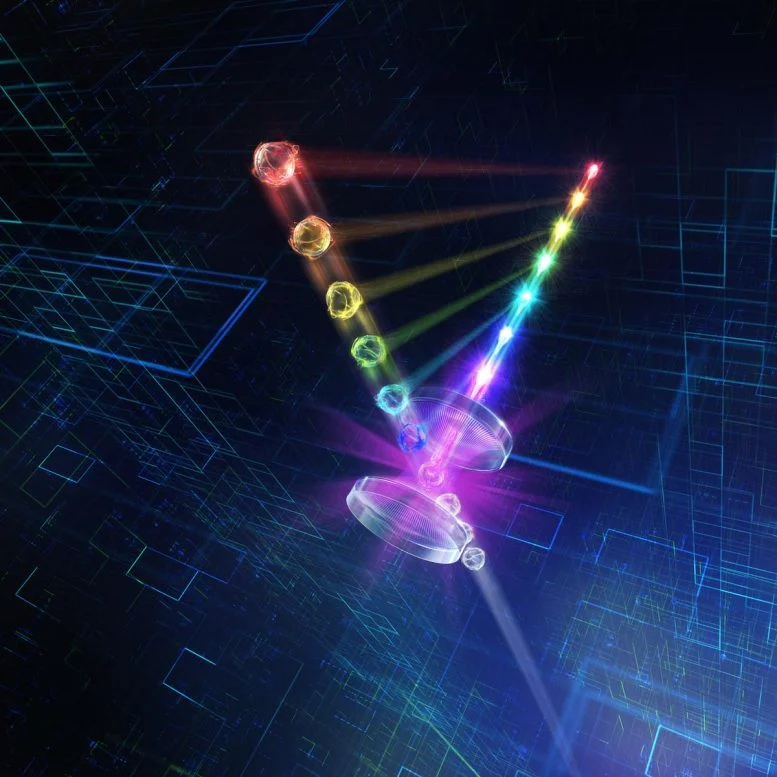
By finely controlling electric fields, the scientists guided the ions one at a time into an optical cavity. Inside the cavity, a carefully calibrated laser pulse caused each ion to emit a single photon, with the photon’s polarization becoming entangled with the ion’s quantum state.
Linking Ions and Photons
The process created a stream of photons; each tied to a different ion-qubit in the register. In future the photons could travel to distant nodes and be used to establish entanglement between separate quantum devices. The researchers achieved an average ion–photon entanglement fidelity of 92 percent, a level of precision that underscores the robustness of their method.
“One of the key strengths of this technique is its scalability,” says Ben Lanyon. “While earlier experiments managed to link only two or three ion-qubits to individual photons, the Innsbruck setup can be extended to much larger registers, potentially containing hundreds of ions and more.” This paves the way for connecting entire quantum processors across laboratories or even continents.
“Our method is a step towards building larger and more complex quantum networks,” says Marco Canteri, the first author of the study. “It brings us closer to practical applications such as quantum-secure communication, distributed quantum computing, and large-scale distributed quantum sensing.”
Broader Applications
Beyond networking, the technology could also advance optical atomic clocks, which keep time so precisely that they would lose less than a second over the age of the universe. Such clocks could be linked via quantum networks to form a worldwide timekeeping system of unmatched accuracy.
Reference: “Photon-Interfaced Ten-Qubit Register of Trapped Ions” by M. Canteri, Z. X. Koong, J. Bate, A. Winkler, V. Krutyanskiy and B. P. Lanyon, 21 August 2025, Physical Review Letters.
DOI: 10.1103/v5k1-whwz
The work was financially supported by the Austrian Science Fund FWF and the European Union, among others, and demonstrates not only a technical milestone but also a key building block for the next generation of quantum technologies.


What i don’t understood is in reality how you are not really a lot more neatly-appreciated than you might be right now. You’re very intelligent. You understand thus significantly in terms of this matter, produced me individually believe it from a lot of numerous angles. Its like men and women are not fascinated unless it is one thing to accomplish with Girl gaga! Your personal stuffs outstanding. All the time deal with it up!


An impressive share, I just given this onto a colleague who was doing a little analysis on this. And he in fact bought me breakfast because I found it for him.. smile. So let me reword that: Thnx for the treat! But yeah Thnkx for spending the time to discuss this, I feel strongly about it and love reading more on this topic. If possible, as you become expertise, would you mind updating your blog with more details? It is highly helpful for me. Big thumb up for this blog post!

Leave a Reply