
By Evan Gough, Universe Today August 14, 2025
Collected at: https://scitechdaily.com/this-earth-sized-exoplanet-is-racing-toward-its-own-destruction/
An ultra-short period planet is spiraling toward destruction within 31 million years. Its extreme heat and dense composition reveal a violent past.
Our circumstances here on the wondrous, life-supporting Earth can distort our view of the Universe. Our planet, with blue skies and a mild climate, is an outlier among worlds. Nowhere else in the Solar System offers anything close to Earth’s conditions, and research on planets beyond our system points in the same direction. A few exoplanets show hints of habitability, yet the vast majority are harsh and unwelcoming.
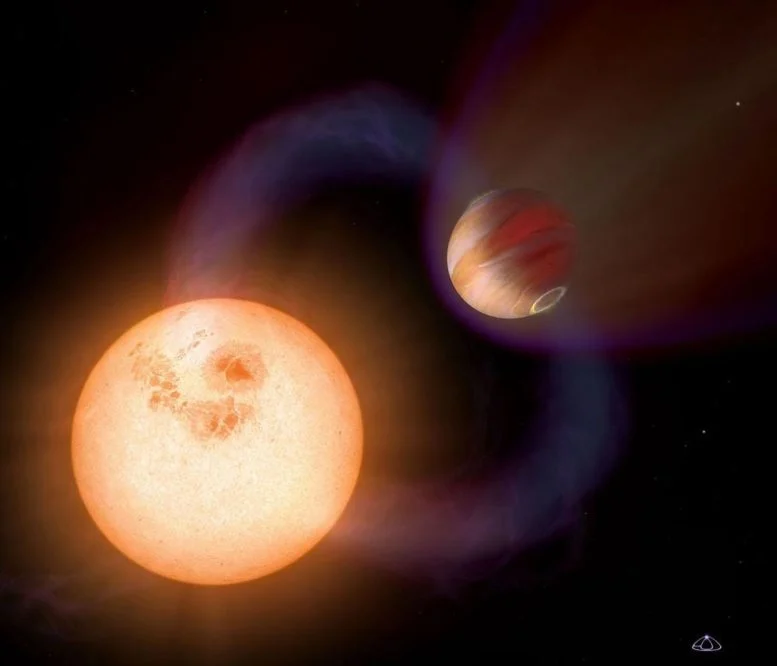
Ultra-Short Period (USP) planets represent one of the most extreme and inhospitable categories. These planets complete an orbit in less than a single Earth day, placing them in extremely close proximity to their stars. At such distances, their surfaces are intensely heated to the point of being molten, and any atmosphere they once possessed has likely been stripped away by the star’s intense radiation. Their closeness also places them in constant danger of destruction, as strong gravitational forces can gradually tear them apart or cause them to spiral inward until they are consumed by their stars.
Discovery of TOI-2431 b
Using data from TESS and other observatories, astronomers have identified an ultra-short period (USP) planet with an exceptionally brief orbital period of just 5 hours and 22 minutes. Their results are detailed in research submitted to Astronomy and Astrophysics under the title “An Earth-Sized Planet in a 5.4h Orbit Around a Nearby K dwarf.” The study’s lead author is Kaya Han Tas of the Anton Pannekoek Institute for Astronomy at the University of Amsterdam in the Netherlands.
This planet, designated TOI-2431 b, stands out for its extreme characteristics. It circles its star more than four times in a single Earth day, placing it among the shortest-period exoplanets known. Of the more than 6,000 confirmed exoplanets, only a little over 100 fall into the USP category.
TOI-2431 b is almost certainly tidally locked, with one side perpetually facing its star. Its surface temperature exceeds 2,000 Kelvin (1700 C/3140 F), making it likely a molten lava world. Unlike Earth, which passed through a brief magma ocean stage before cooling to form a stable crust that supported life, this planet has remained locked in a searing, molten state.
Evidence of a larger past
With a mass of 6.2 times that of Earth but only 1.5 Earth radii, TOI-2431 b’s density points to an intense history. The data suggest it was once a larger planet that has since been stripped to its rocky core by prolonged exposure to its star’s powerful radiation.
According to the researchers, TOI-2431 b is on course for a dramatic end. “The short orbital period of TOI-2431 b suggests that it is subject to strong tidal interactions with its host star, potentially leading to tidal deformation and orbital decay,” they report. The star’s immense gravitational pull distorts the planet, making its shortest axis about 10% shorter than its longest axis.
In addition to being a rare example of extreme planetary conditions, TOI-2431 b provides a valuable opportunity to study the physics of such environments. Its host star’s brightness gives it a high Emission Spectroscopy Metric (ESM) of 27, which the authors note makes it “one of the best USP systems for atmospheric phase-curve analysis.” Emission spectroscopy measures light across multiple wavelengths to determine which chemical elements and molecules are present—in this case, in the planet’s atmosphere. The ESM ranks exoplanets by their potential for follow-up atmospheric studies with tools like the James Webb Space Telescope, whose limited operational lifespan makes the selection of observational targets especially critical.
But the most compelling thing about this planet is its upcoming demise.
Perilously close to destruction
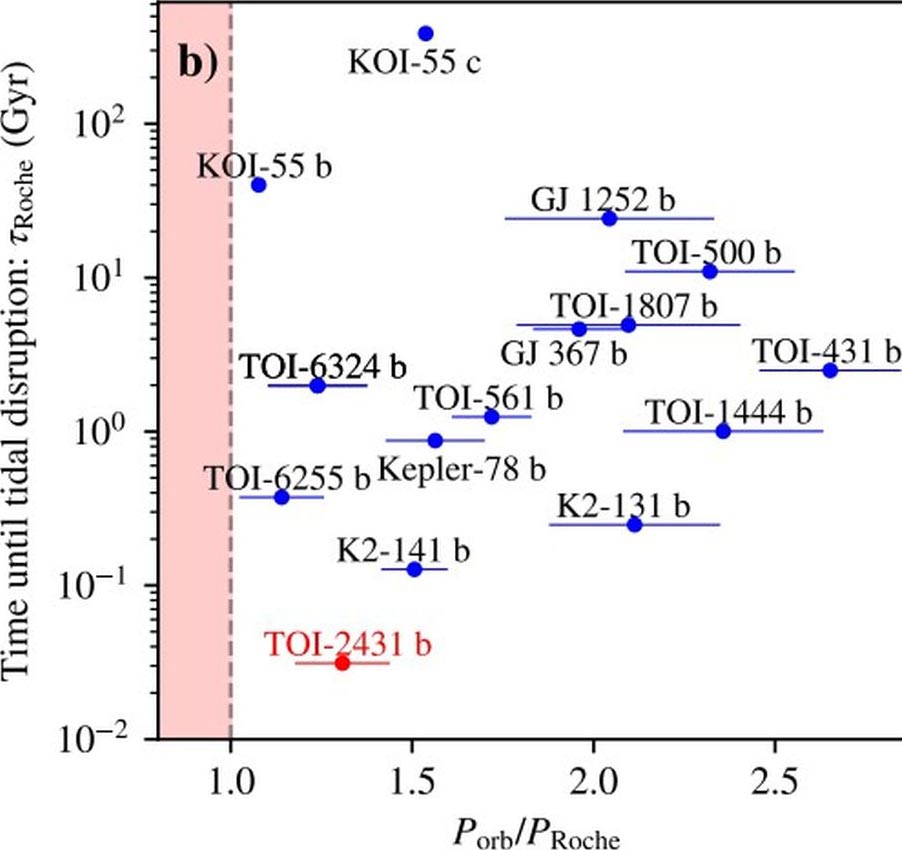
The Roche limit or Roche radius is the distance from a more massive body that a less massive body must not breech if it expects to survive. Inside the Roche limit, a star’s powerful gravity can tear the planet apart. Planets can do the same to moons, and astronomers think that Saturn’s rings could be the remains of other moons that were torn apart after breaching the limit.
Tidal interactions with its host star not only deform the planet. They also dissipate orbital energy, “leading to a gradual inward spiral of a planet toward its host star,” the authors write.
TOI-2431 b is approaching that limit. “We estimate that the current orbital period is only 30% larger than the Roche-limit orbital period, and that it has an expected orbital decay timescale of only ∼31 Myr,” the authors explain. That’s perilously close to destruction, in astronomical terms, where 31 million years is only a tiny fraction of Earth’s 4.5 billion year lifespan.
Why distant planets matter
A distant planet like TOI-2431 b has very little meaning in our personal lives. But it and others like it provide context for humanity’s existence. Each exoplanet, no matter how inhospitable and horrible, is a piece of the cosmic puzzle we find ourselves in. They show us how fortunate we are, how unlikely our civilization is, and how wondrous Earth and all its lifeforms are.
If we sit with that perspective for a while, we can realize why it’s important to build telescopes and study the cosmos. Even a scorching hot lava world with no atmosphere, elongated and spiraling to its destruction, holds important lessons beyond its statistics and properties. Maybe these awful worlds will teach us some humility and we’ll stop taking Earth’s biosphere for granted.
Reference: “An Earth-Sized Planet in a 5.4h Orbit Around a Nearby K dwarf” by Kaya Han Taş, Gudmundur Stefansson, Syarief N.M. Fariz, Esha Garg, Juan I. Espinoza-Retamal, Elise Koo, David Bruijne, Jacob Luhn, Eric B. Ford, Suvrath Mahadevan, Sarah E. Logsdon, Caleb I. Cañas, Te Han, Mark E. Everett, Jaime A. Alvarado-Montes, Cullen Blake, William D. Cochran, Jiayin Dong, Rachel B. Fernandes, Mark R. Giovinazzi, Samuel Halverson, Shubham Kanodia, Daniel Krolikowski, Michael McElwain, Joe Ninan, Leonardo A. Paredes, Paul Robertson and Christian Schwab, 11 July 2025, arXiv.
DOI: 10.48550/arXiv.2507.08464
Adapted from an article originally published on Universe Today.
Leave a Reply