
By Johns Hopkins University August 16, 2025
Collected at: https://scitechdaily.com/scientists-eye-black-holes-as-cosmic-supercolliders-in-the-hunt-for-dark-matter/
A new study suggests that nature might already be running its own supercolliders—inside spinning supermassive black holes.
These cosmic giants could accelerate particles to extreme energies, possibly even generating dark matter particles, a feat human-built facilities like the Large Hadron Collider have yet to achieve.
Black Holes vs. Billion-Dollar Labs
With federal research budgets under strain, scientists are exploring whether black holes could serve as a low-cost, natural alternative to massive facilities built to detect dark matter and other hard-to-find particles that may hold answers to the universe’s greatest mysteries. This idea is at the center of a new study from Johns Hopkins University, which focuses on supermassive black holes.
The researchers propose that these cosmic phenomena could help offset the enormous cost and decades-long timelines required to build advanced research infrastructure, such as the Large Hadron Collider in Europe. The LHC is currently the world’s most powerful particle accelerator and stretches 17 miles underground.
“One of the great hopes for particle colliders like the Large Hadron Collider is that it will generate dark matter particles, but we haven’t seen any evidence yet,” said study co-author Joseph Silk, an astrophysics professor at Johns Hopkins University and the University of Oxford, UK. “That’s why there are discussions underway to build a much more powerful version, a next-generation supercollider. But as we invest $30 billion and wait 40 years to build this supercollider—nature may provide a glimpse of the future in super massive black holes.”
The research was published in Physical Review Letters.
Peering into Matter’s Deepest Secrets
Particle colliders are designed to smash protons and other subatomic particles together at speeds approaching the speed of light. These collisions generate bursts of energy and scattered debris that could reveal never-before-seen particles, including those suspected to make up dark matter—a fundamental, invisible component of the universe that remains undetected. In addition to advancing particle physics, facilities like the LHC have contributed to major breakthroughs in internet technologies, medical treatment for cancer, and high-performance computing.
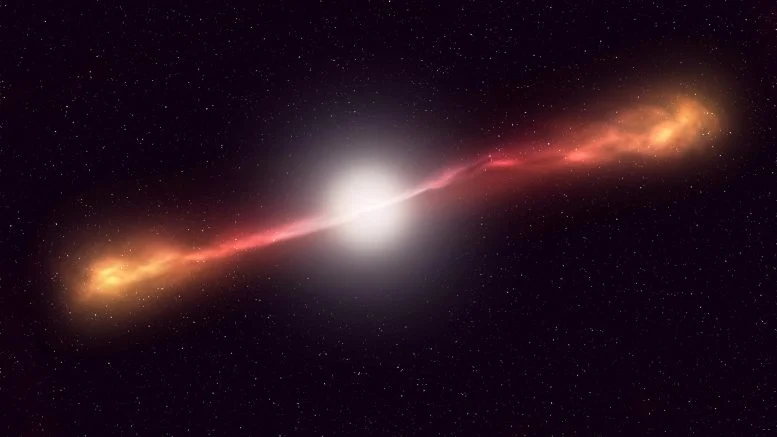
Black holes also rotate, much like planets do, but with far more force due to their intense gravitational pull. Scientists are finding that certain fast-spinning black holes located at the centers of galaxies can emit powerful blasts of plasma. These outbursts are thought to be fueled by jets driven by energy from the black hole’s spin and the surrounding matter (known as an accretion disk). According to the new study, these extreme conditions could potentially mirror the outcomes of experiments in man-made particle colliders.
Cosmic Jets as Natural Supercolliders
“If supermassive black holes can generate these particles by high-energy proton collisions, then we might get a signal on Earth, some really high-energy particle passing rapidly through our detectors,” said Silk, who is also a researcher at the Institute of Astrophysics in Paris and at the University of Oxford. “That would be the evidence for a novel particle collider within the most mysterious objects in the universe, attaining energies that would be unattainable in any terrestrial accelerator. We’d see something with a strange signature that conceivably provides evidence for dark matter, which is a bit more of a leap, but it’s possible.”
The new study shows that plunging “gas flows” near a black hole can draw energy from its spin, becoming much more violent than scientists thought possible. Near a rapidly spinning black hole, these particles can chaotically collide. Although not identical, the process is similar to the collisions scientists create using intense magnetic fields to accelerate particles in the circular tunnel of a high-energy particle collider.
Escaping Particles Carry Extreme Clues
“Some particles from these collisions go down the throat of the black hole and disappear forever. But because of their energy and momentum, some also come out, and it’s those that come out which are accelerated to unprecedentedly high energies,” Silk said. “We figured out how energetic these beams of particles could be: as powerful as you get from a supercollider, or more. It’s very hard to say what the limit is, but they certainly are up to the energy of the newest supercollider that we plan to build, so they could definitely give us complementary results.”
To detect such high-energy particles, scientists could use observatories already tracking supernovae, massive black hole eruptions, and other cosmic events, Silk said. These include detectors like the IceCube Neutrino Observatory in the South Pole or the Kilometer Cube Neutrino Telescope, which recently detected the most energetic neutrino ever recorded under the Mediterranean Sea.
Distance Is No Barrier to Discovery
“The difference between a supercollider and a black hole is that black holes are far away,” Silk said. “But nevertheless, these particles will get to us.”
Reference: “Black Hole Supercolliders” by Andrew Mummery and Joseph Silk, 3 June 2025, Physical Review Letters.
DOI: 10.1103/PhysRevLett.134.221401
Leave a Reply