
By Ames National Laboratory August 13, 2025
Collected at: https://scitechdaily.com/scientists-discover-mysterious-quantum-echo-in-superconductors/
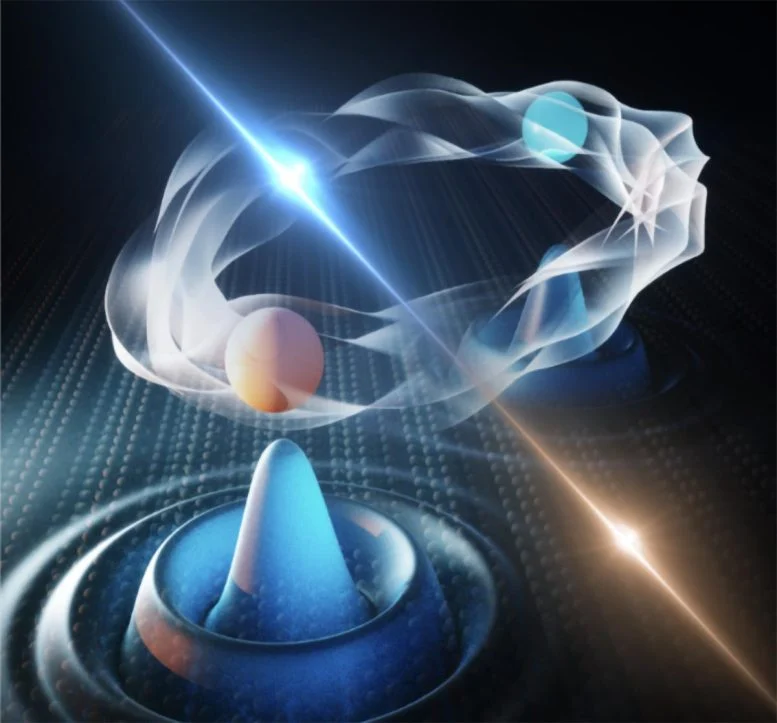
Scientists detected a “Higgs echo” in superconductors that could improve quantum computing. The effect reveals and manipulates hidden quantum states.
Researchers from the U.S. Department of Energy’s Ames National Laboratory and Iowa State University have identified an unusual “quantum echo” in a superconducting material. This finding offers new understanding of quantum behavior that could be applied to future quantum sensing and computing systems.
Superconductors are special materials capable of conducting electricity without any resistance. Inside these materials, scientists can observe collective vibrations called “Higgs modes.” A Higgs mode is a quantum effect that occurs when the electron potential within the material changes in a way similar to the behavior of a Higgs boson. These modes emerge when a material is in the process of transitioning into its superconducting state.
Advanced spectroscopy reveals the Higgs echo
Detecting these vibrations has proven difficult for scientists, as they last only briefly and interact in complex ways with quasiparticles—electron-like excitations that form when superconductivity breaks down.
Through the use of advanced terahertz (THz) spectroscopy methods, the researchers identified a new form of quantum echo, known as the “Higgs echo,” within superconducting niobium materials that are commonly used in quantum computing circuits.
Unique properties and quantum information potential
“Unlike conventional echoes observed in atoms or semiconductors, the Higgs echo arises from a complex interaction between the Higgs modes and quasiparticles, leading to unusual signals with distinct characteristics,” explained Jigang Wang, a scientist at Ames Lab and lead of the research team.
According to Wang, the Higgs echo can remember and reveal hidden quantum pathways within the material. By using precisely timed pulses of THz radiation, his team was able to observe these echoes. Using these THz radiation pulses, they can also use the echoes to encode, store, and retrieve quantum information embedded within this superconducting material.
This research demonstrates the ability to control and observe quantum coherence in superconductors and paves the way for potential new methods of quantum information storage and processing.
“Understanding and controlling these unique quantum echoes brings us a step closer to practical quantum computing and advanced quantum sensing technologies,” said Wang.
Reference: “Discovery of an unconventional quantum echo by interference of Higgs coherence” by Chuankun Huang, Martin Mootz, Liang Luo, Di Cheng, Avinash Khatri, Joong-Mok Park, Richard H. J. Kim, Yihua Qiang, Victor L. Quito, Yongxin Yao, Peter P. Orth, Ilias E. Perakis and Jigang Wang, 25 June 2025, Science Advances.
DOI: 10.1126/sciadv.ads8740
This project was partially supported through the Superconducting Quantum Materials and Systems Center (SQMS).
Leave a Reply