

By CERN August 14, 2025
Collected at: https://scitechdaily.com/a-glimpse-of-new-physics-atlas-edges-closer-to-unlocking-higgs-boson-secrets/
The ATLAS collaboration has reported evidence for Higgs bosons decaying into muons and has enhanced the ability to detect Higgs boson decays involving a Z boson and a photon.
At the 2025 European Physical Society Conference on High Energy Physics (EPS-HEP) in Marseille, France, research on the Higgs boson was a central focus. Among the highlights, the ATLAS collaboration unveiled two detailed studies that targeted exceptionally uncommon Higgs-boson decay processes.
Higgs decay into muons
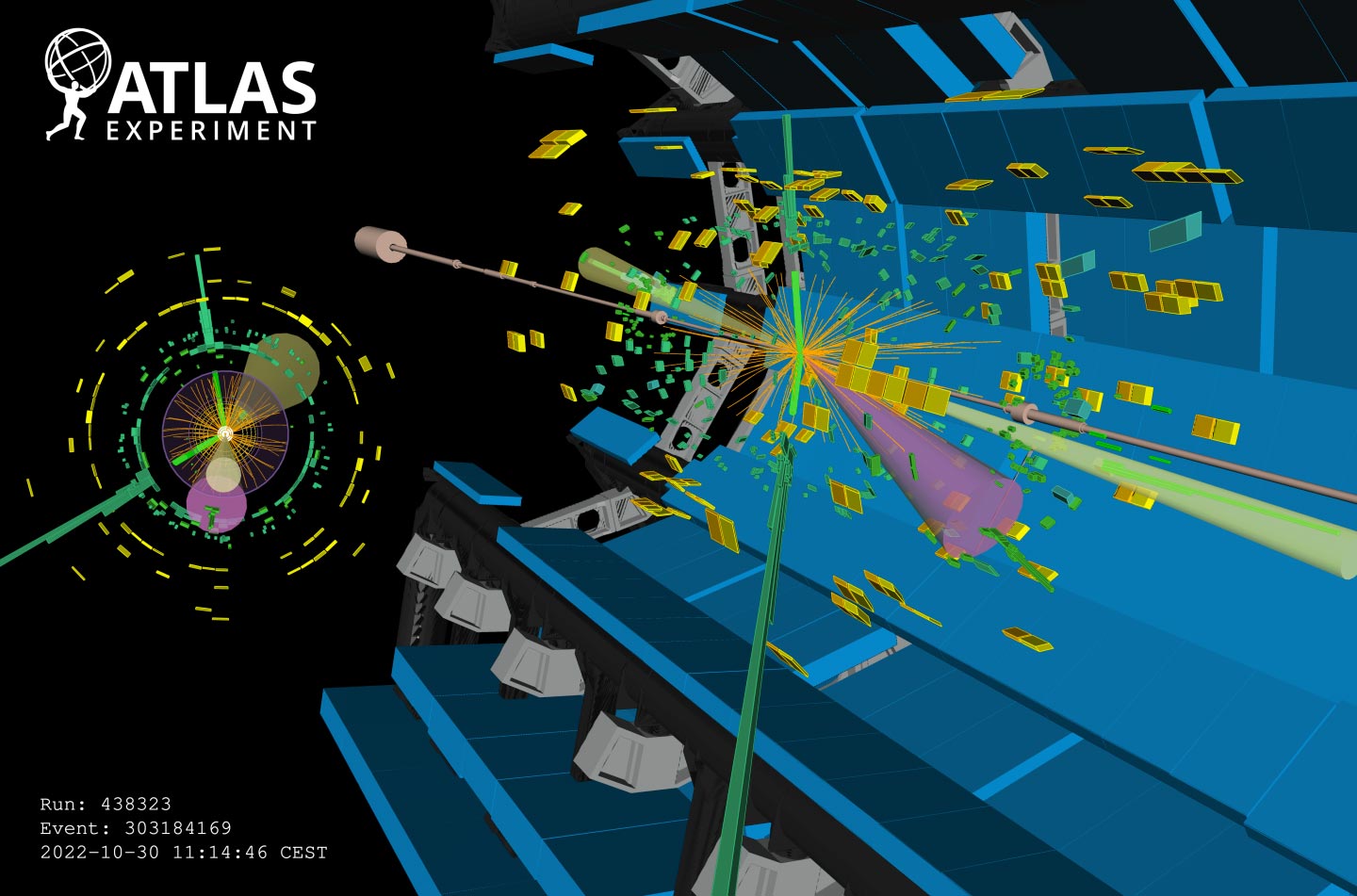
One of the decay modes examined was when the Higgs boson transforms into a pair of muons (H→μμ). Although this event is extremely uncommon—happening in roughly one out of every 5000 Higgs decays—it offers the most direct way to investigate how the Higgs interacts with second-generation fermions. Such studies can help reveal how mass originates across different particle generations. Until now, scientists have only confirmed the Higgs boson’s interactions with third-generation particles, which include the tau lepton as well as the top and bottom quarks.
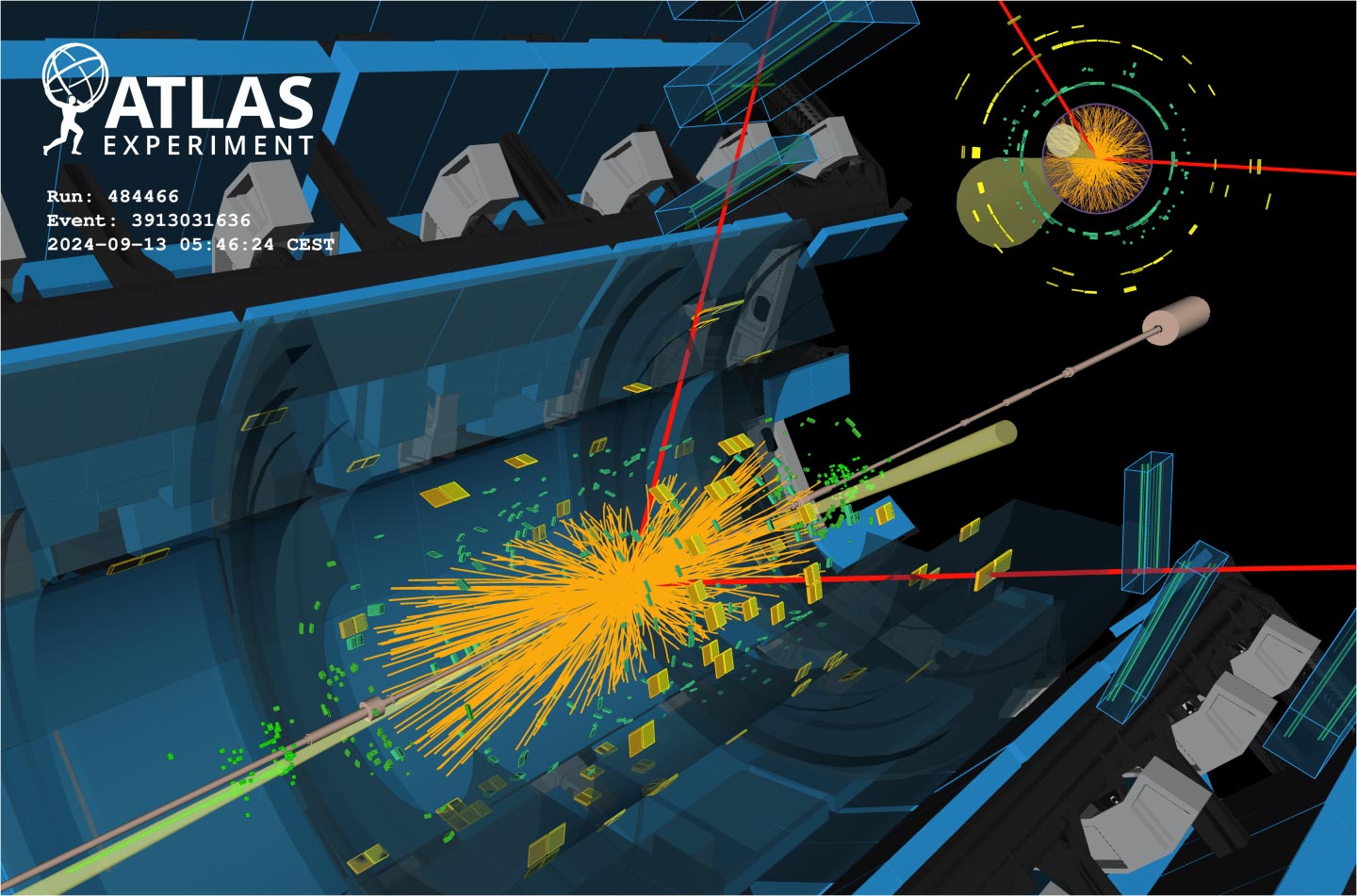
The other decay process explored was the transformation of the Higgs boson into a Z boson and a photon (H→Zγ), with the Z boson later decaying into pairs of electrons or muons. This decay pathway is particularly compelling because it occurs through an intermediate “loop” of virtual particles. If undiscovered particles are involved in this loop, the process could provide valuable clues pointing toward physics beyond the Standard Model.
The challenge of identifying rare events
Detecting these uncommon decay modes is a demanding task. In the case of H→μμ, scientists searched for a subtle excess of events concentrated around a muon-pair mass of 125 GeV, which matches the Higgs boson’s mass. This faint signal can be difficult to distinguish, as it is often obscured by the large number of muon pairs generated through unrelated processes (“background”). The H→Zγ decay, where the Z boson subsequently transforms into electron or muon pairs, is even more challenging to pick out. This is partly because the Z boson decays in this way only about 6% of the time, and because photons can be easily mistaken for particle jets.
To enhance the precision of their search, ATLAS researchers combined data from the first three years of LHC Run 3 with the complete Run 2 dataset. They also introduced an advanced approach to better simulate background events, sorted the recorded data according to the Higgs-production mechanisms, and refined their event-selection strategies.
Evidence for H→μμ
In previous searches for H→μμ using the full Run 2 data set, the ATLAS collaboration saw its first hint of this process at the level of 2 standard deviations, while the CMS collaboration reached a significance of 3 standard deviations with 2.5 standard deviations expected. Now, with the combined Run 2 and Run 3 data sets, the ATLAS collaboration has found evidence for H→μμ with an expected significance of 2.5 standard deviations and an observed significance of 3.4 standard deviations. This means that the chance that the result is a statistical fluctuation is less than 1 in 3000!
As for the H→Zγ process, a previous ATLAS and CMS combined analysis used Run 2 data to find evidence of this decay mode. It reported an excess over the background-only hypothesis of 3.4 standard deviations with 1.6 standard deviations expected. The latest ATLAS result, combining Run 2 and Run 3 data, reported an excess of 2.5 standard deviations. The expected sensitivity of this analysis is 1.9 standard deviations, providing the most stringent expected sensitivity to date for measuring the decay probability (“branching fraction”) of H→Zγ.
These achievements were made possible by the large, excellent data set provided by the LHC, the outstanding efficiency and performance of the ATLAS experiment and the use of novel analysis techniques. With more data on the horizon, the journey of exploration continues!
Meeting: 2025 European Physical Society Conference on High Energy Physics
Leave a Reply