
By Amit Malewar Published: August 11, 2025
Collected at: https://www.techexplorist.com/most-massive-black-hole-ever-found/100622/
Imagine every massive galaxy as a grand cosmic city, and at its heart, lurking in the shadows, is a gravitational monarch: a supermassive black hole (SMBH). These invisible titans don’t just sit idly; they co-evolve with their galaxies, shaping their growth like silent architects over billions of years.
In elliptical galaxies, the size of the black hole is tightly linked to how fast stars zip around the center, like dancers responding to an unseen conductor. But here’s the catch: most of what we know comes from nearby galaxies, because measuring these black holes across deep time has been like trying to hear whispers across a roaring universe.
Now, a new study has shattered expectations. Astronomers have spotted what might be the most massive black hole ever detected, a dormant beast weighing in at 36 billion solar masses, making it 10,000 times heavier than the one in our own Milky Way. It is located at a distance of some 5 billion light-years.
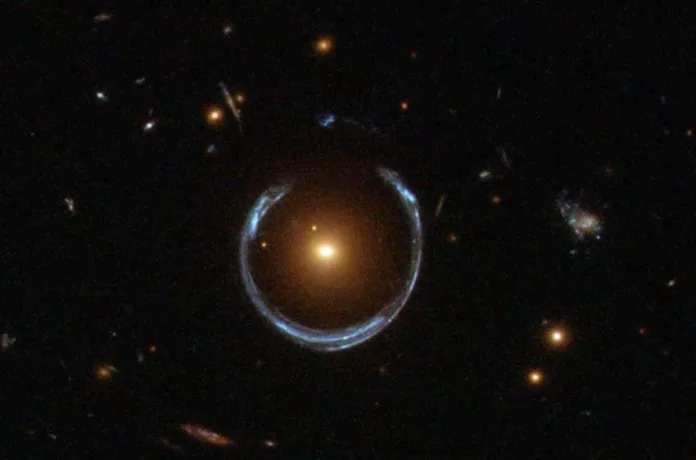
The newly discovered black hole lies in one of the largest galaxies ever observed, known as the Cosmic Horseshoe. This galaxy is so massive that it bends spacetime, causing light from a more distant galaxy to curve around it and form a glowing horseshoe-shaped arc called an Einstein ring.
To detect the black hole, scientists used two techniques: Gravitational lensing and Stellar kinematics.
Stellar kinematics is considered the most reliable method for measuring black hole masses. However, it usually only works for nearby galaxies because distant ones appear too small in the sky to observe the region around their central black holes.

Adding in gravitational lensing helped the team “push much further out into the universe.
The team detected the effect of a black hole in two ways: it is altering the path that light takes as it travels past the black hole, and it is causing the stars in the inner regions of its host galaxy to move extremely quickly (almost 400 km/s). By combining these two measurements, the team can be completely confident that the black hole is real.
Lead researcher, PhD candidate Carlos Melo, of the Universidade Federal do Rio Grande do Sul (UFRGS) in Brazil, added: “This discovery was made for a ‘dormant’ black hole – one that isn’t actively accreting material at the time of observation.”
“Its detection relied purely on its immense gravitational pull and the effect it has on its surroundings.”
“What is particularly exciting is that this method allows us to detect and measure the mass of these hidden ultramassive black holes across the universe, even when they are completely silent.”
The discovery is significant because it will help astronomers understand the connection between supermassive black holes and their host galaxies.
Journal Reference:
- Carlos R Melo-Carneiro , Thomas E Collett , Lindsay J Oldham , Wolfgang Enzi , Cristina Furlanetto , Ana L Chies-Santos , Tian Li. Unveiling a 36 billion solar mass black hole at the centre of the Cosmic Horseshoe gravitational lens. Monthly Notices of the Royal Astronomical Society. DOI: DOI: 10.1093/mnras/staf1036
Leave a Reply