
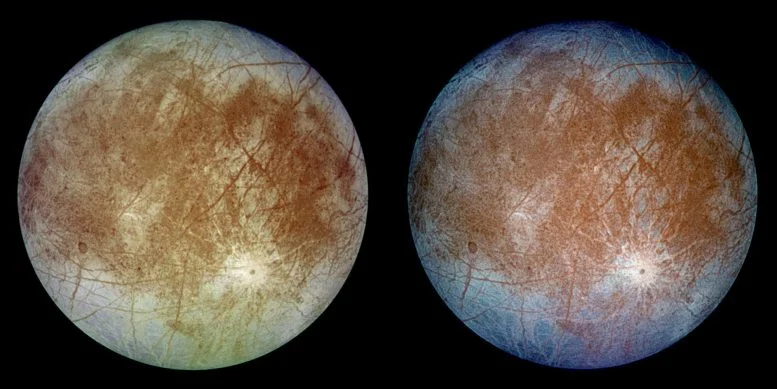
By Southwest Research Institute August 6, 2025
Collected at: https://scitechdaily.com/europas-bizarre-hotspot-scientists-may-have-solved-a-long-standing-space-mystery/
Europa’s surface chemistry hints at life-supporting conditions below. Lab tests reveal how peroxide forms in unexpected places.
Researchers at Southwest Research Institute (SwRI) carried out laboratory experiments to investigate the puzzling presence of frozen hydrogen peroxide (H2O2) on Jupiter’s icy moon Europa. Their findings, detailed in the Planetary Science Journal, may clarify surprising data collected by the James Webb Space Telescope (JWST).
Analysis of the JWST observations revealed unexpectedly high concentrations of hydrogen peroxide in Europa’s warmer equatorial regions, particularly in an area known as Tara Regio. This contradicted earlier laboratory studies, which predicted that hydrogen peroxide would be more abundant in the colder, polar zones.
Designing lab experiments to replicate Europa
The unusual findings prompted Bereket Mamo, a graduate student at The University of Texas at San Antonio and a contractor with SwRI, to propose a NASA-funded experimental study to explore the phenomenon. He secured a Future Investigators in NASA Earth and Space Science and Technology grant to support his research, which was conducted at SwRI’s Center for Laboratory Astrophysics and Space Science Experiments (CLASSE).
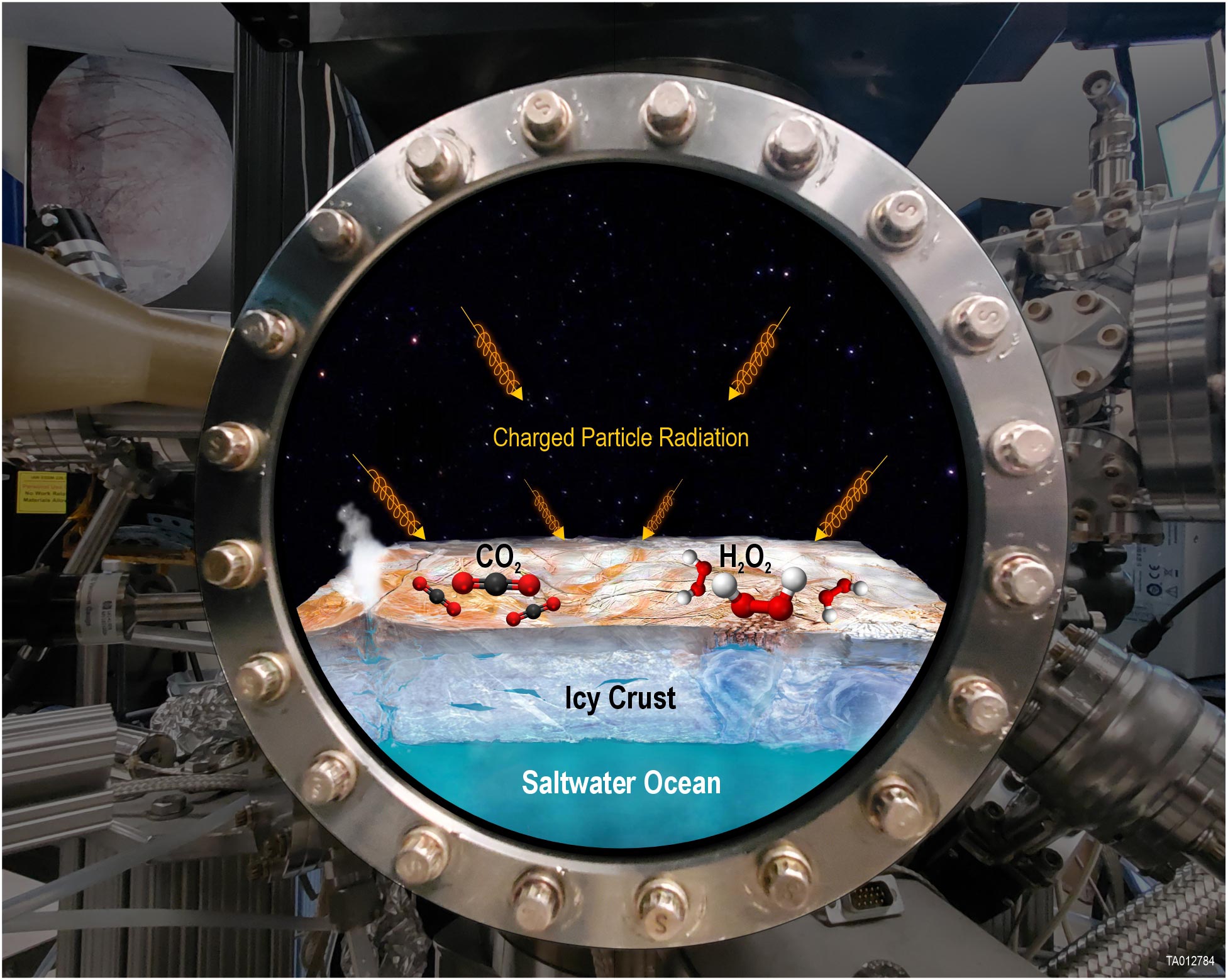
Mamo and his team observed that the areas on Europa with increased hydrogen peroxide, known as chaos terrains, also exhibited higher concentrations of carbon dioxide (CO2). Scientists believe that this CO2 may be escaping from a subsurface liquid ocean, rising through fractures in the icy surface.
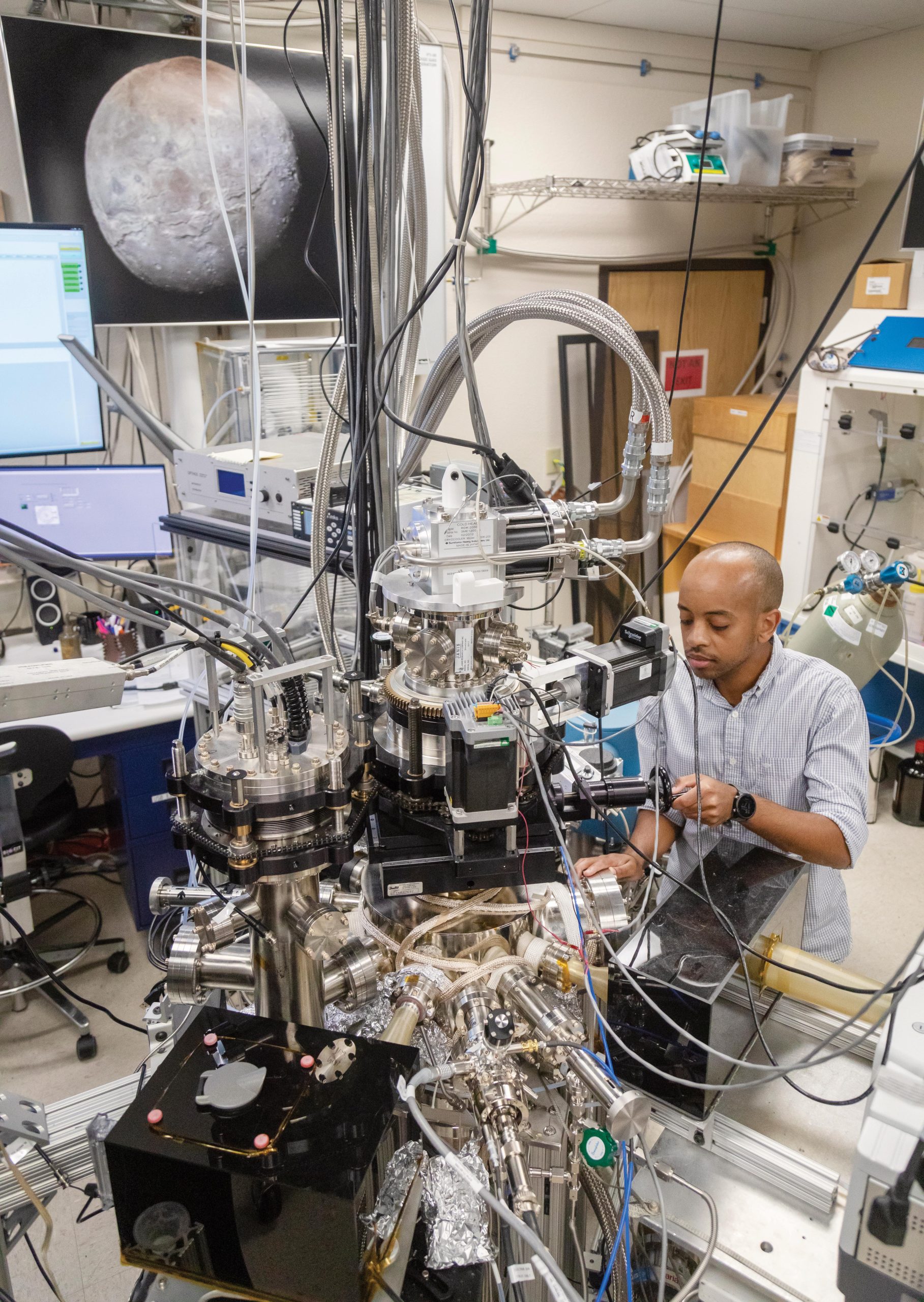
“We simulated the surface environment of Europa inside a vacuum chamber by depositing water ice mixed with CO2,” Mamo said. “We then irradiated this ice mixture with energetic electrons to see how the peroxide production changed.”
Experiments at SwRI showed that even small concentrations of CO2 mixed with water ice can greatly increase the formation of hydrogen peroxide under temperature conditions similar to those on Europa’s surface. This finding helps clarify the unexpected results observed by the James Webb Space Telescope.
Implications for Europa’s habitability
Dr. Ujjwal Raut, a program manager in SwRI’s Planetary Science Section and Mamo’s advisor, explained that one of the main goals of their research is to evaluate Europa’s potential to support life. He pointed to the presence of hydrogen peroxide alongside CO2, sodium chloride, and other compounds as particularly noteworthy. Raut suggested this combination indicates a chemical cycle in which materials from Europa’s subsurface ocean rise to the surface, become irradiated, and form oxidants like hydrogen peroxide. Over geological timescales, these oxidants could return to the ocean and react with seafloor reductants, releasing chemical energy that might help sustain life.
“Synthesis of oxidants like hydrogen peroxide on Europa’s surface is important from an astrobiological point of view,” said Richard Cartwright from Johns Hopkins University Applied Physics Laboratory and a co-author of the paper. “In fact, an entire NASA mission, the Europa Clipper, is en route to the Jovian system right now to explore the icy moon and help us understand Europa’s habitability.
“Our experiments provide clues to better understand JWST Europa observations and serve as a prelude to upcoming close-range investigations by Europa Clipper and ESA’s JUICE spacecraft,” Cartwright added.
“When you have a source of carbon from the interior, such as from an interior ocean like on Europa, and you combine it with energy coming from the magnetosphere, it produces new species on the surface, including hydrogen peroxide and other organic compounds, that store chemical energy,” says Dr. Ben Teolis, a planetary scientist at SwRI and another co-author of the paper. “Chemical energy is important because it is a necessary ingredient for the dark habitable ocean worlds where the sun doesn’t shine.”
These findings provide a plausible explanation for the perplexing hydrogen peroxide distribution on Europa. They also have implications for understanding its existence on other icy bodies, such as Jupiter’s moon Ganymede and Pluto’s moon Charon, where it has been detected along with CO2.
Reference: “Laboratory Investigation of CO2-driven Enhancement of Radiolytic H2O2 on Europa and Other Icy Moons” by Bereket D. Mamo, Ujjwal Raut, Ben D. Teolis, Trevor P. Erwin, Richard J. Cartwright, Silvia Protopapa, Kurt D. Retherford and Tom A. Nordheim, 21 July 2025, The Planetary Science Journal.
DOI: 10.3847/PSJ/ade3d8
Leave a Reply