
By University of Warwick August 9, 2025
Collected at: https://scitechdaily.com/this-seemingly-normal-star-was-hiding-a-violent-past/
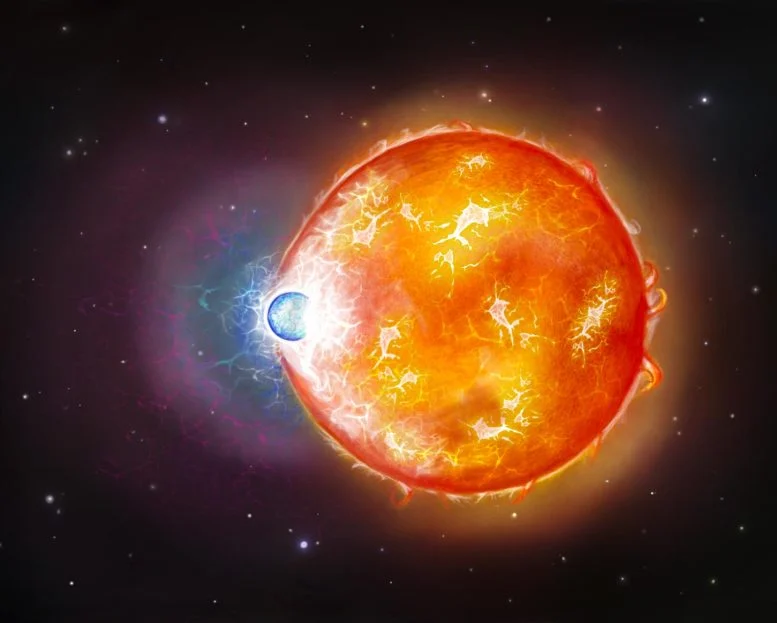
A seemingly ordinary white dwarf star, located just 130 light-years away, has revealed an extraordinary secret: it is the aftermath of a rare and violent stellar collision.
Using the Hubble Space Telescope’s ultraviolet vision, astronomers detected faint carbon traces rising from the star’s core — a telltale sign of two stars merging into one.
Mysterious White Dwarf Yields Clues to Its Origin
Astronomers at the University of Warwick have found strong evidence that a nearby white dwarf is actually the aftermath of two stars merging, a rare type of stellar remnant identified through ultraviolet observations from the Hubble Space Telescope. These observations revealed carbon in the star’s scorching atmosphere, offering a clue to its unusual origin.
White dwarfs are the compact remnants left when stars burn through their fuel and collapse. They are roughly the size of Earth but have half the Sun’s mass, with carbon-oxygen cores wrapped in helium and hydrogen layers. While such stars are common, white dwarfs with masses greater than the Sun are unusual and not fully understood.
In new research published in Nature Astronomy, the Warwick team examined WD 0525+526, a high-mass white dwarf located 130 light-years from Earth. This star’s mass is about 20% higher than the Sun’s, placing it in the “ultra-massive” category. The puzzle for astronomers has been how such a massive white dwarf could have formed.
Ultraviolet Revelations From Hubble
Although it is possible for a white dwarf of this size to be created from the collapse of a single massive star, Hubble’s ultraviolet data told a different story. The star shows small amounts of carbon moving from its core into its hydrogen-rich atmosphere, a signal that it likely formed when two stars merged rather than from the death of one large star.
“In optical light (the kind of light we see with our eyes), WD 0525+526 looks like a heavy but otherwise ordinary white dwarf,” said first author Dr. Snehalata Sahu, Research Fellow at the University of Warwick. “However, through ultraviolet observations obtained with Hubble, we were able to detect faint carbon signatures that were not visible to optical telescopes.
“Finding small amounts of carbon in the atmosphere is a telltale sign that this massive white dwarf is likely to be a be the remnant of a merger between two stars colliding. It also tells us there may be many more merger remnants like this masquerading as common pure-hydrogen atmosphere white dwarfs. Only ultraviolet observations would be able to reveal them to us.”
Typically, thick layers of hydrogen and helium surround a white dwarf’s core, hiding heavier elements such as carbon from view. In the violent process of two stars combining, these outer layers can be almost completely stripped away, leaving only a thin shell. This thin envelope no longer blocks carbon from reaching the surface, which is exactly what scientists observed in WD 0525+526.
A Post-Merger Star Unlike Any Other
Antoine Bédard, Warwick Prize Fellow in the Astronomy and Astrophysics group at Warwick and co-first author said, “We measured the hydrogen and helium layers to be ten-billion times thinner than in typical white dwarfs. We think these layers were stripped away in the merger, and this is what now allows carbon to appear on the surface.
“But this remnant is also unusual: it has about 100,000 times less carbon on its surface compared to other merger remnants. The low carbon level, together with the star’s high temperature (nearly four times hotter than the Sun), tells us WD 0525+526 is much earlier in its post-merger evolution than those previously found. This discovery helps us build a better understand the fate of binary star systems, which is critical for related phenomena like supernova explosions.”
Adding to the mystery is how carbon reaches the surface at all in this much hotter star. The other merger remnants are later in their evolution and cool enough for convection to bring carbon to the surface. But WD 0525+526 is far too hot for that process. Instead, the team identified a subtler form of mixing called semi-convection, seen here for the first time in a white dwarf. This process allows small amounts of carbon to slowly rise into the star’s hydrogen-rich atmosphere.

The Role of Hubble and What Comes Next
“Finding clear evidence of mergers in individual white dwarfs is rare,” added Professor Boris Gänsicke, Department of Physics, University of Warwick, who obtained the Hubble data for this study. “But ultraviolet spectroscopy gives us the ability to detect these signs early, when the carbon is still invisible at optical wavelengths. Because the Earth’s atmosphere blocks ultraviolet light, these observations must be carried out from space, and currently, only Hubble can do this job.
“Hubble just turned 35 years old, and while still going strong, it is very important that we start planning for a new space telescope that will eventually replace it.”
As WD 0525+526 continues to evolve and cool, it is expected that more carbon will emerge at its surface over time. For now, its ultraviolet glow offers a rare glimpse into the earliest stage of a stellar merger’s aftermath — and a new benchmark for how binary stars end their lives.
Reference: “A hot white dwarf merger remnant revealed by an ultraviolet detection of carbon” by Snehalata Sahu, Antoine Bédard, Boris T. Gänsicke, Pier-Emmanuel Tremblay, Detlev Koester, Jay Farihi, J. J. Hermes, Mark A. Hollands, Tim Cunningham and Seth Redfield, 6 August 2025, Nature Astronomy.
DOI: 10.1038/s41550-025-02590-y
Leave a Reply