
August 8, 2025 by Rakesh Kumar, PhD
Collected at: https://www.eeworldonline.com/what-are-phased-array-antennas-and-how-do-they-work/
Phased array antennas are advanced antenna systems that utilize the principle of constructive and destructive interference to steer a beam of radio waves electronically. This phenomenon happens without any physical movement of the antenna itself. This FAQ will cover the basics of phased array antennas, their working, hardware challenges, and a case study.
What are phased array antennas?
Instead of a single antenna element, a phased array antenna consists of multiple individual antenna elements arranged in a specific pattern, often in a linear or planar configuration. Each of these elements can be controlled independently in terms of the phase and sometimes the amplitude of the signal it transmits or receives.
The key characteristic is their ability to steer the beam electronically. This offers significant advantages over traditional mechanical steering, which involves physically rotating the antenna. They find applications in 5G wireless networks and satellite communications, weather radar, military defense systems, automotive collision avoidance, and even medical ultrasound imaging.
How do they work?
The fundamental principle behind phased array antennas is beamforming, which relies on precisely manipulating the phase (and sometimes amplitude) of the signals fed to or received from each individual antenna element.

Figure 1. Basic phased array concept showing how a central controller manages individual antenna elements through phase shifters and amplifiers. (Image: Mini-Circuits)
At its core, a phased array consists of a central phase controller that manages multiple antenna elements, each equipped with its own phase shifter and power amplifier. The animation in Figure 1 illustrates this basic concept, showing how one controller can simultaneously manage multiple antenna elements to create a focused, steerable beam.
The work can be broken down into further steps for better understanding:
- Multiple elements: They are a row of small antennas where each of these antennas transmits a radio wave. The combined effect of the transmission leads to a spread out of the aves.
- Phase shifting: A computer system controls these phase shifters, which can introduce a precise delay or advance in the signal reaching each individual antenna element. This means that while all elements might be transmitting the same frequency, the “start time” of the wave from each element can be slightly different.
- Constructive interference (beamforming): When the signals from all individual elements are transmitted with specific phase differences, they will constructively interfere in a particular direction. This means that in that desired direction, the peaks of the waves from each element align and add up, creating a strong, focused beam.
- Destructive interference (beam nulling): In other directions, due to the carefully chosen phase differences, the waves from different elements will destructively interfere. This means the peaks of one wave might align with the troughs of another, effectively canceling each other out. This reduces signal strength in unwanted directions, helping to minimize interference.
- Electronic steering: By rapidly and precisely changing the phase shifts applied to each element, the computer can electronically “steer” the direction of the main beam. This happens almost instantaneously, without any moving parts. This allows for incredibly fast scanning of a wide area.
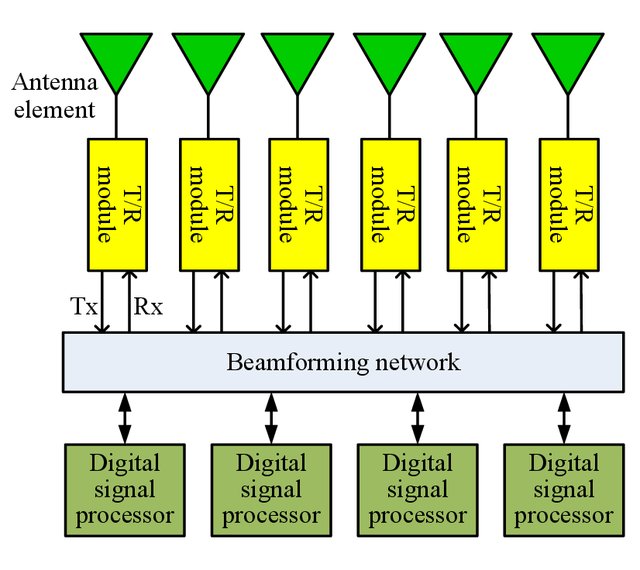
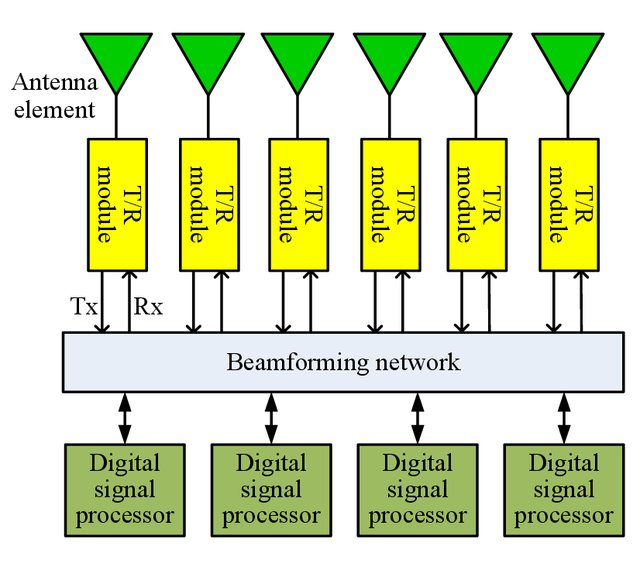
Figure 2. Complete phased array system showing antenna elements, T/R modules, beamforming network, and digital signal processors. (Image: IEEE Access)
Figure 2 shows how these components integrate into a complete phased array system. Each antenna element connects to its own transmitter-receiver (T/R) module, which handles signal amplification and phase control. The beamforming network coordinates all elements, while digital signal processors manage the complex calculations needed for precise beam steering and signal processing.
While the fundamental principles of phased arrays are well established, translating these concepts into practical hardware presents significant engineering challenges. The gap between theoretical beamforming and commercially viable systems requires careful consideration of thermal management, manufacturing precision, and component integration.
Physical implementation challenges
The hardware shown in Figure 3 illustrates a modern 5G phased array module, demonstrating how all the components are integrated into a compact 140×140 mm package.

Figure 3. Commercial 5G phased array module showing antenna elements (top) and supporting electronics with cooling system (bottom). (Image: Fujikura)
The top side reveals the antenna elements arranged in a precise grid pattern. These are the actual radiating elements that transmit and receive the radio waves. Each small square in the array is an individual antenna element that can be independently controlled for phase and amplitude.
The bottom side houses all the supporting electronics, including amplifiers, phase shifters, frequency converters, and digital control circuits. The prominent cooling fan highlights one of the major engineering challenges: thermal management. To maintain performance and prevent component failure, high-frequency, high-power electronics generate significant heat that requires efficient removal.
This real-world example shows how modern phased arrays achieve remarkable miniaturization while solving complex engineering problems like heat dissipation, electromagnetic interference, and precise manufacturing tolerances required for effective beamforming.
Case study
A real-world example of phased array technology in action is the mobile weather radar system deployed by Chinese meteorologists for severe storm monitoring (Figure 4). This truck-mounted phased array radar represents a significant advancement over traditional weather radars that use large rotating dish antennas.

Figure 4. Mobile phased array weather radar system deployed in China for severe storm tracking. (Image: Journal of Atmospheric and Oceanic Technology)
The system shown above was specifically designed to track fast-developing severe weather events, including supercells and tornadoes. This phased array system can electronically steer its beam and capture complete atmospheric data in under one minute, unlike traditional weather radars that require several minutes to complete a full volume scan.
During field testing, the radar successfully tracked a dangerous supercell thunderstorm that produced damaging winds and hailstones. The rapid scanning capability allowed meteorologists to observe storm evolution in real-time, including the formation and dissipation of the storm’s hook echo.
Summary
Phased array antennas are a combination of individual antennas that are arranged in such a way as to electronically steer the beam. There is no mechanical movement, which enables extremely fast scanning. They are very agile and can optimize the beam to reduce interference from other signals.
References
Advances in Chinese Dual-Polarization and Phased-Array Weather Radars: Observational Analysis of a Supercell in Southern China, Journal of Atmospheric and Oceanic Technology
Fujikura 28GHz Millimeter-wave Wireless Communications Module Fujikura’s state-of-the-art 5G Phased Array Antenna Technology: FutureAccess, Fujikura
A Review of Multibeam Phased Array Antennas as LEO Satellite Constellation Ground Station, IEEE Access
A Brief Overview of Phased Array Systems, Mini-Circuits
What is a Phased Array Antenna?, Ansys
Leave a Reply