
July 31, 2025 by SciDev.Net
Collected at: https://phys.org/news/2025-07-young-tackle-arsenic-tainted-sensors.html
What began as a modest school project by two curious teenagers in Bihar, eastern India, has evolved into a cutting-edge startup, using artificial intelligence (AI) and digital sensors to tackle one of the country’s most pressing water crises.
Arpit Kumar and his younger brother Abhijeet Kumar are the founders of Navmarg Research & Innovation Pvt. Ltd., a company that is tackling the widespread problem of arsenic contamination using a technology developed through years of research.
Arsenic contamination is a serious health concern in India, with the potential to cause cancers, neurological and cardiovascular diseases, and impaired cognitive function, especially in children.
The toxic chemical is mostly found in groundwater, the source of drinking water for many rural communities in the country.
For the two brothers, it all began as a project in the first year of high school, for the National Children’s Science Congress.
Arpit Kumar tells SciDev.Net, “The topic assigned to us was to understand the dynamics of arsenic contamination in Bihar, as well as why mitigation solutions, especially the technological interventions, often fail.
“It wasn’t just about technical efficiency … but also about the implementation part, which required socially inspired technology design and simplicity with community participation.”
Having seen first-hand the harmful health effects of arsenic contaminated water leading to illness and infant deformities, the pair set out to create a simple solution to remove the toxic chemical from water.
They read some research papers and the idea was developed into a project which got an A+ grade at the Congress.
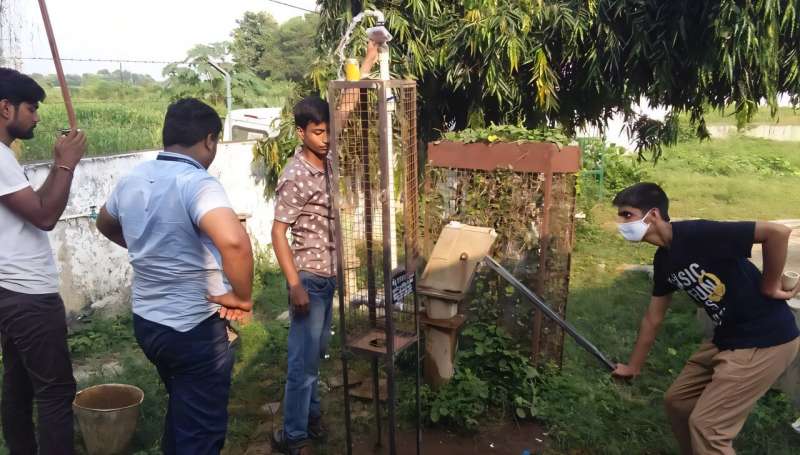
The solution uses physical magnetic separation using neodymium magnets attached to a steel conical structure through which the water is passed to be purified.
Fast forward to 2019, and the Kumar brothers had refined their solution and tested it rigorously in the school lab.
This led to a research-backed, field-tested technology to purify arsenic-tainted water, which garnered support from government and national institutions.
The Molecular Magnetic Technology for Arsenic Removal, or METAL, method is a simple, chemical free and low-cost method to purify water.
Arpit tells SciDev.Net, “METAL powers our flagship product MARU—the Magnetic Arsenic Removal Unit.
“The active separation core are magnets made of metallic alloys of rare earth elements as the active separation core, which is housed in a stainless-steel body, making it truly all metal.”
Shambhavi Sinha joined them in 2022 as technology and analytics lead and Navmarg Research & Innovation was founded in 2023, built on five years of research and development in applied sciences.
“The reason this company was created was because we believe we were solving genuine problems,” says Sinha.
Arsenic pollution impacts the alluvial regions of India, including West Bengal, Bihar, Jharkhand, Uttar Pradesh, Assam, and Punjab, as well as the hard-rock terrain situated in the states of Chhattisgarh and Karnataka.
The Bengal basin has the highest incidence of arsenic contamination, with areas such as Patna, Vaishali, Bhagalpur, Munger, and Buxar affected.
So far, the Navmarg team say they have purified over 300,000 liters of water, impacting more than 4,000 lives, and installed a 5,000 liters-per-hour municipal unit plant in the Bhojpur district of Bihar, eastern India.
“Our technology is easy to maintain,” says Sinha. “In all the pilot projects, people suggested keeping the technology in place. Our operational costs are low, too, compared to other projects.”
Real-time sensors
Other projects in the startup’s pipeline include sensors for rapid detection of arsenic and bacteria such as E. coli in water. These sensors will give a real-time estimation based on electrical properties.
The innovators are using AI for anomaly detection and predictive maintenance, with the details being kept tightly under wraps pending patenting procedures for the sensors.
“Our company Navmarg’s target is not only to make products but to go into research and development as well,” explains Arpit.
Their achievements have won them national recognition, including from the Ministry of Jal Shakti, which supplies the country’s water.
For Arpit, the project has been a success “because we did not chase unicorns—we chased impact.”
“In our case empathy guides our technology,” he adds.
Sajan Daniel George, director of the Manipal Institute of Applied Physics in southwest India, tells SciDev.Net, “These kids are dedicated and have won many awards. The concept is cost effective, working well and can be scaled up. In the next few years, this technology can be put to use in more areas.”
The startup has recently registered as a company in the Government e-Marketplace, a digital platform for procurement of goods and services in India.
“We plan to go on to the commercial market in three to four months so that people can buy our technology,” Sinha adds.

Leave a Reply