
July 24, 2025 by Paul Arnold, Phys.org
Collected at: https://techxplore.com/news/2025-07-whofi-surveillance-technology-track-people.html
Hi-tech surveillance technologies are a double-edged sword. On the one hand, you want sophisticated devices to detect suspicious behavior and alert authorities. But on the other, there is the need to protect individual privacy. Balancing public safety and personal freedoms is an ongoing challenge for innovators and policymakers.
This debate is set to reignite with news that researchers at La Sapienza University in Rome have developed a system that can identify individuals just by the way they disrupt Wi-Fi signals.
The scientists have dubbed this new technology “WhoFi.” Unlike traditional biometric systems such as fingerprint scanners and facial recognition, it doesn’t require direct physical contact or visual feeds. WhoFi can also track individuals in a larger area than a fixed-position camera, provided there is a Wi-Fi network.
Researchers Danilo Avalo, Daniele Pannone, Dario Montagnini and Emad Emam describe their technology in their article published on the arXiv preprint server. Their approach leverages an existing technique called Channel State Information (CSI), which captures how Wi-Fi signals change when they encounter people and objects. These alterations can be used to create rich biometric information, say the researchers.
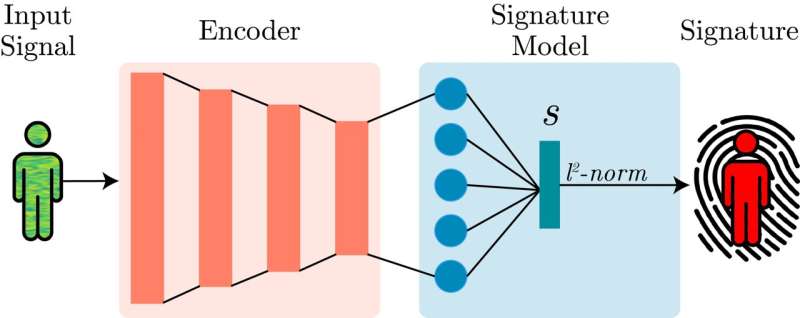
The team trained a deep neural network to interpret these unique Wi-Fi disruptions as individual “fingerprints” unique to a person. The system can learn and distinguish people based on how they alter the signal, even when in different surroundings. And it does so with 95.5 percent accuracy, according to the researchers.
This isn’t the team’s first foray into this field. In 2020, they proposed a similar technique called “EyeFi,” but they say their new approach is much more accurate.
Privacy concerns
While WhoFi may offer superior surveillance performance compared to current systems, it raises significant concerns about privacy. For example, people can be tracked without their knowledge and following their movements may reveal sensitive information about their routines.
The team acknowledges the issues and potential for misuse, but states that their re-identification (Re-ID) system does not capture a person’s identity or personal data.
“By leveraging non-visual biometric features embedded in Wi-Fi CSI, this study offers a privacy-preserving and robust approach for Wi-Fi-based Re-ID, and it lays the foundation for future work in wireless biometric sensing,” wrote the researchers.
WhoFi was an academic exercise, and there are currently no commercial or government plans for it. However, it may not be long before we see something similar in use, as the advantages for surveillance are compelling. Wi-Fi sensing can operate in darkness, through walls, and in areas with obstructions or hidden spaces. It is also less susceptible to factors like fog or smoke and is more discreet than traditional cameras.
More information: Danilo Avola et al, WhoFi: Deep Person Re-Identification via Wi-Fi Channel Signal Encoding, arXiv (2025). DOI: 10.48550/arxiv.2507.12869
Journal information: arXiv
Leave a Reply