
By NASA’s Marshall Space Flight Center July 20, 2025
Collected at: https://scitechdaily.com/nasa-just-discovered-where-these-mysterious-space-x-rays-really-come-from/
Astronomers have just solved a long-standing mystery about a rare, rapidly spinning neutron
Using NASA’s IXPE telescope and a fleet of observatories, scientists discovered that the system’s intense X-rays don’t come from its glowing accretion disk as previously believed, but from a chaotic, high-speed wind of particles hurled out by the pulsar itself. The findings challenge old models and reveal a single, powerful mechanism behind the pulsar’s radiation. It’s a dramatic twist in our understanding of how dead stars can still light up the universe.
Explosive Star Remnants and a Mysterious Pulsar System
A global team of astronomers has made a significant discovery about how the energetic remains of exploded stars interact with the space around them. Using NASA’s IXPE (Imaging X-ray Polarimetry Explorer) along with several other observatories, researchers gathered new insights into this dynamic cosmic behavior.
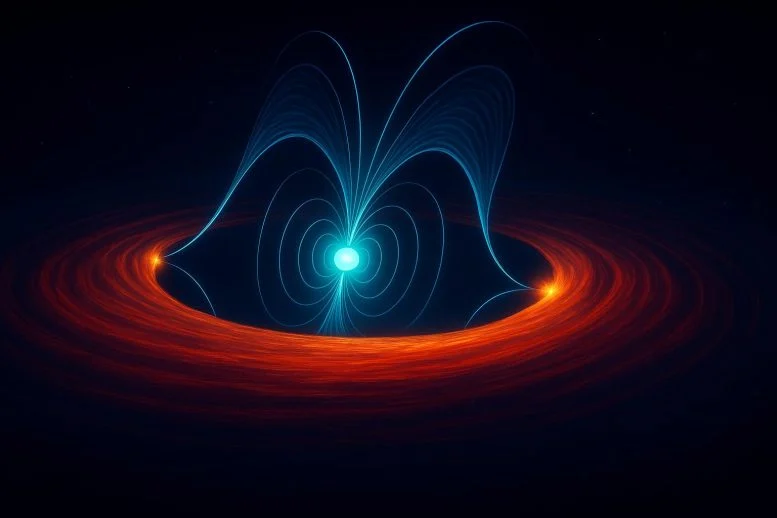
The scientists, working across the United States, Italy, and Spain, focused their investigation on a puzzling stellar system known as PSR J1023+0038, or simply J1023. This system features a rapidly spinning neutron star that draws material from a smaller companion star. As a result, an accretion disk of matter has formed around the neutron star. The neutron star also functions as a pulsar, emitting intense beams of radiation from its magnetic poles as it spins, creating a pattern that resembles a lighthouse sweeping through space.
What makes J1023 especially important is that it switches between two distinct phases. In one phase, the pulsar actively pulls in material from its companion star. In the other, it becomes quieter, sending out detectable pulses as radio waves. Because of this behavior, astronomers classify it as a “transitional millisecond pulsar.”
Cosmic Laboratories for Neutron Star Evolution
“Transitional millisecond pulsars are cosmic laboratories, helping us understand how neutron stars evolve in binary systems,” said researcher Maria Cristina Baglio of the Italian National Institute of Astrophysics (INAF) Brera Observatory in Merate, Italy, and lead author of a paper in The Astrophysical Journal Letters illustrating the new findings.
The big question for scientists about this pulsar system was: Where do the X-rays originate? The answer would inform broader theories about particle acceleration, accretion physics, and the environments surrounding neutron stars across the universe.
The source surprised them: The X-rays came from the pulsar wind, a chaotic stew of gases, shock waves, magnetic fields, and particles accelerated near the speed of light, that hits the accretion disk.
Probing Polarized Light with IXPE and ESO
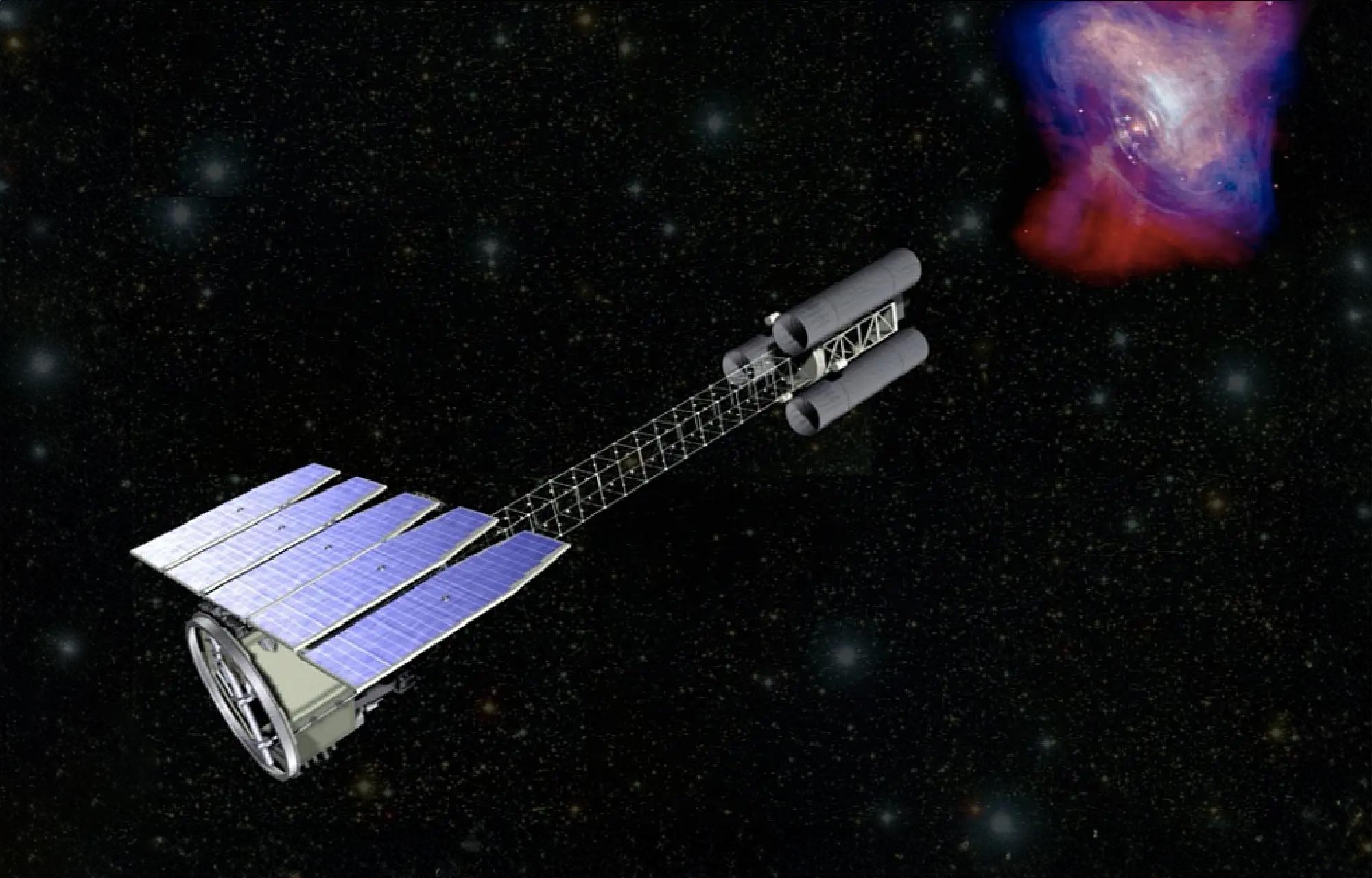
To determine this, astronomers needed to measure the angle of polarization in both X-ray and optical light. Polarization is a measure of how organized light waves are. They looked at X-ray polarization with IXPE, the only telescope capable of making this measurement in space, and compared it with optical polarization from the European Southern Observatory’s Very Large Telescope in Chile. IXPE launched in December 2021 and has made many observations of pulsars, but J1023 was the first system of its kind that it explored.
NASA’s NICER (Neutron star Interior Composition Explorer) and Neil Gehrels Swift Observatory provided valuable observations of the system in high-energy light. Other telescopes contributing data included the Karl G. Jansky Very Large Array in Magdalena, New Mexico.
Matching Polarization Confirms a Theory
The result: scientists found the same angle of polarization across the different wavelengths.
“That finding is compelling evidence that a single, coherent physical mechanism underpins the light we observe,” said Francesco Coti Zelati of the Institute of Space Sciences in Barcelona, Spain, co-lead author of the findings.
This interpretation challenges the conventional wisdom about neutron star emissions of radiation in binary systems, the researchers said. Previous models had indicated that the X-rays come from the accretion disk, but this new study shows they originate with the pulsar wind.
Pulsar Winds as Dominant Energy Engines
“IXPE has observed many isolated pulsars and found that the pulsar wind powers the X-rays,” said NASA Marshall astrophysicist Philip Kaaret, principal investigator for IXPE at NASA’s Marshall Space Flight Center in Huntsville, Alabama. “These new observations show that the pulsar wind powers most of the energy output of the system.”
Astronomers continue to study transitional millisecond pulsars, assessing how observed physical mechanisms compare with those of other pulsars and pulsar wind nebulae. Insights from these observations could help refine theoretical models describing how pulsar winds generate radiation – and bring researchers one step closer, Baglio and Coti Zelati agreed, to fully understanding the physical mechanisms at work in these extraordinary cosmic systems.
Reference: “Polarized Multiwavelength Emission from Pulsar Wind—Accretion Disk Interaction in a Transitional Millisecond Pulsar” by Maria Cristina Baglio, Francesco Coti Zelati, Alessandro Di Marco, Fabio La Monaca, Alessandro Papitto, Andrew K. Hughes, Sergio Campana, David M. Russell, Diego F. Torres, Francesco Carotenuto, Stefano Covino, Domitilla de Martino, Stefano Giarratana, Sara E. Motta, Kevin Alabarta, Paolo D’Avanzo, Giulia Illiano, Marco M. Messa, Arianna Miraval Zanon and Nanda Rea, 31 June 2025, The Astrophysical Journal Letters.
DOI: 10.3847/2041-8213/add7d2
More about IXPE
IXPE (Imaging X-ray Polarimetry Explorer) is a groundbreaking space observatory that is transforming our understanding of the high-energy universe. A joint mission between NASA and the Italian Space Agency, with scientific collaborators from 12 countries, IXPE is the first satellite dedicated to measuring the polarization of X-rays from extreme cosmic objects like neutron stars, black holes, and supernova remnants.
Led by NASA’s Marshall Space Flight Center in Huntsville, Alabama, IXPE is delivering unprecedented data that reveal the physical conditions, geometry, and behavior of some of the most energetic and mysterious phenomena in the cosmos. Spacecraft operations are managed by BAE Systems, Inc., in partnership with the University of Colorado’s Laboratory for Atmospheric and Space Physics in Boulder.
By capturing how X-rays are polarized—how their waves are oriented—IXPE helps astronomers probe magnetic fields, particle acceleration, and emission mechanisms in ways never before possible.
Leave a Reply