
July 10, 2025 by Faith Pring, University of Nottingham
Collected at: https://phys.org/news/2025-07-capturing-anesthetic-gases-global.html
A new study from the University of Nottingham has looked at how the anesthetic gases breathed out by animal patients are released into the atmosphere and contribute to global warming.
The study, an industry first, published in British Journal of Anaesthesia evaluated the capture of gases from anesthetized dogs and cats to measure the efficiency of a volatile gas capture device. This study team included Mars Linnaeus and Waltham Pet Care Science Institute staff.
The future aim of this technology will be to capture the gases, reprocess and reuse the anesthetic drugs, moving from a linear (take-make-waste) to a circular (reuse-repair-recycle) economy.
The study demonstrated an efficiency of 65% capture of isoflurane and prevented an average release of 3.75 kgCO2e for each 20-minute anesthetic period in the study, (equivalent to 14 miles driven in an average UK car).
The study also identified that capture is dependent on multiple factors including blood pressure during anesthesia.
Medical health care has been forward in acknowledging its greenhouse gas emissions, which contribute to the existential risk from climate change.
There is similar concern in veterinary health care, with an estimated 21% of the carbon emissions for a canine orthopedic procedure resulting from volatile anesthetics.
“Reducing the carbon footprint associated with anesthesia and surgery, in humans or animals, is an important issue, and one way we can do this is to capture the waste gases to prevent environmental damage,” says Professor Kate White from the School of Veterinary Medicine and Science.
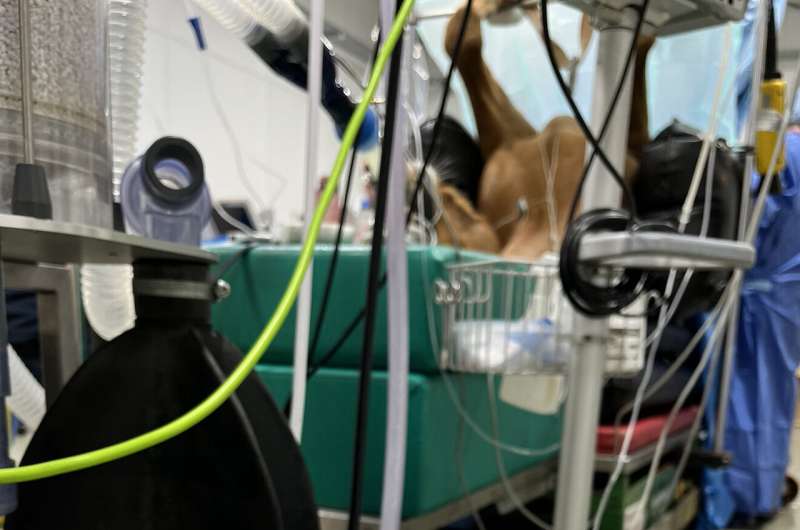
“My team have been evaluating the capture of isoflurane, sevoflurane and desflurane using SageTech’s technology in dogs, cats, horses, ruminants and even zoo animals and teaching the veterinary students at the University of Nottingham about the concept.
“The technology in combination with interventions such as reducing single use items and low flow anesthesia offers significant potential as we transition to a low carbon world.”
Professor White will be presenting results of 4 further studies using this technology in different species with different volatile agents at the World Congress of Veterinary Anaesthesia and Analgesia in Paris, 16–19 September 2025.
More information: Kate White et al, Efficiency of isoflurane capture from anaesthetised veterinary patients: a single-centre study of a volatile capture device, British Journal of Anaesthesia (2025). DOI: 10.1016/j.bja.2025.03.034
Journal information: British Journal of Anaesthesia
Leave a Reply