
July 9, 2025 by XIia Ruize, Zhao Weiwei, Chinese Academy of Sciences
Collected at: https://techxplore.com/news/2025-07-strategy-boosts-solid-state-ion.html
Recently, a research team led by Professor Huang Xingjiu at the Institute of Solid-State Physics, the Hefei Institutes of Physical Science of the Chinese Academy of Sciences, has proposed a novel material design strategy to improve the performance of all-solid-state ion-selective electrodes (ISEs).
The findings were published as an Inside Front Cover article in Chemical Science.
Rapidly advancing all-solid-state ion-selective electrodes, as critical components of intelligent biological and chemical sensors, demonstrate broad application prospects. The key to constructing high-performance all-solid-state ion-selective electrodes lies in developing transduction layer materials with high hydrophobicity and large capacitance. However, insufficient attention to interfacial capacitance under operational conditions directly compromises sensor signal reliability.
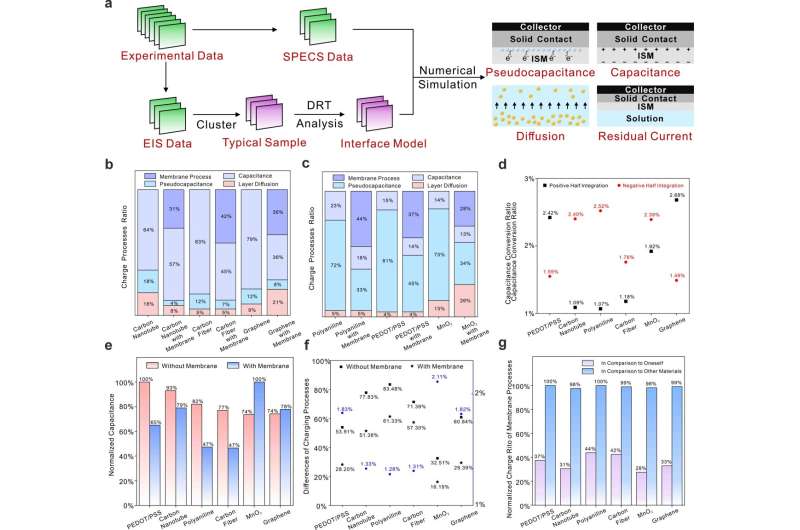
To address this issue, the team introduced a new design strategy focused on achieving interfacial electrochemical capacitance symmetry. Through a combination of electrochemical experiments and kinetic simulations, they discovered that ion-selective membranes act as “valves” within the electrode interface, restricting the effective capacitance of transduction materials. This limitation occurs regardless of whether the membranes are modified, leading to suboptimal material performance.The research was published as Inside Front Cover article in Chemical Science. Credit: Xia Ruize
Further research discovered a correlation between charge storage symmetry and capacitance conversion efficiency under varying overpotential conditions. The presence of ion-selective membranes was found to universally constrain the capacitive performance of different materials, causing significant discrepancies between the interfacial capacitance of transduction layers during operation and that of membrane-free modified electrodes.
The study highlights that designing effective solid-state transduction materials requires not only high hydrophobicity and large intrinsic capacitance, but also a deep understanding of the dynamic interactions between the material and the membrane. Achieving balanced charge-discharge behavior across varying operating conditions is crucial for optimizing sensor performance.
This research provides a new strategy for designing transduction layer materials based on electrode interface kinetics principles, while the methodology can also serve as a universal approach across electrochemical fields.
More information: Rui-Ze Xia et al, Inhibitions imposed by kinetic constraints of membranes in all-solid-state ion-selective electrodes: characteristics of interfacial capacitance in solid contacts, Chemical Science (2025). DOI: 10.1039/D5SC01241D
Journal information: Chemical Science
Leave a Reply