
By Amit Malewar 7 Jul, 2025
Collected at: https://www.techexplorist.com/synthetic-loofah-stronger-plastic-smarter/100001/
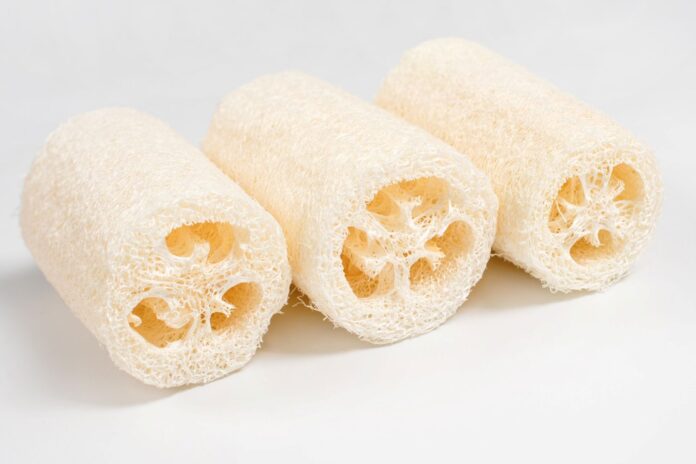
You’ve probably seen a loofah sponge, those coarse, tough, weblike things hanging in showers. But what you might not know is that they’re not synthetic at all. A natural loofah is the dried, fibrous skeleton of a tropical gourd, often called the Egyptian cucumber.
It is rigid when dry but flexible when wet. It quickly dries to prevent it from molding and is fully biodegradable and eco-friendly.
Its structure is so effective that scientists are now mimicking it in synthetic materials for filters, electronics, and sustainable technology.
Researchers, including those from the University of Tokyo, created a new loofah-like polymer material, which is fine enough to filter things like viruses but is strong enough to be a rigid construction material for devices. Like natural loofah, this synthetic loofah material is also flexible when wet and responds to changes in pH.
Thanks to its porous, lightweight structure and the ability to be coated onto other substances, the loofah sponge is inspiring a new generation of functional, eco-friendly materials. These materials use minimal raw input while maintaining strength and versatility, opening the door to more sustainable manufacturing.
Associate Professor Yoshimitsu Itoh from the Department of Chemistry and Biotechnology at the University of Tokyo said, “Though we did not set out to create something with such an appearance, it was a pleasant surprise. So-called polymer materials like this already exist in nature, but we wanted to create something synthetic, as it affords us control over its properties such that we can give it various useful functions.”
Unlike other lightweight polymers with mechanical weakness due to their extra softness, this new material has low density: only half a gram of material per cubic centimeter has a stiffness of 11 gigapascals. This is perhaps four times stronger than that of an ordinary polymer.
The team is also creating a new kind of ultrathin, porous membrane. By gently “baking” the material in a special, oxygen-free environment, they can turn it into a carbon-based membrane that might one day be used in tiny electronic components like microcapacitors.
But that’s not all. This material can also respond to its environment. For example, changes in pH, how acidic or basic something is, can make the membrane more or less stiff, which in turn changes how porous it is. That means it could be used in smart filters or sensors that adapt in real time.
Professor Itoh said, “In principle, this material we created could find many uses, though we have many steps to take before contemplating industrial integration of any kind. But the production is very cheap and easy to perform, using only pure water with a voltage applied and a mixture of deprotonated resorcinol and an aldehyde, which spontaneously combine to make an ultrathin membrane with a loofah-like appearance under an electron microscope. One big advantage of this membrane is that there is no need for post-processing. Usually, thin films are made by first synthesizing the bulk polymer and then processing it into a film. Our method can directly give the product the form of a thin film and is, in principle, applicable to roll-to-roll processing. This is a big advantage for the production.”
Journal Reference
- Yoshimitsu Itoh, Tengfei Fu, Pier-Luc Champagne, Yudai Yokoyama, Kunita Numabe, You-lee Hong, Yusuke Nishiyama, Hsiao-Fang Wang, Akemi Kumagai, Hiroshi Jinnai, Hirohmi Watanabe, Teiko Shibata-Seki, Asuteka Nagao, Tsutomu Suzuki, Yukie Saito, Keigo Wakabayashi, Takeharu Yoshii, Atsushi Izumi, Katsumi Hagita, Junichi Furukawa, and Takuzo Aida, “Electric double-layer synthesis of a sponge-like, lightweight reticular membrane,” Science: DOI: 10.1126/science.adq0782
Leave a Reply