
By Optica June 21, 2025
Collected at: https://scitechdaily.com/are-we-ready-to-redefine-the-second-scientists-just-took-a-major-step/
By comparing optical clocks in six different countries, researchers have taken a major step toward establishing a new global time standard.
In a new study, researchers conducted the most extensive coordinated comparison of optical clocks to date by running both the clocks and their connecting links at the same time across six countries. Covering thousands of kilometers, this experiment marks an important step toward redefining the second and eventually creating a global optical time scale.
“The accurate time and frequency signals provided by atomic clocks are essential for many everyday technologies — like GPS, managing power grids and keeping financial transactions in sync,” said Helen Margolis, head of time and frequency at the National Physical Laboratory (NPL) in the United Kingdom. “Our findings could help to improve the performance of next-generation optical clocks, unleashing entirely new applications and advancing scientific endeavors that rely on time and frequency.”
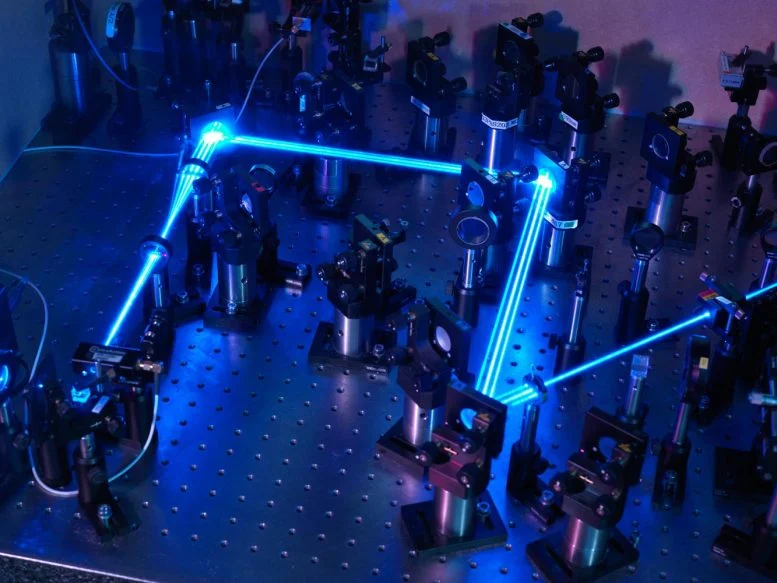
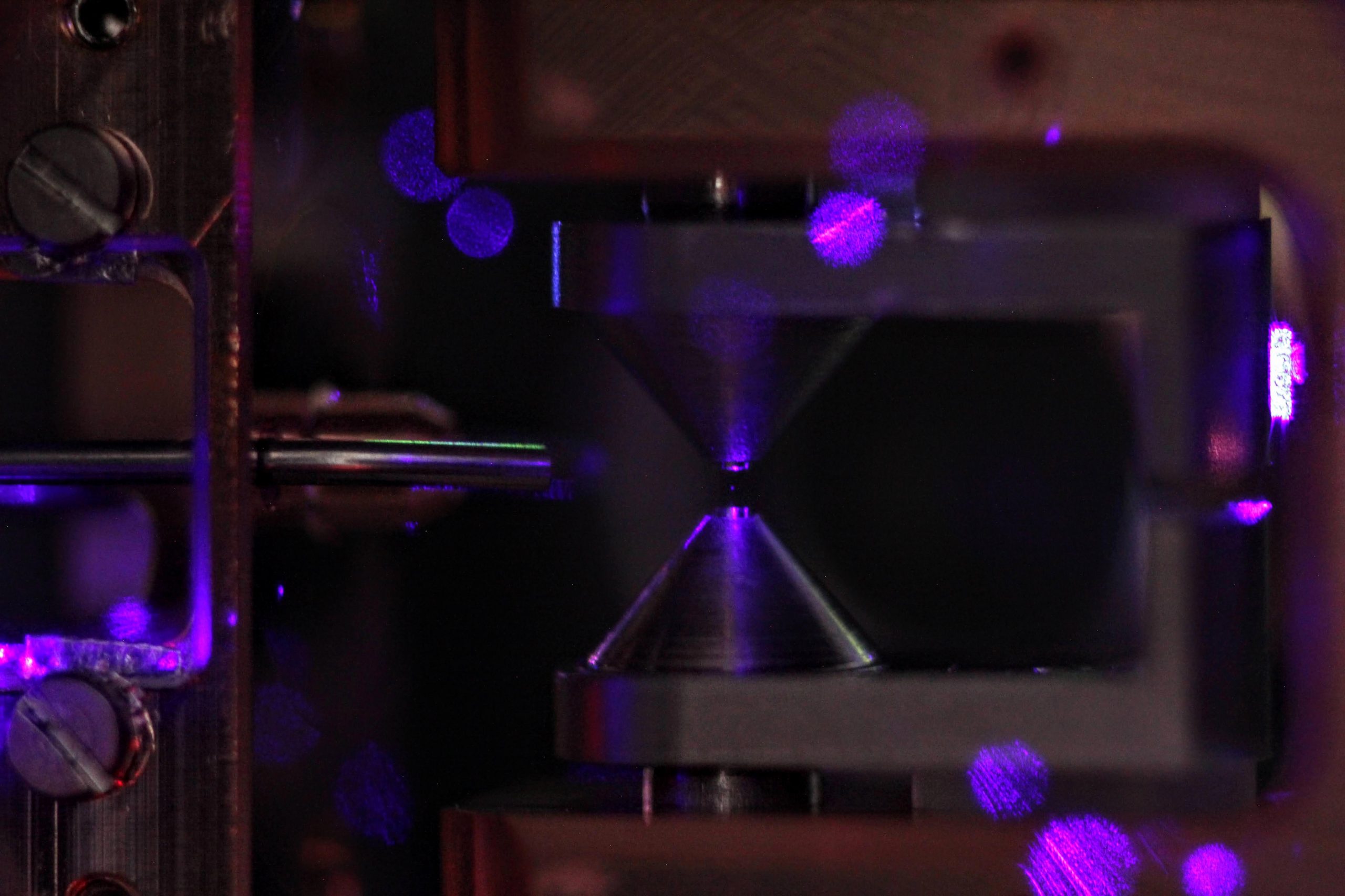
Optical clocks are a type of atomic clock that use lasers to excite atoms in a controlled way, causing them to shift between specific energy levels. These shifts occur at highly precise frequencies, which serve as the “ticks” of the clock. Since optical clocks use different types of atoms to measure time, fully harnessing their precision requires comparing them over long distances.
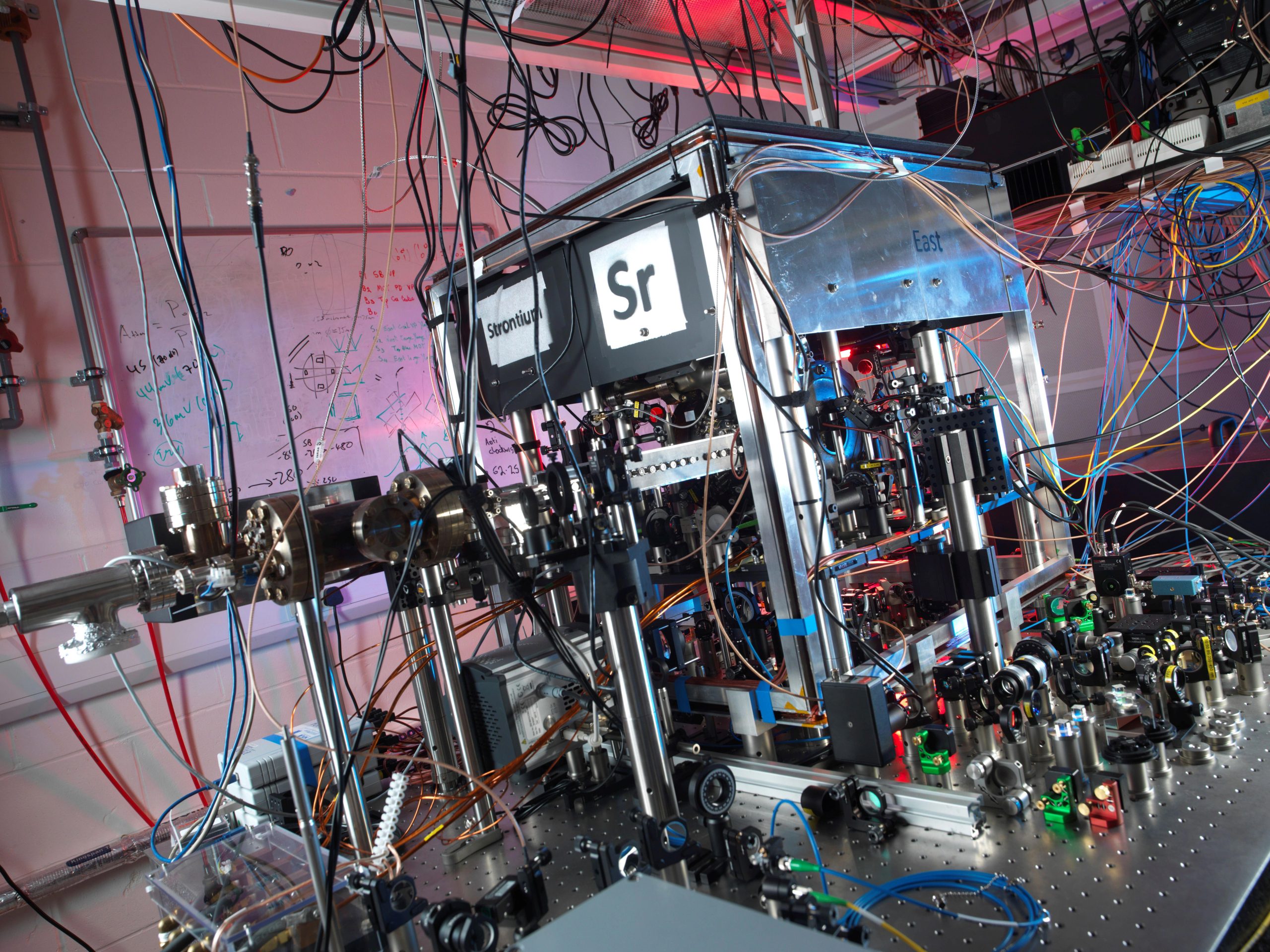
In Optica, the flagship journal of the Optica Publishing Group, a team of researchers from multiple institutions presents the results of 38 comparisons, or frequency ratios, performed simultaneously using ten different optical clocks. Four of these comparisons were carried out directly for the first time, and many others were measured with significantly improved accuracy.
“These measurements provide critical information about what work is still needed for optical clocks to achieve the precision and reliability required for use in international timekeeping,” said Marco Pizzocaro, senior researcher at the Instituto Nazionale Di Ricerca Metrologica (INRiM) in Italy. “Our experiment also showed how optical clocks across Europe can be linked to measure frequency ratios with state-of-the-art precision. This creates a distributed lab, which could also be used for carrying out tests of fundamental physics, such as searching for dark matter or testing the basic rules of physics.”
Are optical clocks ready?
For decades, the global time standard has been based on an average of signals from cesium microwave atomic clocks located around the world. But as optical clocks have become increasingly precise and stable, there is growing support for redefining the International System of Units (SI) second using optical clocks instead. These clocks are now about 100 times more accurate than the best cesium clocks and can measure time so precisely that they would gain or lose less than one second over billions of years.
To use optical clocks for international timekeeping, it is essential to compare data from different clocks to ensure they are functioning consistently. To support this effort, researchers conducted a highly coordinated comparison of optical clocks across six countries as part of a major EU-funded collaboration.
“Comparing multiple clocks at the same time and using more than one type of link technology provides far more information than the mostly pairwise clock comparisons that have been carried out to date,” said Thomas Lindvall, senior scientist at VTT MIKES in Finland. “With a coordinated set of measurements, it becomes possible to check consistency while also providing more trusted results. These results can help determine which optical clock(s) should be used in the new definition of the second.”
Linking the clocks
To carry out the measurements, the researchers had to link the frequency outputs from the different optical clock systems. They did this using two methods: radio signals from satellites and laser light travelling through optical fibers.
The satellite method used GPS signals from the satellite navigation system, which was available to all the clocks included in the study. However, this linking technique has limited precision due to measurement uncertainties caused by factors like signal noise or instrument limits.
The researchers also used customized optical fiber links, which allowed measurements with 100 times greater precision than the satellite technique. However, these stable, high-precision connections could only be used to connect clocks in France, Germany, and Italy during the international comparison. In addition, local comparisons within Germany and the UK — where multiple clocks were located at the same institute — were conducted with short optical fibers, which reduced uncertainty even more.
The researchers said that coordinating the simultaneous operation of ten high-performance clocks in various countries and all the links connecting the clocks required extensive planning that started well in advance of the measurements. The data analysis also brought some challenges.
“Not all the results confirmed what we expected, and we observed some inconsistencies in the measurements,” said Rachel Godun, principal scientist at NPL. “However, comparing so many clocks at once and using more than one technique for linking the clocks made it easier to identify the source of the problem.”
The experiment identified some areas where more work is needed. For example, to confirm that all clocks are performing as expected, measurement uncertainties must be reduced to match the precision of the clocks themselves. Repeated measurements will then be needed to confirm the reliable operation necessary to build confidence in both the clocks and the links. Beyond that, several other criteria must also be met before redefining the second, including proving that optical clocks can contribute regularly and consistently to international time scales.
Reference: “Coordinated international comparisons between optical clocks connected via fiber and satellite links” by Dang-Bao-An Tran, E. Anne Curtis, Irene Goti, Takumi Kobayashi, Uwe Sterr, Thomas Fordell, Matias Risaro, Elena Cantoni, Melina Filzinger, Maxime Mazouth-Laurol, Jonas Keller, Anders E. Wallin, Christian Chardonnet, Helen S. Margolis, Stefano Condio, Billy I. Robertson, Giancarlo Cerretto, Olivier Lopez, Rodolphe Le Targat, Nishant M. Bhatt, Jérôme Lodewyck, Thomas Legero, Ian R. Hill, Mads Tønnes, Adam O. Parsons, Michel Abgrall, H. Nimrod Hausser, Marco Pizzocaro, Haosen Shang, Thomas Lindvall, Daisuke Akamatsu, Christian Lisdat, Kazumoto Hosaka, Filippo Levi, Paul-Eric Pottie, Alexandra Tofful, Kilian Stahl, Heiner Denker, Simone Donadello, Matthew Y. H. Johnson, Tanja E. Mehlstäubler, Etienne Cantin, Tabea Nordmann, Joshua Klose, Akiko Nishiyama, Alexander Kuhl, Burghard Lipphardt, Jacob Tunesi, Cecilia Clivati, Erik Benkler, Kalle Hanhijärvi, Sebastian Koke, Martin Steinel, Davide Calonico, Gérard Petit, Nils Huntemann, Sören Dörscher, Chen-Hao Feng, Miguel Angel Cifuentes Marin, Rachel M. Godun, Hongli Liu, Anne Amy-Klein, Benjamin Pointard, Alberto Mura and Marco Schioppo, 19 June 2025, Optica.
DOI: 10.1364/OPTICA.561754
Leave a Reply