
June 17, 2025 by Daegu Gyeongbuk Institute of Science and Technology
Collected at: https://techxplore.com/news/2025-06-simulator-optimizes-vehicle-resources-enable.html
Through industry–academia collaboration, a joint research team developed an Integrated Network-Computing Load Balancing (“INCL Balancing”) simulator optimized for next-generation 6G services. This is the world’s first research project to implement a load-balancing simulator that integrates network and computational resources in an autonomous driving environment. It is expected to markedly improve the safety, real-time control performance, and energy efficiency of autonomous vehicles linked to vehicular edge computing (VEC).
The research is published in the journal IEEE Communications Magazine. The team included Choi Ji-woong, Jwa Hoon-seung, and Kim Baek-gyu from the Department of Electrical Engineering and Computer Science at DGIST.
Currently, autonomous vehicle systems typically process all sensor data inside the vehicle or offload some data to a VEC server. However, in situations with high data collection and processing volumes, such as in urban traffic environments, bottlenecks in network and computing resources can occur in a complex manner, affecting the stability of autonomous driving.
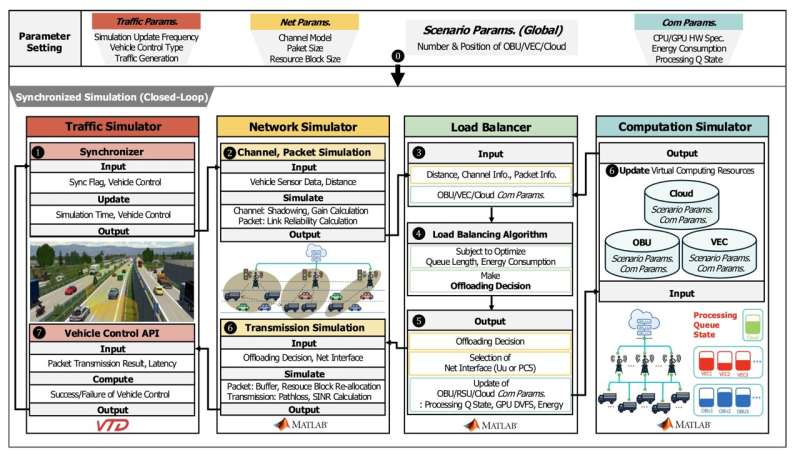
To deal with this problem, Prof. Choi’s team at DGIST collaborated with Prof. Kwak Jung-ho’s team at Korea University to design a simulator framework that integrates computational and communications resources between the onboard unit (OBU) in the vehicle, the VEC server, and the cloud server. On this basis, they also developed a dynamic offloading and dynamic voltage and frequency scaling (DVFS) algorithm.
The newly developed INCL Balancing simulator combines an autonomous driving simulator (Virtual Test Drive (VTD)) based on real-world road scenarios and a MATLAB-based network computing simulator. It enables real-time control by comprehensively considering network quality, computing resource status, and energy consumption based on changes in time and space.
Using eight scenarios reflecting real-world road conditions (e.g., platooning, road intersections, merging road lanes, and accident response) and real-world road data from Cheongna District, Incheon, the research team experimentally verified how effectively the proposed technology distributes traffic and computational load and reduces latency and power consumption compared with existing technologies.
In particular, the research team mathematically designed a load optimization algorithm that considers the reliability of the vehicle-to-vehicle communications link (Packet Delivery Ratio (PDR)), processing delay, and energy consumption. This ensures greater safety and performance than the existing fixed offloading method.
Simulation results showed an average energy saving of 21.7% compared with a simple VEC offloading method and a 73.3% improvement in throughput rate compared with the existing cost-minimization-based algorithm. These results demonstrate the potential for substantial performance improvements in autonomous vehicles.
“This research is significant because it enables precise simulation-based analysis of the balance between latency, energy efficiency, and safety in an autonomous driving environment where communication and computational resources fluctuate in real time,” said Prof. Choi.
“It is expected to be widely applied to various 6G-based application services, such as highway platooning, smart city road intersection control, and emergency vehicle priority passage control, in the future. It can be utilized by autonomous driving operators, vehicle cloud platforms, and mobile communication operators and can also be extended to digital twin–based services.”
More information: Jeongho Kwak et al, An Integrated Network-Computing Load Balancing Simulator for VEC-Assisted Autonomous Vehicles, IEEE Communications Magazine (2025). DOI: 10.1109/MCOM.003.2400432


Leave a Reply