
By National Institutes of Natural Sciences June 7, 2025
Collected at: https://scitechdaily.com/scientists-just-found-the-oldest-barred-spiral-galaxy-and-its-a-monster/
A massive barred spiral galaxy from 11.1 billion years ago has been discovered, showing star-forming activity and gas dynamics never seen before. It may reshape our understanding of how galaxies like the Milky Way evolved.
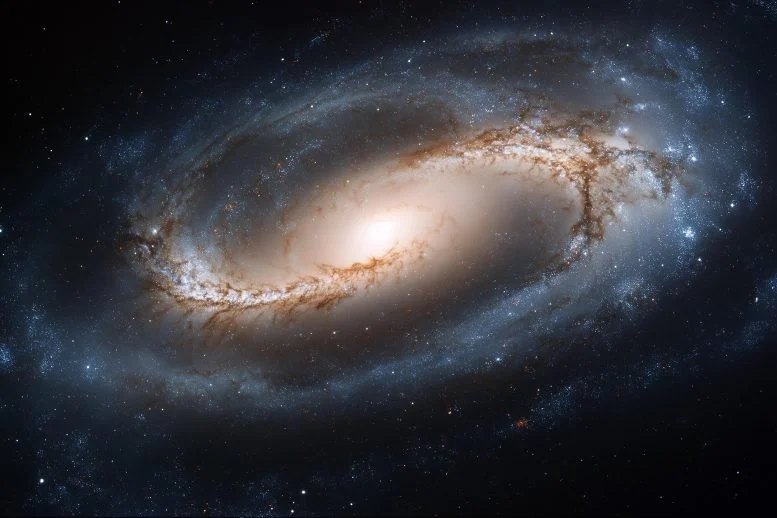
Astronomers have spotted a massive, highly active spiral galaxy from the early Universe that sheds new light on how galaxies like our own Milky Way take shape. This ancient galaxy features a bright central bar—a structure seen in many modern spiral galaxies—and its discovery is helping scientists better understand how these cosmic giants grow and evolve.
Some spiral galaxies, including the Milky Way, have a straight bar running through their centers. This bar acts like a funnel, directing gas inward where it can fuel the birth of new stars. But one big mystery remains: why do only about half of spiral galaxies have bars? And what role do these structures play in shaping a galaxy’s future?

A Monster Galaxy from the Early Universe
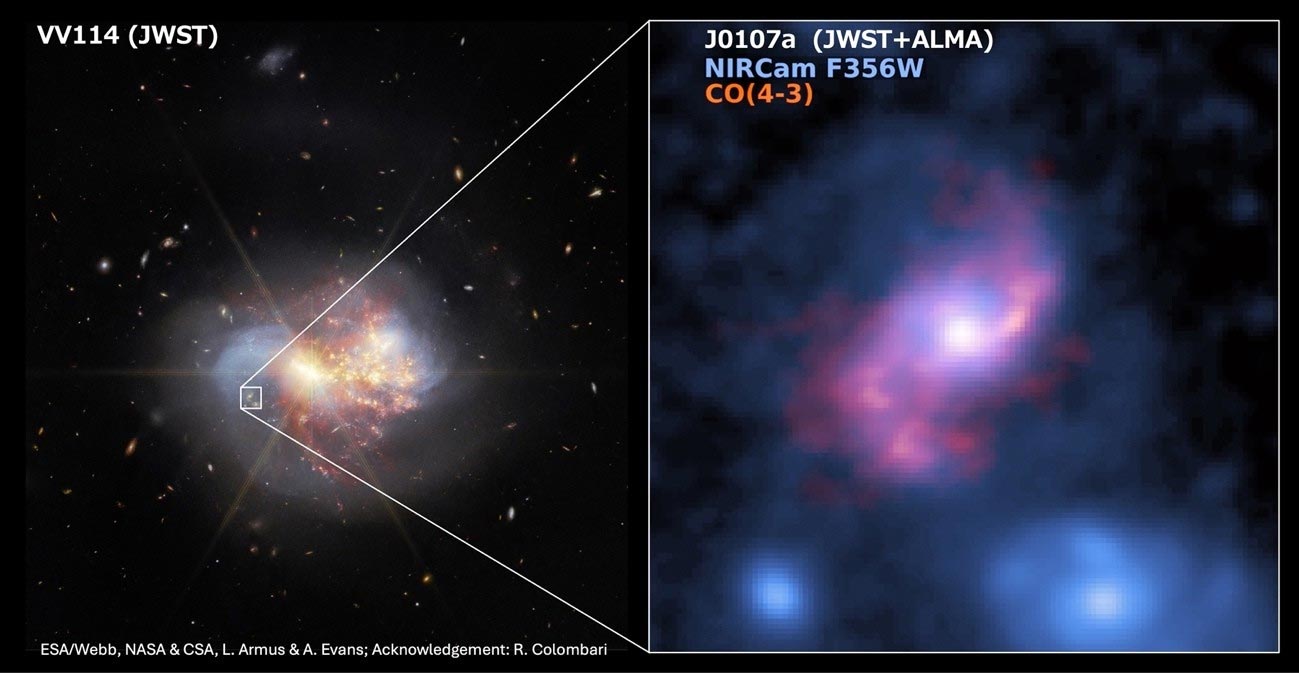
To explore these questions, a team of researchers led by Shuo Huang at the National Astronomical Observatory of Japan and Nagoya University turned to the powerful ALMA radio telescope. They focused on a galaxy called J0107a, located in the constellation Cetus, which existed an astonishing 11.1 billion years ago. J0107a is what scientists call a “monster galaxy” — a galaxy undergoing a rapid growth spurt by forming stars at an extraordinary rate.
For a long time, it was nearly impossible to study these distant galaxies in detail. But thanks to the sharp vision of the James Webb Space Telescope, astronomers can now see clear spiral patterns and even central bars in some of these ancient giants. J0107a stands out as the oldest and most massive barred spiral galaxy ever observed. That makes it a powerful time capsule for studying how these majestic galactic structures formed and evolved in the early Universe.
Gas Dynamics and Unexpected Discoveries
The team found that in J0107a, the distribution and motion of gas in the bar is similar to modern galaxies. But compared to modern galaxies, the concentrations of gas are several times higher, and the speed of the gas flow is faster, reaching several hundred kilometers per second. Astronomers believe that this massive influx of gas to the center will fuel significant additional star formation, helping to drive the evolution of this monster galaxy. This is the first time these features have been observed, and they were not predicted by theoretical or simulation models.
New Clues to Galactic Evolution
Huang comments, “We expect that the detailed information about the distribution and movement of gas gained through these observations will provide important clues for exploring not only the origins of the diversity of galaxies, but also the formation and evolution of more normal barred spiral galaxies.”
Reference: “Large gas inflow driven by a matured galactic bar in the early Universe” by Shuo Huang, Ryohei Kawabe, Hideki Umehata, Kotaro Kohno, Yoichi Tamura and Toshiki Saito, 21 May 2025, Nature.
DOI: 10.1038/s41586-025-08914-2
Leave a Reply