
June 5, 2025 by Ingrid Fadelli, Phys.org
Collected at: https://phys.org/news/2025-06-iii-multiferroics-ferroelectricity-driven-magnetism.html
Multiferroics are materials that exhibit more than one ferroic property, typically ferroelectricity (i.e., a spontaneous electric polarization that can be reversed by electric fields) and ferromagnetism (i.e., the spontaneous magnetic ordering of electron spins). These materials have proved promising for the development of various new technologies, including spintronics, devices that exploit the spin of electrons to process and store information.
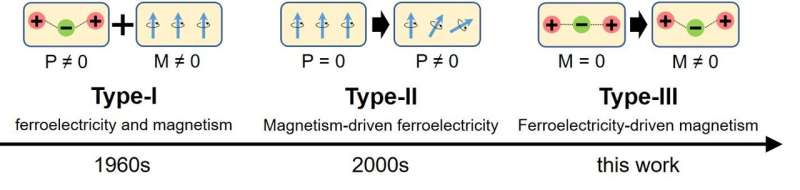
So far, physicists and material scientists have uncovered two distinct types of multiferroics, dubbed Type-I and Type-II multiferroics. In Type-I multiferroics, ferroelectricity and magnetism arise independently from distinct physical mechanisms, while in Type-II multiferroics, ferroelectricity is driven by magnetic ordering.
Researchers at Nanjing University of Science and Technology recently predicted the existence of a third type of multiferroics, referred to as Type-III multiferroics, in which magnetism is driven by ferroelectricity. Their paper, published in Physical Review Letters, could inspire future efforts aimed at identifying materials with the characteristics they described, which could be highly advantageous for the advancement of spintronics as well as other memory and information processing systems.
“Our recent work aims to explore multiferroic materials that enable electric control of magnetism,” Chengxi Huang, co-author of the paper, told Phys.org. “Controlling magnetism with electric fields holds great potential for creating low-cost and nonvolatile memory devices.
“However, it remains a significant challenge because most materials do not exhibit strong enough interactions between their magnetic and electric properties, a phenomenon known as the magnetoelectric effect. Multiferroic materials, which combine both magnetism and electric polarization (ferroelectricity), offer a possible solution.”
The reliable control of magnetism in materials using electric fields is crucial for the development of highly performing spintronics. Despite their potential, the two types of multiferroics identified so far have significant limitations, which make them impractical for the electrical control of magnetism in real devices.

Type-I multiferroics have a weak magnetoelectric coupling, which means that they fail to effectively couple magnetism and electric fields. On the other hand, Type-II multiferroics exhibit a very limited electric polarization (i.e., they do not separate charges very strongly, even when in a ferroelectric state).
To facilitate the advancement of spintronic devices, Huang and his colleagues started exploring the existence of other types of multiferroics. As part of their recent study, they employed state-of-the-art computational methods rooted in density functional theory to study the properties of multiferroic materials.
“We theoretically proposed a new class of materials, termed Type-III multiferroics, where magnetism is directly driven by ferroelectricity, and revealed a general microscopic mechanism of magnetoelectric coupling,” explained Huang. “Type-III multiferroics could potentially offer both strong magnetoelectric effect and substantial electric polarization, making them ideal candidates for efficient electric control of magnetism.”
If their existence is confirmed, Type-III multiferroics could play a key role in the development of next-generation memory devices and logic circuits. So far, Huang and his colleagues merely showed that they could exist theoretically according to calculation results, yet their work could soon inspire other research groups to seek for materials exhibiting the ferroelectricity-driven magnetism they described.
“Currently, the experimental verification of Type-III multiferroics remains challenging due to the lack of potential candidates, so the first thing we are planning to do is provide a database of Type-III multiferroic structures via high-throughput computations,” added Huang.
“Beyond this, there are many important and fundamental issues that merit further investigation in this area, such as the temperature dependence of the magnetoelectric properties and their responses to external electric and magnetic fields. We will work on these in our future research.”
More information: Jintao Jiang et al, Ferroelectricity-Driven Magnetism in a Metal Halide Monolayer, Physical Review Letters (2025). DOI: 10.1103/PhysRevLett.134.196801
Journal information: Physical Review Letters
Leave a Reply