
April 25, 2025 by Jeff Shepard
Collected at: https://www.eeworldonline.com/why-are-cryogenic-microwave-power-measurements-important-for-quantum-computing/
Cryogenic (cryo) microwave (µw) power measurements are vital for advancing quantum computing. Delicate quantum devices require operation at cryo temperatures to maintain coherence and stability. Accurate power measurements at cryo temperatures are also required to optimize and debug quantum hardware.
This article begins by reviewing cryo zones in a quantum computer and the related µw metrology needs. It then looks at how µw calibration units (MCUs) are used for making power measurements in the coldest cryo zone and concludes by considering a specific implementation of a cryo bolometer for making heat measurements and characterizing µw operation.
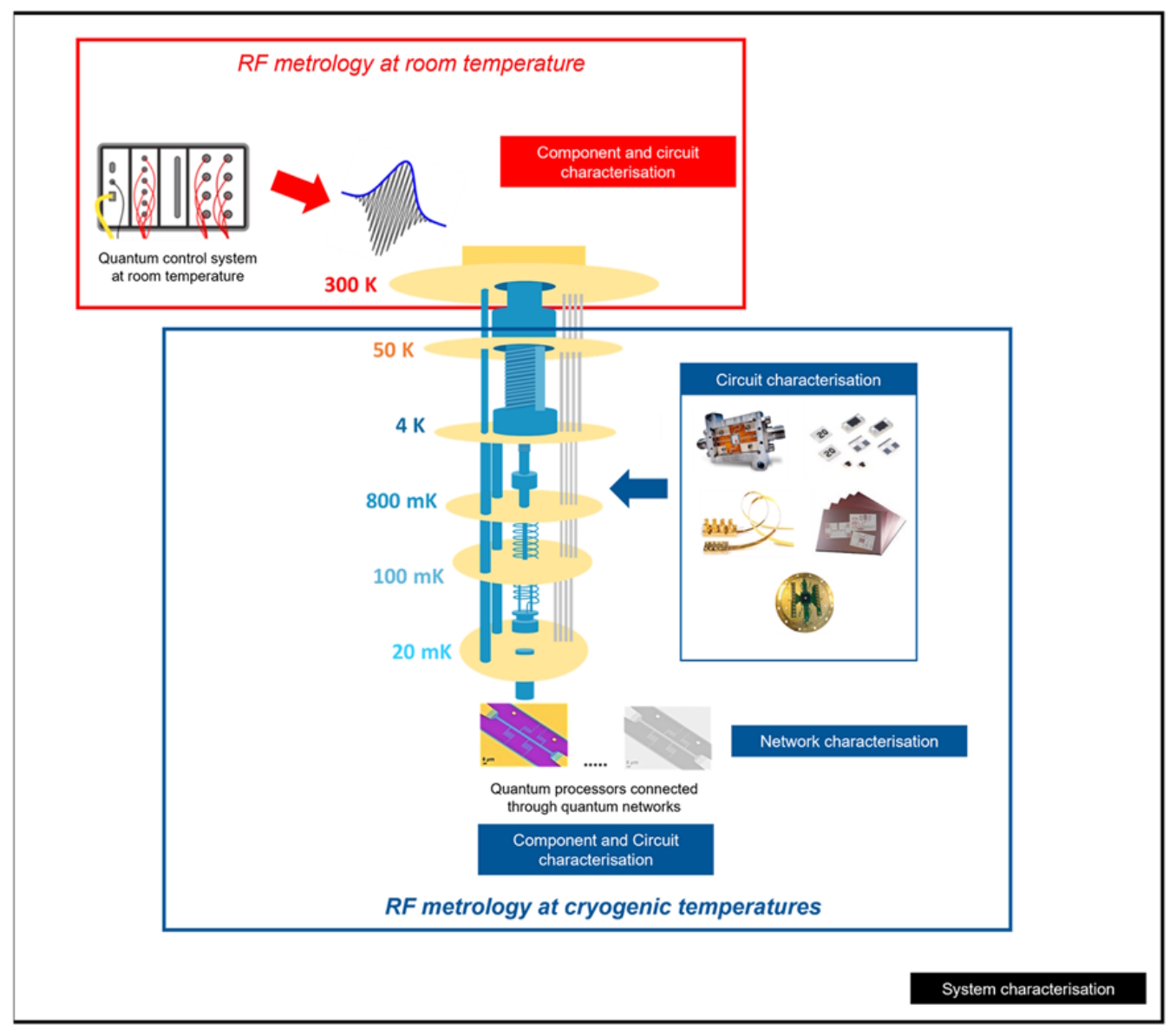
Many quantum processors operate at temperatures in the milli-Kelvin (mK) range. Those computers use µw pulses to state and operate the qubits. A quantum computing system has temperature regimes from room temperature down to mK.
The performance of the µw components, including amplifiers, filters, and mixers, used within the quantum processor must be characterized at their operating temperature, with the measurements linked to external systems operating at room temperature (Figure 1). Key measurements include scattering (S) parameters, power consumption, and noise.

Cryo µw power measurements are performed by converting the incoming signal into heat that can be detected by a specialized sensor like a bolometer or a transition edge sensor. The multi-stage dilution fridges used to create the cryo environment are complex structures, and careful calibration procedures are necessary to account for cable losses and other thermal effects that can impact the accuracy of measurements.
A known DC current is used to calibrate the meteorology system, and the temperature rise is measured. Once the system is calibrated, the sensors can absorb µw power, causing a temperature rise and a corresponding DC that can be directly converted to a power measurement.
The system must be optimized for the specific µw frequency range, and any noise sources must be managed to reduce interference to acceptable levels. S-parameters are measured to fully characterize the µw signal transmission through the cryo system, providing data about reflection and transmission coefficients at different frequencies.
Cryo S-parameter MCU
One architecture for characterizing the performance of the cryo system is shown in Figure 2. The dilution fridge has six stages, dropping the temperature from room temperature (about 300 K) to under 20 mK. A vector network analyzer sits at the top of the system at room temperature, and the MCU is situated in the <20 mK section with the device under test (DUT).

The interconnects must support high performance for µw frequencies up to several GHz and provide high thermal attenuation. The number of thermal photons reaching the coldest section must be well below the single photon level to ensure reliable qubit operation.
Cryo µw bolometer
A cryo µw bolometer has been fabricated to quantify the performance of quantum computer components. The design, shown in Figure 3, has three elements: a DC heater, a thermal absorber, and a readout circuit.

Summary
Accurate µw power measurements at cryo temperatures are important when optimizing and debugging quantum computing hardware. The qubits in those computers are controlled using µw pulses. To fully characterize the µw signal transmission through the cryo system, S-parameters must be characterized to provide data about reflection and transmission coefficients at GHz frequencies.
Leave a Reply