
By Max Planck Institute for Intelligent Systems April 10, 2025
Collected at: https://scitechdaily.com/new-ai-algorithm-analyzes-neutron-star-collisions-3600x-faster-than-traditional-methods/
A machine learning method has the potential to revolutionize multi-messenger astronomy.
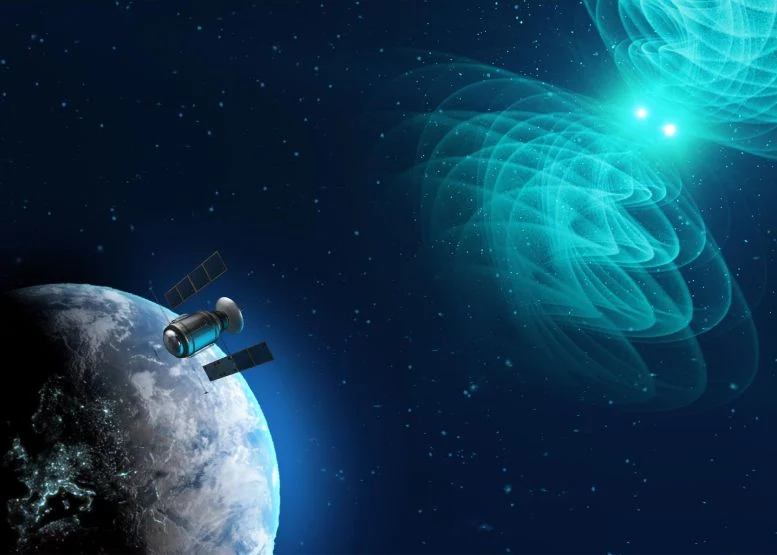
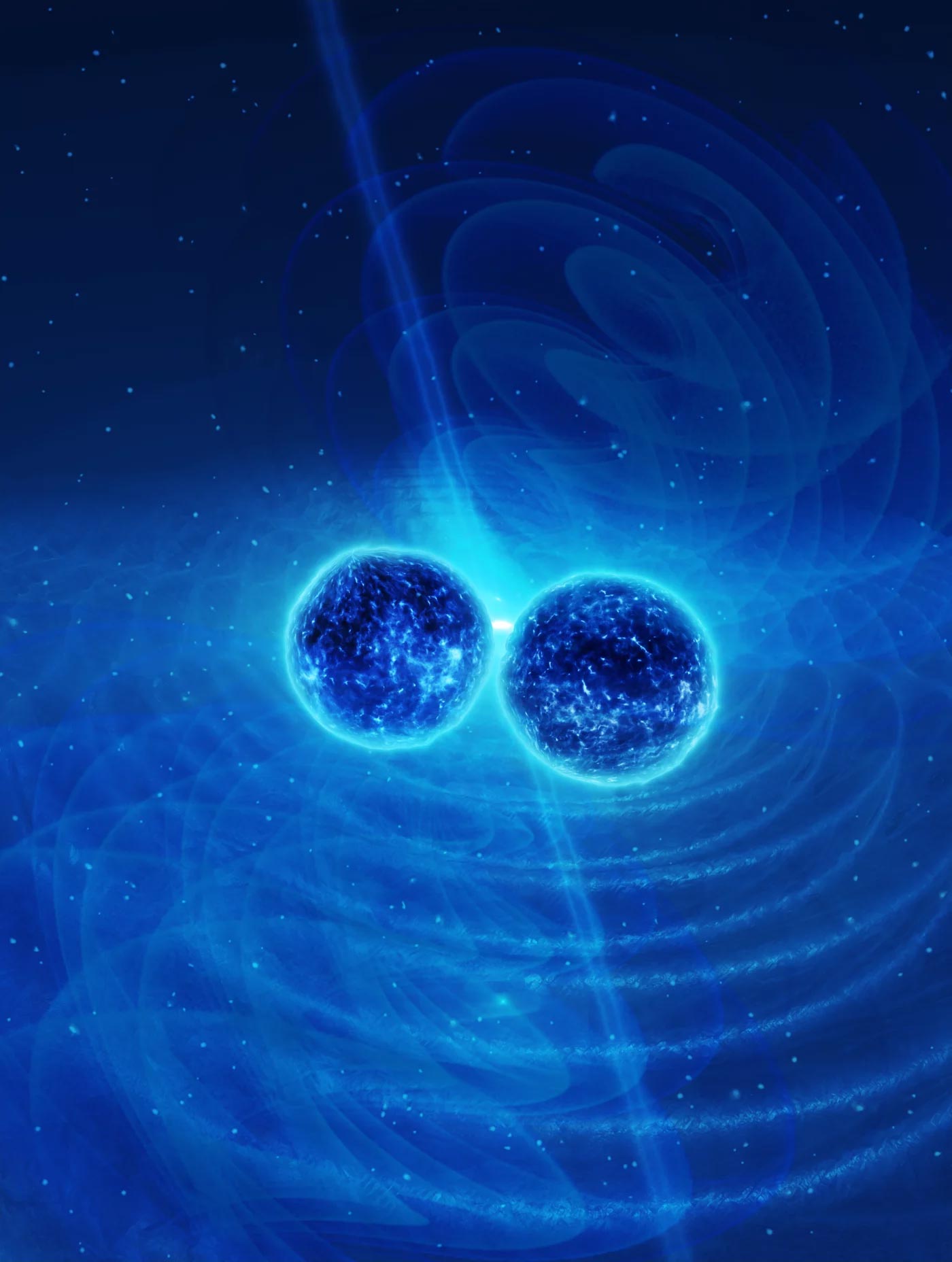
Detecting binary neutron star mergers is a top priority for astronomers. These rare collisions between dense stellar remnants produce gravitational waves followed by bursts of light, offering a unique opportunity to study matter and gravity under some of the most extreme conditions in the universe. However, timing is critical, key signals can be missed without rapid analysis.
In a new study, an interdisciplinary team of researchers introduces a new machine learning approach that can analyze gravitational waves from neutron star mergers almost in real time, even before the merger is complete. The method uses a neural network to quickly interpret incoming data, allowing astronomers to swiftly search for associated light and other electromagnetic signals. This advancement could play a pivotal role in preparing for the next generation of gravitational wave observatories.
Binary neutron star mergers occur hundreds of millions of light-years from Earth, and the gravitational wave signals they produce are challenging to decode. Current detectors capture minutes of data per event, while future observatories may collect hours or even days’ worth. Processing this volume of data using traditional methods is both time-consuming and computationally intensive.
To address this, an international team developed a machine learning algorithm called DINGO-BNS (Deep INference for Gravitational-wave Observations from Binary Neutron Stars). This neural network can characterize merging neutron star systems in about one second, compared to nearly an hour using the fastest existing techniques. Their findings were recently published in the journal Nature.
Why is real-time computation important?
Neutron star mergers emit visible light (in the subsequent kilonova explosion) and other electromagnetic radiation in addition to gravitational waves.
“Rapid and accurate analysis of the gravitational-wave data is crucial to localize the source and point telescopes in the right direction as quickly as possible to observe all the accompanying signals,” says the first author of the publication, Maximilian Dax, who is a Ph.D. student in the Empirical Inference Department at the Max Planck Institute for Intelligent Systems (MPI-IS), at ETH Zurich and at the ELLIS Institute Tübingen.
The real-time method could set a new standard for data analysis of neutron star mergers, giving the broader astronomy community more time to point their telescopes toward the merging neutron stars as soon as the large detectors of the LIGO-Virgo-KAGRA (LVK) collaboration identify them.
“Current rapid analysis algorithms used by the LVK make approximations that sacrifice accuracy. Our new study addresses these shortcomings,” says Jonathan Gair, a group leader in the Astrophysical and Cosmological Relativity Department at the Max Planck Institute for Gravitational Physics in the Potsdam Science Park.
Indeed, the machine learning framework fully characterizes the neutron star merger (e.g., its masses, spins, and location) in just one second without making such approximations. This allows, among other things, to quickly determine the sky position 30% more precisely. Because it works so quickly and accurately, the neural network can provide critical information for joint observations of gravitational-wave detectors and other telescopes. It can help to search for the light and other electromagnetic signals produced by the merger and to make the best possible use of the expensive telescope observing time.
Catching a neutron star merger in the act
“Gravitational wave analysis is particularly challenging for binary neutron stars, so for DINGO-BNS, we had to develop various technical innovations. This includes for example a method for event-adaptive data compression,” says Stephen Green, UKRI Future Leaders Fellow at the University of Nottingham. Bernhard Schölkopf, Director of the Empirical Inference Department at MPI-IS and at the ELLIS Institute Tübingen, adds: “Our study showcases the effectiveness of combining modern machine learning methods with physical domain knowledge.”
DINGO-BNS could one day help to observe electromagnetic signals before and at the time of the collision of the two neutron stars. “Such early multi-messenger observations could provide new insights into the merger process and the subsequent kilonova, which are still mysterious,” says Alessandra Buonanno, Director of the Astrophysical and Cosmological Relativity Department at the Max Planck Institute for Gravitational Physics.
Reference: “Real-time inference for binary neutron star mergers using machine learning” by Maximilian Dax, Stephen R. Green, Jonathan Gair, Nihar Gupte, Michael Pürrer, Vivien Raymond, Jonas Wildberger, Jakob H. Macke, Alessandra Buonanno and Bernhard Schölkopf, 5 March 2025, Nature.
DOI: 10.1038/s41586-025-08593-z

Leave a Reply