
By GSI Helmholtz Centre for Heavy Ion Research April 2, 2025
Collected at: https://scitechdaily.com/stellar-time-machine-rare-particle-decay-sheds-light-on-the-suns-mysterious-origins/
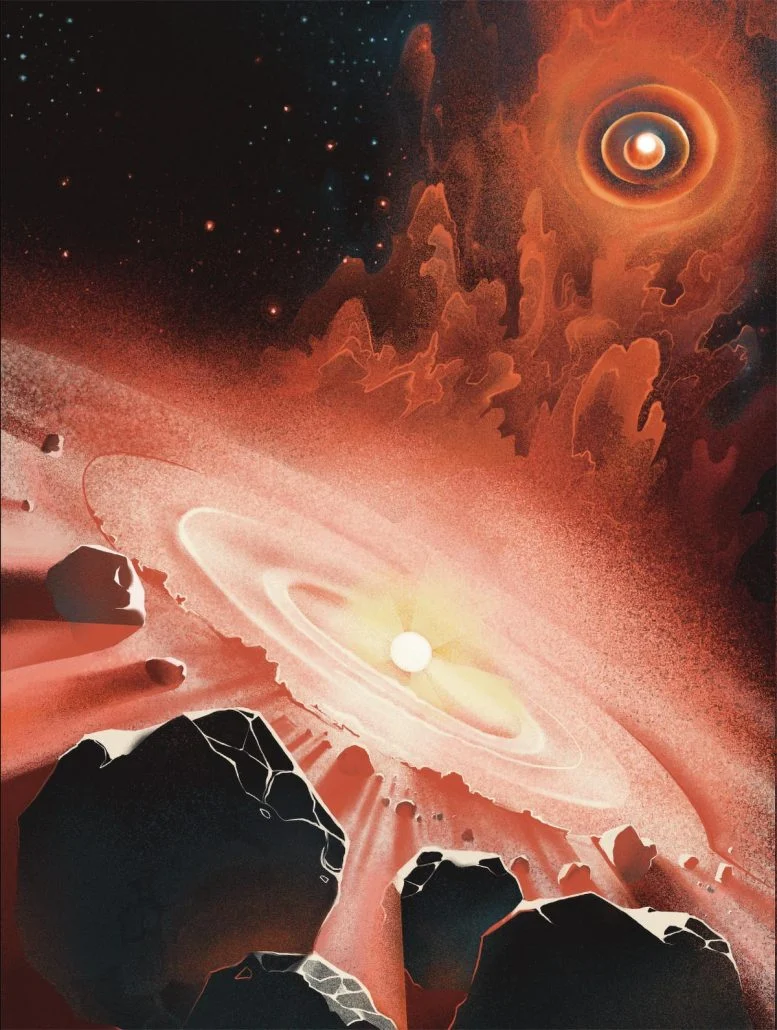
New experiments on thallium decay have helped determine the Sun formed over 10–20 million years, improving stellar nucleosynthesis models.
Have you ever wondered how long it took our Sun to form in the stellar nursery where it was born? An international team of scientists has just brought us closer to the answer. They successfully measured a rare nuclear process, bound-state beta decay, in fully ionized thallium-205 (²⁰⁵Tl⁸¹⁺) ions at the Experimental Storage Ring (ESR) of GSI/FAIR in Germany. This breakthrough sheds new light on how the radioactive isotope lead-205 (²⁰⁵Pb) is formed in asymptotic giant branch (AGB) stars and helps refine estimates of the Sun’s formation timeline. Their findings were published in Nature.
Current estimates suggest the Sun took tens of millions of years to form from its parent molecular cloud. This timeline is inferred from the presence of long-lived radionuclides that were produced shortly before the Sun’s birth. These isotopes were created in AGB stars, dying stars of intermediate-mass, and spread through the solar neighborhood via stellar winds.
Although these radionuclides have long since decayed, they left behind traceable amounts of their decay products in primitive meteorites, allowing scientists to reconstruct their origin. To accurately time the Sun’s formation, scientists look for radionuclides that are produced exclusively by the slow neutron capture process (s-process), with no contamination from other nucleosynthesis pathways. The best candidate is ²⁰⁵Pb—an “s-only” nucleus that fits these criteria.
Reversing Roles in Atomic Decay
On Earth, the isotope ²⁰⁵Pb decays into ²⁰⁵Tl through a process where one of its protons combines with an atomic electron, transforming into a neutron and emitting an electron neutrino. This decay—known as electron capture—relies on the very small energy difference between ²⁰⁵Pb and ²⁰⁵Tl. However, the higher electron binding energies in ²⁰⁵Pb (due to its greater nuclear charge, Z = 82) make this transformation energetically favorable. Interestingly, if all electrons are stripped from the atoms—such as in extremely high-temperature environments—the situation reverses.
Without electrons, ²⁰⁵Tl becomes unstable and undergoes beta-minus decay to form ⁵²⁰⁵Pb. This inversion occurs in asymptotic giant branch (AGB) stars, where temperatures of several hundred million Kelvin fully ionize atoms. The production of ²⁰⁵Pb in AGB stars, therefore, depends critically on the rate at which ²⁰⁵Tl decays under these ionized conditions. However, this decay cannot be observed in typical laboratory settings because, under normal conditions, ²⁰⁵Tl is stable.
The decay of 205Tl is only energetically possible if the produced electron is captured into one of the bound atomic orbits in 205Pb. This is an exceptionally rare decay mode known as bound-state beta decay. Moreover, the nuclear decay leads to an excited state in 205Pb which is situated only by a minuscule 2.3 kiloelectronvolt above the ground state but is strongly favored over the decay to the ground state. The 205Tl-205Pb pair can be imagined as a stellar seesaw model, as both decay directions are possible, and the winner depends on the stellar environment conditions of temperature and (electron) density — and on the nuclear transition strength which was the great unknown in this stellar competition.
Pioneering the Bound-State Beta Decay Experiment
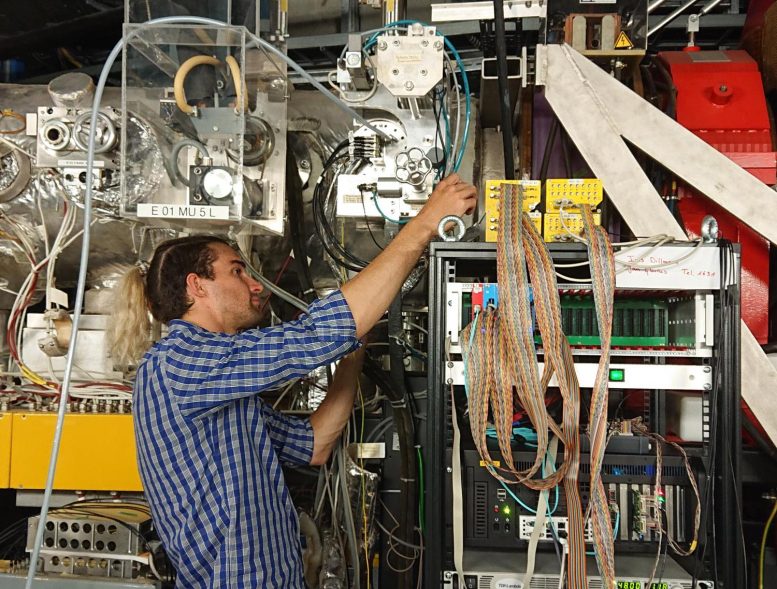
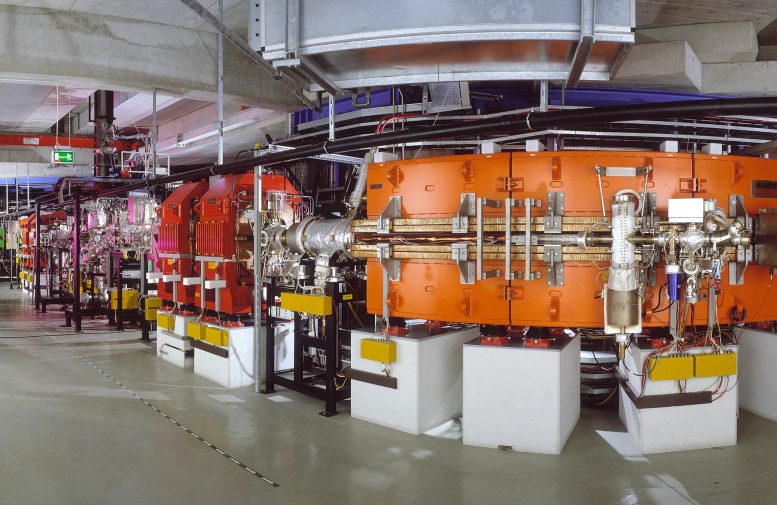
This unknown has now been unveiled in an ingenious experiment conducted by an international team of scientists coming from 37 institutions representing twelve countries. Bound-state beta decay is only measurable if the decaying nucleus is stripped of all electrons and is kept under these extraordinary conditions for several hours. Worldwide, this is only possible at the GSI/FAIR heavy-ion Experimental Storage Ring (ESR) combined with the fragment separator (FRS).
“The measurement of 205Tl81+ had been proposed in the 1980s, but it has taken decades of accelerator development and the hard work of many colleagues to bring to fruition,” says Professor Yury Litvinov of GSI/FAIR, spokesperson of the experiment. “A plethora of groundbreaking techniques had to be developed to achieve the required conditions for a successful experiment, like production of bare 205Tl in a nuclear reaction, its separation in the FRS and accumulation, cooling, storage and monitoring in the ESR.”
“Knowing the transition strength, we can now accurately calculate the rates at which the seesaw pair 205Tl-205Pb operates at the conditions found in AGB stars,” says Dr. Riccardo Mancino, who performed the calculations as a post-doctoral researcher at the Technical University of Darmstadt and GSI/FAIR.
The 205Pb production yield in AGB stars has been derived by researchers from the Konkoly Observatory in Budapest (Hungary), the INAF Osservatorio d’Abruzzo (Italy), and the University of Hull (UK), implementing the new 205Tl/205Pb stellar decay rates in their state-of-the-art AGB astrophysical models. “The new decay rate allows us to predict with confidence how much 205Pb is produced in AGB stars and finds its way into the gas cloud which formed our Sun,” explains Dr. Maria Lugaro, researcher at Konkoly Observatory. “By comparing with the amount of 205Pb we currently infer from meteorites, the new result gives a time interval for the formation of the Sun from the progenitor molecular cloud of ten to twenty million years that is consistent with other radioactive species produced by the slow neutron capture process.”
Collaborative Science Illuminates Solar Origins
“Our result highlights how groundbreaking experimental facilities, collaboration across many research groups, and a lot of hard work can help us understand the processes in the cores of stars. With our new experimental result, we can uncover how long it took our Sun to form 4.6 billion years ago,” says Guy Leckenby, doctoral student from TRIUMF and first author of the publication.
The measured bound-state beta decay half-life is essential to analyze the accumulation of 205Pb in the interstellar medium. However, other nuclear reactions are also important including the neutron capture rate on 205Pb for which an experiment is planned utilizing the surrogate reaction method in the ESR. These results clearly illustrate the unique possibilities offered by the heavy-ion storage rings at GSI/FAIR allowing to bring the Universe to the lab.
Reference: “High-temperature 205Tl decay clarifies 205Pb dating in early Solar System” by Guy Leckenby, Ragandeep Singh Sidhu, Rui Jiu Chen, Riccardo Mancino, Balázs Szányi, Mei Bai, Umberto Battino, Klaus Blaum, Carsten Brandau, Sergio Cristallo, Timo Dickel, Iris Dillmann, Dmytro Dmytriiev, Thomas Faestermann, Oliver Forstner, Bernhard Franczak, Hans Geissel, Roman Gernhäuser, Jan Glorius, Chris Griffin, Alexandre Gumberidze, Emma Haettner, Pierre-Michel Hillenbrand, Amanda Karakas, Tejpreet Kaur, Wolfram Korten, Christophor Kozhuharov, Natalia Kuzminchuk, Karlheinz Langanke, Sergey Litvinov, Yuri A. Litvinov, Maria Lugaro, Gabriel Martínez-Pinedo, Esther Menz, Bradley Meyer, Tino Morgenroth, Thomas Neff, Chiara Nociforo, Nikolaos Petridis, Marco Pignatari, Ulrich Popp, Sivaji Purushothaman, René Reifarth, Shahab Sanjari, Christoph Scheidenberger, Uwe Spillmann, Markus Steck, Thomas Stöhlker, Yoshiki K. Tanaka, Martino Trassinelli, Sergiy Trotsenko, László Varga, Diego Vescovi, Meng Wang, Helmut Weick, Andrés Yagüe Lopéz, Takayuki Yamaguchi, Yuhu Zhang and Jianwei Zhao, 13 November 2024, Nature.
DOI: 10.1038/s41586-024-08130-4
The work is dedicated to deceased colleagues Fritz Bosch, Roberto Gallino, Hans Geissel, Paul Kienle, Fritz Nolden, and Gerald J. Wasserburg, who were supporting this research for many years.
Leave a Reply