
March 21, 2025 by Kimm Fesenmaier, California Institute of Technology
Collected at: https://techxplore.com/news/2025-03-solar-powered-reactor-potential-jet.html
Increasing energy demands and problems associated with burning fossil fuels have heightened interest in more sustainable energy sources, such as sunlight. But there are still areas where carbon-based fuel remains the standard, such as in the aviation industry. To address this need, scientists have been working to devise a way to use sunlight to generate solar-thermal heating that could then drive the chemical reactions that are needed to make jet fuel with net-zero carbon emissions.
Now, a team at Caltech that is part of a Department of Energy (DOE) Energy Innovation Hub known as the Liquid Sunlight Alliance, or LiSA, has developed such a solar-thermal heating system on a small scale and demonstrated that it can successfully drive an important reaction for jet fuel production.
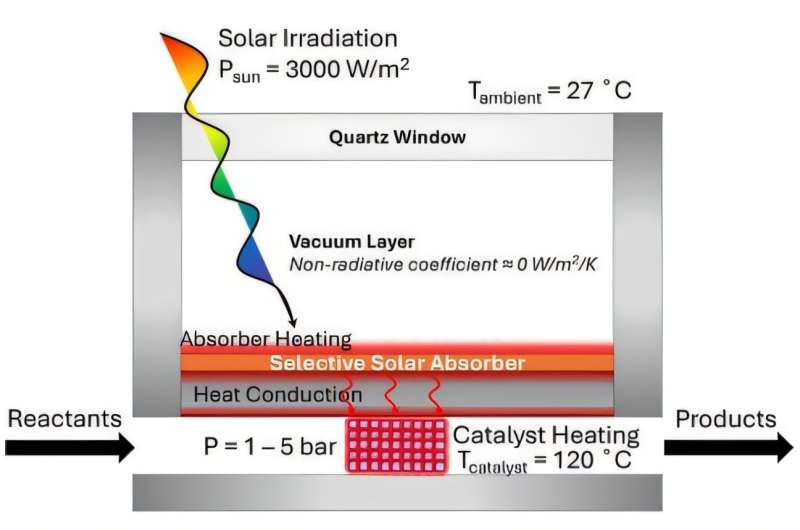
Completely powered by solar energy, the so-called photothermocatalytic reactor incorporates a spectrally selective solar absorber to maximize the generation of solar-thermal heating. The modular design of the reactor takes advantage of current fabrication technologies and existing silicon solar panel production infrastructure.
The team has demonstrated a lab-scale operation of the reactor, and simulations show that the technology has the potential to scale up to sizes representative of commercial silicon-based thin-film technologies.
“This device demonstrates that the heat generated by abundant solar energy can be used to directly drive catalytic processes, which has normally been done using electricity or fossil fuels,” says Harry Atwater, the Howard Hughes Professor of Applied Physics and Materials Science, Otis Booth Leadership Chair of the Division of Engineering and Applied Science, and LiSA director.
The paper is published in the journal Device. The lead author of the paper is Magel P. Su (Ph.D. ’24), who designed and fabricated the solar absorber while a graduate student in the Atwater Group.
The reactor incorporates a selective solar absorber with a multilayer design. The goal of such an absorber is to capture as much as possible of the solar spectrum while losing as little heat as possible to the surroundings. “That’s very hard to accomplish with a single material, so we went with a multilayer stack,” explains Caltech’s Aisulu Aitbekova, an author of the new paper and a Kavli Nanoscience Institute (KNI) Postdoctoral Scholar Research Associate in Applied Physics and Materials Science.
The Caltech team developed a stack of layers consisting of materials such as silicon, germanium, and gold carefully deposited atop a silver substrate. “Each layer has a specific role, but when combined together, they give you the desired output,” Aitbekova says.

In this system, a quartz window at the top allows light to illuminate the solar absorber; a vacuum layer helps minimize heat losses; and the solar absorber sits at the bottom, in direct contact with the chemical reactor. The selective solar absorber achieves a calculated maximum temperature of 249°C under one sun illumination and 130°C under ambient operating conditions (25°C, 1 atm).
The team used the generated solar-thermal heating to drive ethylene oligomerization, a chemical reaction that has traditionally relied on heat derived from the burning of fossil fuels. The oligomerization reaction, which begins with ethylene (C2H4), a hydrocarbon with two carbon atoms connected by a double bond, can be used to make longer hydrocarbon chains called alkenes, which still feature a carbon–carbon double bond.
Jet fuels include a wide distribution of hydrocarbon chains, with anywhere from seven to 26 carbon atoms. In the new paper, the Caltech scientists were able to make liquid alkene products with the same range of carbon atoms using solar energy as the only driving force.
Unlike concentrated solar technology, the reactor does not require solar tracking. Solar tracking allows a solar collector, reflector, or photovoltaic panel to follow the sun during the day to maximize the absorbed solar radiation. However, solar tracking systems are more expensive than devices mounted at a fixed angle and orientation.
“We’re not competing with concentrated solar technology, where you can reach up to 2,700 suns,” Aitbekova says. “We’re looking for a complementary technology that can be used in areas where concentrated solar is not feasible.”
In this paper, the team started with ethylene, which is currently derived from fossil fuels. But Aitbekova notes that the LiSA team recently published another paper demonstrating how to make ethylene from carbon dioxide (CO2), water, and sunlight. “So, now we show two steps: First, we use CO2, water, and sunlight to make ethylene, and then we do ethylene oligomerization. And solar energy is the only energy input to the system.”
More information: Magel P. Su et al, A photothermocatalytic reactor and selective solar absorber for sustainable fuel synthesis, Device (2024). DOI: 10.1016/j.device.2024.100604
Journal information: Device


Please let me know if you’re looking for a writer for your weblog. You have some really good posts and I believe I would be a good asset. If you ever want to take some of the load off, I’d absolutely love to write some content for your blog in exchange for a link back to mine. Please shoot me an email if interested. Thanks!


With havin so much content and articles do you ever run into any issues of plagorism or copyright infringement? My blog has a lot of unique content I’ve either authored myself or outsourced but it looks like a lot of it is popping it up all over the web without my authorization. Do you know any ways to help reduce content from being ripped off? I’d really appreciate it.


Thanks for this excellent article. Yet another thing to mention is that many digital cameras are available equipped with any zoom lens that enables more or less of the scene being included by simply ‘zooming’ in and out. These types of changes in {focus|focusing|concentration|target|the a**** length are generally reflected inside viewfinder and on significant display screen at the back of your camera.


I have learned new things via your blog site. One other thing I’d prefer to say is the fact newer laptop or computer operating systems have a tendency to allow a lot more memory to use, but they in addition demand more storage simply to function. If people’s computer is not able to handle additional memory and also the newest software requires that ram increase, it is usually the time to shop for a new Laptop or computer. Thanks


Howdy would you mind stating which blog platform you’re using? I’m planning to start my own blog soon but I’m having a hard time choosing between BlogEngine/Wordpress/B2evolution and Drupal. The reason I ask is because your design seems different then most blogs and I’m looking for something unique. P.S Apologies for being off-topic but I had to ask!

Yet another thing I would like to mention is that as opposed to trying to suit all your online degree training on days that you finish off work (considering that people are exhausted when they get back), try to find most of your lessons on the weekends and only a few courses for weekdays, even if it means a little time off your weekend. This is beneficial because on the saturdays and sundays, you will be more rested along with concentrated in school work. Thx for the different tips I have mastered from your blog.


The following time I learn a weblog, I hope that it doesnt disappoint me as a lot as this one. I mean, I do know it was my choice to read, but I actually thought youd have one thing attention-grabbing to say. All I hear is a bunch of whining about something that you possibly can fix if you happen to werent too busy on the lookout for attention.

Leave a Reply