
By NASA March 9, 2025
Collected at: https://scitechdaily.com/nasa-just-found-a-supermassive-black-hole-rotating-the-wrong-way/
Astronomers have uncovered a baffling cosmic anomaly — a supermassive black hole in galaxy NGC 5084 that appears to be completely tilted relative to its galaxy’s structure.
This discovery, hidden for years in archival data, was only brought to light using cutting-edge image analysis techniques.
A Black Hole Mystery Uncovered
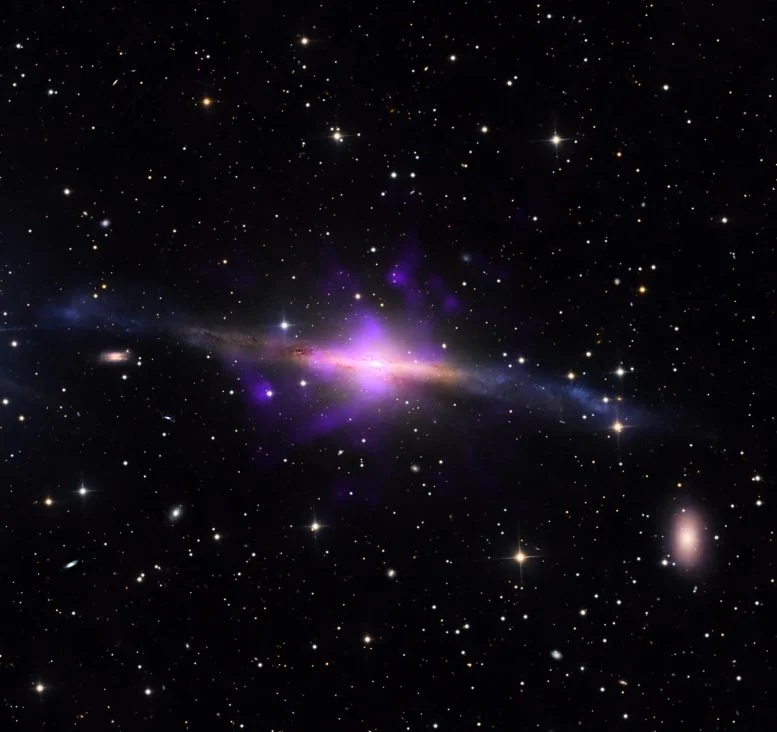
NASA researchers have identified a surprising black hole in the galaxy NGC 5084 — one that appears to be “tipped over,” rotating at an unusual angle compared to the rest of the galaxy. While NGC 5084 has been studied for years, this unexpected black hole orientation remained hidden within old data archives. The breakthrough came when scientists at NASA’s Ames Research Center in California’s Silicon Valley applied new image analysis techniques to re-examine archival data from the Chandra X-ray Observatory.
By using these advanced methods, astronomers at Ames discovered an astonishing feature: four long plumes of plasma — hot, charged gas — emerging from the galaxy. One pair of plumes extends above and below the galaxy’s plane, a common pattern in some galaxies. However, the second pair, positioned within the plane of the galaxy and forming an “X” shape with the first, is highly unusual. Typically, galaxies exhibit only one or two such plumes, making this discovery even more remarkable.
New Techniques Reveal the Unexpected
The method revealing such unexpected characteristics for galaxy NGC 5084 was developed by Alejandro Serrano Borlaff, a research scientist with Bay Area Environmental Research Institute and based at Ames, and colleagues to detect low-brightness X-ray emissions in data from the world’s most powerful X-ray telescope. What they saw in the Chandra data seemed so strange that they immediately looked to confirm it, digging into the data archives of other telescopes and requesting new observations from two powerful ground-based observatories.

The surprising second set of plumes was a strong clue this galaxy housed a supermassive black hole, but there could have been other explanations. Archived data from NASA’s Hubble Space Telescope and the Atacama Large Millimeter/submillimeter Array (ALMA) in Chile then revealed another quirk of NGC 5084: a small, dusty, inner disk turning about the center of the galaxy. This, too, suggested the presence of a black hole there, and, surprisingly, it rotates at a 90-degree angle to the rotation of the galaxy overall; the disk and black hole are, in a sense, lying on their sides.
Piecing Together the Galactic Puzzle
The follow-up analyses of NGC 5084 allowed the researchers to examine the same galaxy using a broad swath of the electromagnetic spectrum – from visible light, seen by Hubble, to longer wavelengths observed by ALMA and the Expanded Very Large Array of the National Radio Astronomy Observatory near Socorro, New Mexico.
“It was like seeing a crime scene with multiple types of light,” said Borlaff, who is also the first author on the paper reporting the discovery. “Putting all the pictures together revealed that NGC 5084 has changed a lot in its recent past.”
“It was like seeing a crime scene with multiple types of light.”
Alejandro Serrano Borlaff, NASA Research Scientist
“Detecting two pairs of X-ray plumes in one galaxy is exceptional,” added Pamela Marcum, an astrophysicist at Ames and co-author on the discovery. “The combination of their unusual, cross-shaped structure and the ‘tipped-over,’ dusty disk gives us unique insights into this galaxy’s history.”
A History of Cosmic Upheaval
Typically, astronomers expect the X-ray energy emitted from large galaxies to be distributed evenly in a generally spherical shape. When it’s not, such as when concentrated into a set of X-ray plumes, they know a major event has, at some point, disturbed the galaxy.
Possible dramatic moments in its history that could explain NGC 5084’s toppled black hole and double set of plumes include a collision with another galaxy and the formation of a chimney of superheated gas breaking out of the top and bottom of the galactic plane.
More studies will be needed to determine what event or events led to the current strange structure of this galaxy. But it is already clear that the never-before-seen architecture of NGC 5084 was only discovered thanks to archival data – some almost three decades old – combined with novel analysis techniques.
The paper presenting this research was published in The Astrophysical Journal.
Reference: “SAUNAS. II. Discovery of Cross-shaped X-Ray Emission and a Rotating Circumnuclear Disk in the Supermassive S0 Galaxy NGC 5084” by Alejandro S. Borlaff, Pamela M. Marcum, Pasquale Temi, Nushkia Chamba, S. Drew Chojnowski, Enrique Lopez-Rodriguez, Aneta Siemiginowska, Seppo Laine, Anton M. Koekemoer, Kelly N. Sanderson, Audrey F. Dijeau, Moire K. M. Prescott, Leslie Proudfit and Michael N. Fanelli, 18 December 2024, The Astrophysical Journal.
DOI: 10.3847/1538-4357/ad7c4b
The image analysis method developed by the team – called Selective Amplification of Ultra Noisy Astronomical Signal, or SAUNAS – was described in The Astrophysical Journal in May 2024.

Leave a Reply