
By European Southern Observatory (ESO) March 2, 2025
Collected at: https://scitechdaily.com/scientists-capture-the-universes-hidden-web-of-dark-matter/
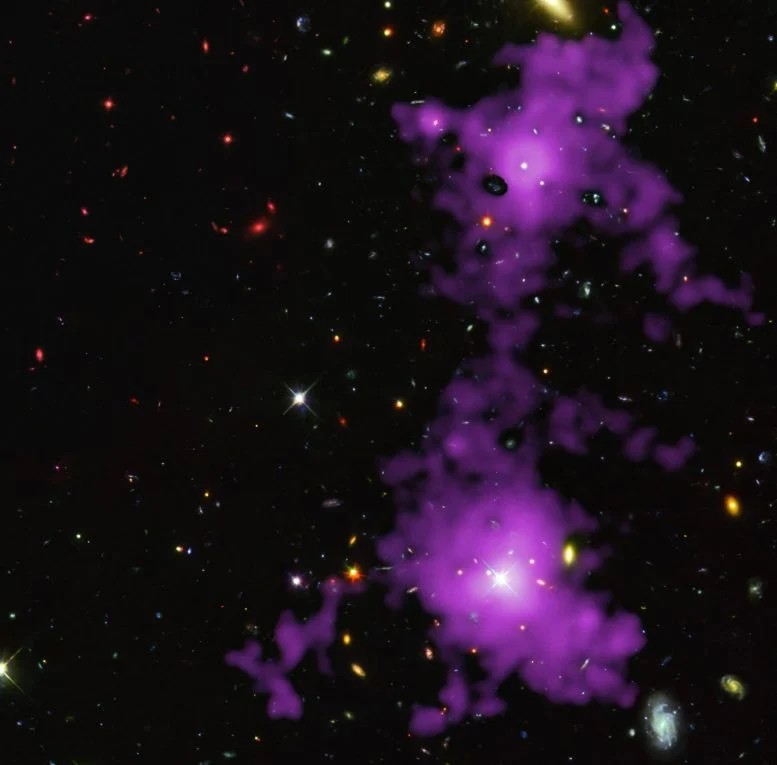
Dark matter, though invisible, weaves a vast cosmic web that binds galaxies together. For the first time, astronomers have captured a sharp image of one of these filaments, stretching 3 million light-years through space.
Using the powerful MUSE instrument on the VLT, they revealed a faint glow of gas shaped by dark matter’s gravitational pull. This filament provides a glimpse into the early Universe, supporting theories of galaxy formation.
Unveiling the Dark Matter Web
Could an invisible web of dark matter be shaping the universe around us? While its effects can be seen across the cosmos, this vast structure remains largely hidden. However, astronomers have now captured the clearest image yet of one of its filaments—a massive thread-like structure stretching 3 million light-years between two distant galaxies in the early universe.
This filament, influenced by dark matter’s gravity, was imaged using ESO’s Very Large Telescope (VLT) and appears in purple, overlaid on a background image from the Hubble Space Telescope.
The Challenge of Observing the Invisible
Dark matter makes up about 85% of all matter in the universe, yet it is completely invisible. However, the gas surrounding it is not. Although this gas emits an extremely faint glow, it is notoriously difficult to detect.
After approximately 150 hours of observations, a team of astronomers led by Davide Tornotti, a PhD student at the University of Milano-Bicocca in Italy, successfully captured this sharp image. Their success was made possible by the extraordinary sensitivity of the MUSE instrument on the VLT, which has become a key tool in mapping the elusive cosmic web.
A Breakthrough in Imaging the Cosmic Web
The light from this filament took 11 billion years to reach us, and it shows exactly what theory predicted. In the early Universe, filaments of dark matter could have created a large web that entangled gas through their gravitational pull. Once gas accumulated at the intersection between filaments, it would have provided the fuel necessary to form galaxies. As we observe more of these mysterious filaments, what else will we find trapped within this dark web?
Explore Further:
- First Direct Image of the Cosmic Web Reveals the Universe’s Hidden Highways
- Astronomers Just Found a 3-Million-Light-Year Connection Between Galaxies
Reference: “High-definition imaging of a filamentary connection between a close quasar pair at z = 3” by Davide Tornotti, Michele Fumagalli, Matteo Fossati, Alejandro Benitez-Llambay, David Izquierdo-Villalba, Andrea Travascio, Fabrizio Arrigoni Battaia, Sebastiano Cantalupo, Alexander Beckett, Silvia Bonoli, Pratika Dayal, Valentina D’Odorico, Rajeshwari Dutta, Elisabeta Lusso, Celine Peroux, Marc Rafelski, Mitchell Revalski, Daniele Spinoso and Mark Swinbank, 29 January 2025, Nature Astronomy.
DOI: 10.1038/s41550-024-02463-w
Leave a Reply