
By Royal Astronomical Society February 22, 2025
Collected at: https://scitechdaily.com/ai-just-discovered-a-hidden-cosmic-blast-that-could-transform-astronomy/
A long-lost cosmic explosion, buried within two decades of NASA’s Chandra X-ray data, has finally been uncovered by astronomers using artificial intelligence.
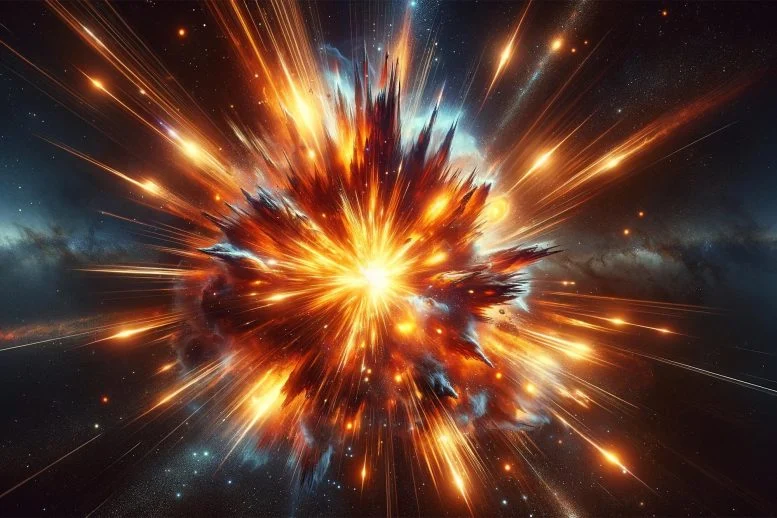
This incredibly powerful and fleeting X-ray burst, never seen before, challenges our understanding of space. Could it be the first X-ray burster ever detected in the Large Magellanic Cloud? Or perhaps a rare, violent flare from a magnetar? Or something completely unknown?
Mysterious Cosmic Explosion Hidden in Plain Sight
Astronomers have made a rare “needle in the haystack” discovery — an extremely powerful explosion from an unknown object outside our galaxy.
This cosmic event remained hidden for years within NASA’s Chandra X-ray Observatory archives, buried in two decades of observations. It was recently uncovered in a new study published in Monthly Notices of the Royal Astronomical Society.
Researchers from Stanford University and Harvard University suggest this mysterious explosion could be the first X-ray burster ever detected in the Large Magellanic Cloud (LMC), a rare flare from a magnetar — one of the most enigmatic objects in the universe — or something entirely new.
A Cosmic Photo Album Surprise
“Have you ever flipped through old photo albums and suddenly found something fascinating hidden in the background of a picture, no one had ever noticed before? Now imagine doing that on a cosmic scale,” said lead researcher Steven Dillmann, a PhD student at Stanford University.
“Using a novel machine learning approach, we looked back through over 20 years of archived observations from NASA’s Chandra X-ray Observatory and discovered a remarkable, powerful X-ray flash from an unknown object outside our own galaxy that had gone unnoticed for years within the vast Chandra archive – a true needle in the haystack event.”

A Flash That Vanished in Seconds
On May 15, 2020, while Chandra was observing the remains of an exploded star in the LMC (a small galaxy neighboring our Milky Way), it accidentally captured a bright and extremely fast X-ray flash from an unknown origin.
This flash appeared and disappeared within a few seconds, went unnoticed during the initial observation, and so was stored in the large Chandra archive.
Unlike traditional approaches, the novel machine learning method used in the new study managed to uncover the so-called extragalactic fast X-ray transient (FXT), which the researchers named XRT 200515 in reference to the day it was detected by Chandra.
An Explosion Unlike Any Other
“The cosmic flash is particularly interesting because of its unusual characteristics that are different to any of the other extragalactic FXTs that have previously been detected by Chandra,” said Mr Dillmann.
“It produced an incredibly energetic initial burst that lasted for only 10s, whereas others lasted for minutes or hours. This was followed by a longer, less energetic afterglow lasting for a few minutes.”
As neither Chandra nor any other telescope has ever recorded the source before or since this burst, its true nature remains a puzzle.

Theories Behind the Mysterious Burst
The researchers believe one explanation is that it could be the first X-ray burster ever discovered in the LMC. These are systems involving two stars: one small and super-dense dead star (called a neutron star) and a normal companion star that orbits around it.
The neutron star is like a cosmic vacuum cleaner – its powerful gravity pulls gas off its companion star. When enough gas builds up on the neutron star’s surface, it triggers a massive thermonuclear explosion that releases an intense burst of X-ray radiation.
Another theory is that it could be a rare, giant flare from a distant magnetar – neutron stars with extremely strong magnetic fields. These flares are some of the most explosive events in the cosmos, releasing a huge amount of gamma rays in a very short time.
If XRT 200515 is an X-ray counterpart to such an event, it would be the first giant magnetar flare observed at these X-ray energy levels.
The final explanation the researchers put forward is that it might be a previously unknown type of cosmic explosion that could reveal new insights about the universe.
“This discovery reminds us that space is dynamic and ever-changing, with exciting phenomena occurring constantly,” said Mr Dillmann.
AI Opens the Door to More Discoveries
“It also demonstrates the value of using artificial intelligence for scientific discovery in archived astronomical data – there might be countless other discoveries waiting to be found in observations we’ve already made.”
The researchers are now fine-tuning their method to search for signs of planets outside the Milky Way, building on previous breakthrough work led by co-author Rosanne di Stefano, which identified the first potential extragalactic planet candidate.
Reference: “Representation learning for time-domain high-energy astrophysics: Discovery of extragalactic fast X-ray transient XRT 200515” by Steven Dillmann, Juan Rafael Martínez-Galarza, Roberto Soria, Rosanne Di Stefano and Vinay L Kashyap, 23 December 2024, Monthly Notices of the Royal Astronomical Society.
DOI: 10.1093/mnras/stae2808
Leave a Reply