

By Compuscript Ltd February 18, 2025
Collected at: https://scitechdaily.com/surface-wave-driven-metasurfaces-open-a-new-era-for-terahertz-optics/
Researchers have developed a novel metasurface-based method to generate terahertz complex vector light fields using surface waves.
A recent paper in Opto-Electronic Sciences explores the generation of terahertz complex vector light fields on a metasurface driven by surface waves.
As information and communication technologies advance—particularly with the rise of 5G and 6G networks, artificial intelligence, and the Internet of Things—there is a growing demand for on-chip optical control devices that offer high bandwidth, fast operation, low power consumption, and compact size. However, conventional optical devices often struggle with limitations such as bulkiness, low efficiency, and restricted control capabilities.
Metasurfaces are a novel class of optical devices composed of ultra-thin, subwavelength artificial structures arranged in precise patterns. These engineered surfaces enable extraordinary optical effects, including anomalous reflection and refraction, planar prisms, holographic imaging, and surface wave excitation. Recent research has explored the use of on-chip surface waves as an excitation source, leveraging metasurfaces to efficiently decouple surface waves and control wavefronts in free space, expanding possibilities for on-chip optical applications.
However, most previous studies have focused primarily on phase control. Achieving simultaneous control over phase, amplitude, and polarization remains a major challenge, yet it is essential for more flexible and advanced light field manipulation.
A Novel Method for Generating Complex Vector Beams
This paper proposes a general method for designing ultra-compact on-chip optical devices that can efficiently generate pre-designed complex wavefront vector beams (VOFs) under surface wave (SW) excitation, with experimental verification in the terahertz (THz) frequency range.
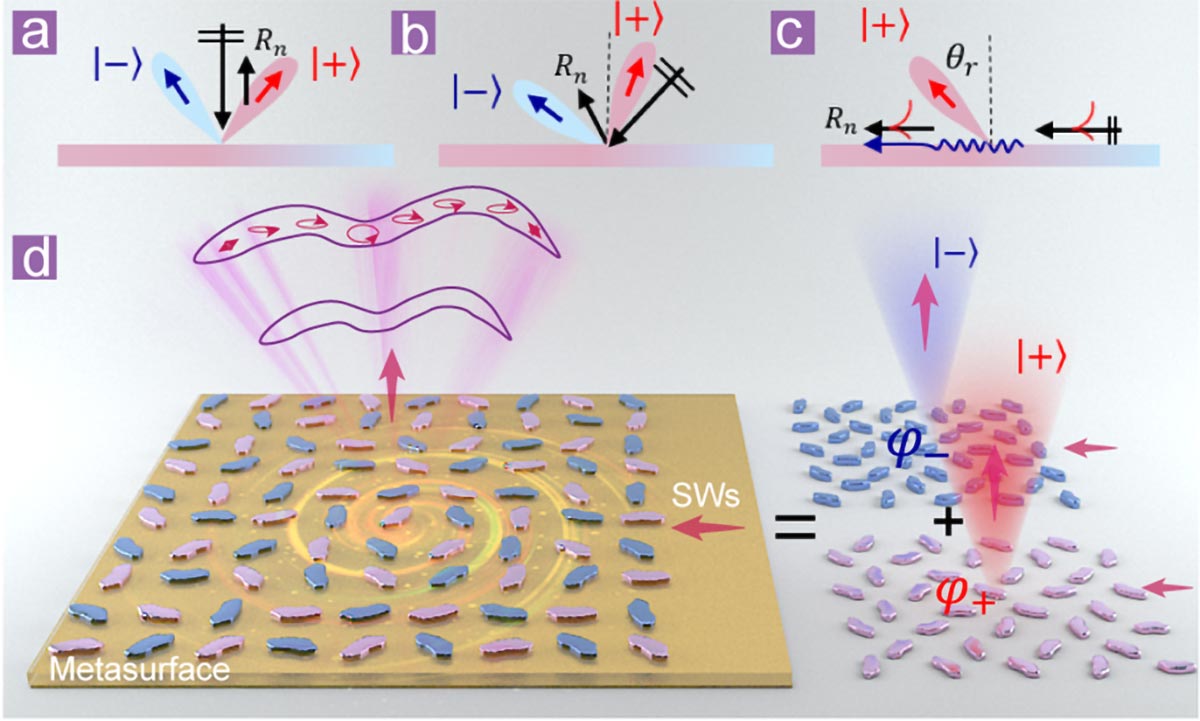
For reflective metasurface devices with linear geometric phase, when illuminated by linearly polarized light in the vertical direction, the scattered field will simultaneously contain both spin-related and spin-independent anomalous and normal modes (as shown in Fig. 1a).
As the incident angle increases, one of the anomalous modes and normal modes, after being manipulated by the metasurface, both have their reflection angles gradually increase. When the incident wave is an on-chip surface wave, the mode “surviving” in free space is a specific circularly polarized light, and both the radiation angle and polarization state of this mode can be arbitrarily controlled by precisely designing the phase gradient of the metasurface (Fig. 1b, c).
Composite Metasurfaces for Complex Vector Light Fields
Building on the above concepts, researchers have further proposed the idea of designing composite metasurfaces to radiate complex vector light fields. The traditional single “artificial atom” is expanded into a 2×2 “artificial molecule,” where the different subunits (blue and purple) have independent rotation angles and directions.
Under the illumination of surface waves, these subunits can simultaneously radiate left-handed circular polarization (LCP) and right-handed circular polarization (RCP) components. By controlling the local phase and polarization components through interference effects, specific wavefronts and polarization distributions of vector beams can be constructed on a macroscopic scale (Fig. 1d).
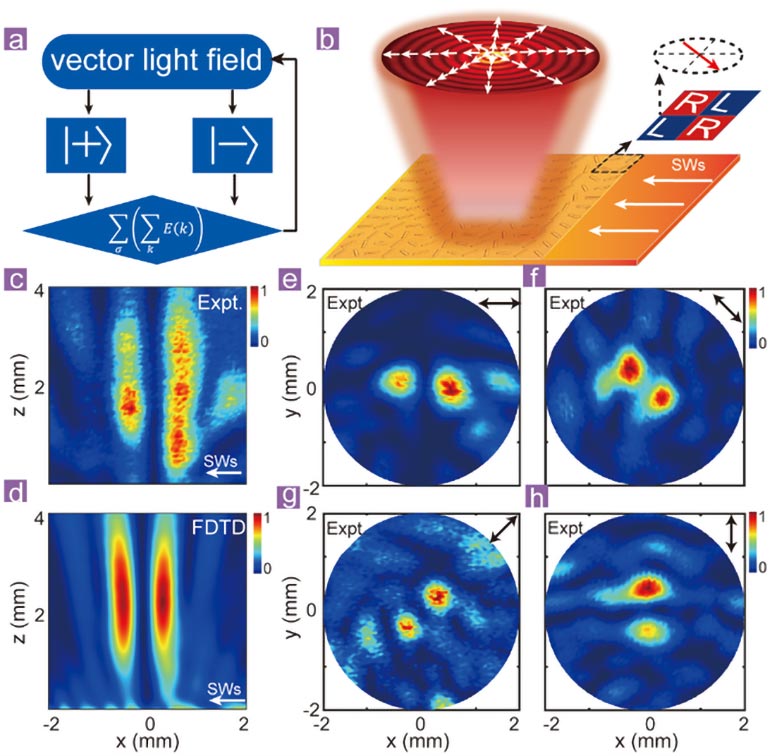
To achieve this concept, researchers have developed a universal design method that decomposes the target vector light field into a sum of different wave vectors and circular polarization basis vectors. Through the mapping relationship between the target total field and the artificial atoms, the design parameters of the composite metasurface are determined, ultimately completing the design of the prototype device (Fig. 2a).
For example, the researchers developed a terahertz device that generates a radially polarized Bessel beam under surface wave excitation. Using full-wave simulation and near-field scanning, the light field morphology was demonstrated in different planes and polarization directions, showing excellent agreement, thereby verifying the device’s outstanding performance (Fig. 2b-g). This research provides a new approach for achieving highly integrated on-chip terahertz devices, with broad application prospects in fields such as biosensing, high-speed communication, lidar, and augmented and virtual reality (AR/VR).
Reference: “Efficient generation of vectorial terahertz beams using surface-wave excited metasurfaces” by Zhuo Wang, Weikang Pan, Yu He, Zhiyan Zhu, Xiangyu Jin, Muhan Liu, Shaojie Ma, Qiong He, Shulin Sun and Lei Zhou, 15 January 2025, Opto-Electronic Science.
DOI: 10.29026/oes.2025.240024
Leave a Reply