
By Erin Woodward, SLAC National Accelerator Laboratory February 21, 2025
Collected at: https://scitechdaily.com/the-fastest-dance-in-the-universe-scientists-capture-electrons-in-perfect-sync/
By using ultrafast lasers, researchers have observed electrons moving in perfect sync inside particles smaller than a nanometer. This breakthrough unlocks new ways to manipulate light and electrons, paving the way for next-generation technology.
It may be the tiniest and fastest synchronized movement ever recorded.
According to a study in Science Advances, an international team of researchers observed electrons moving in perfect unison around a particle smaller than a nanometer. Using ultrafast light pulses, they excited the electrons and measured their motion with unprecedented precision — marking the first-ever measurement at the sub-nanometer scale.
Breaking the Nanometer Barrier
This synchronized electron motion, known as plasmonic resonance, allows light to be temporarily trapped. This phenomenon has numerous applications, from converting light into chemical energy to enhancing light-sensitive devices and even generating electricity from sunlight. While plasmonic resonance has been extensively studied in systems as small as 10 nanometers, this breakthrough shatters previous limits by measuring it at an even smaller scale.
“These findings demonstrate, for the first time, that attosecond measurements can provide valuable insights into plasmonic resonances at scales smaller than a nanometer.”
Shubhadeep Biswas, Lead author on the paper and a SLAC project scientist
The study was conducted by researchers from the Department of Energy’s SLAC National Accelerator Laboratory and Stanford University in collaboration with Ludwig-Maximilians-Universität München, University of Hamburg, DESY, Northwest Missouri State University, Politecnico di Milano, and the Max Planck Institute for the Structure and Dynamics of Matter.
Pushing the Limits of Light Control
Early studies have indicated that when plasmonic resonances unfold at incredibly small scales, new phenomena emerge, allowing light to be confined and controlled with unprecedented precision. This characteristic makes understanding exactly how resonances play out at small scales a very interesting topic for researchers.
To better understand plasmonic resonance, researchers first excite electrons around a particle, then wait for them to release their excess energy by emitting an electron. By timing that interval, scientists can determine whether true resonance – with all electrons moving in unison – has occurred, or if just one or two electrons were affected. However, these resonances happen at ultrafast timescales – mere attoseconds, or billionths of a billionth of a second. Observation of these resonances in real time was beyond the reach of existing technologies.
Harnessing Laser Technology
Fortunately, advances in laser technology have enabled researchers to measure electron movements with attosecond precision.
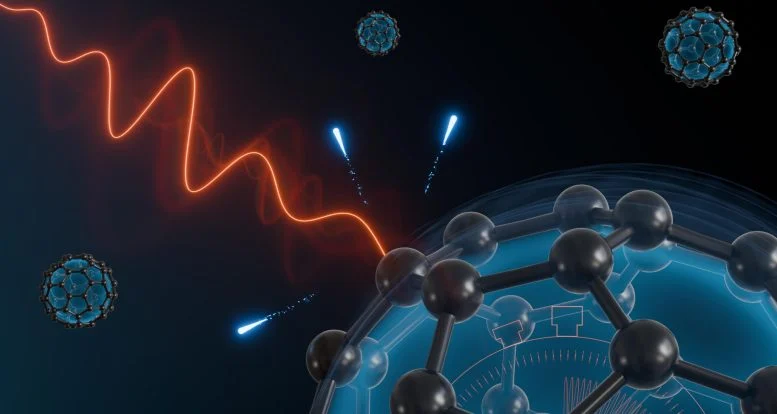
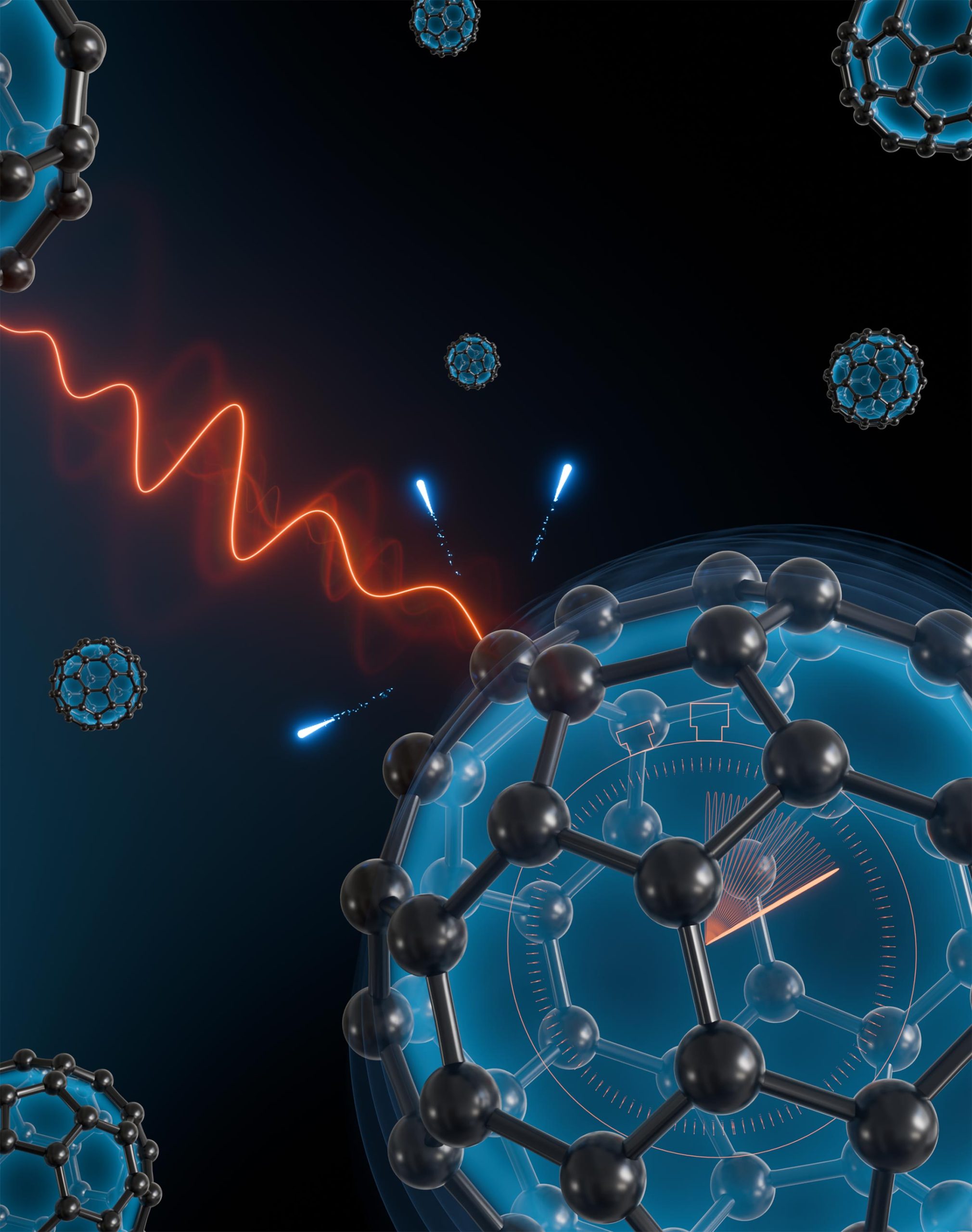
Using attosecond, extreme ultraviolet light pulses, the team triggered and recorded the behavior of electrons within soccer-ball-shaped carbon molecules, informally known as “buckyballs,” that measure just 0.7 nanometers in diameter. They precisely timed the process, from the instant light excited the electrons to the moment electrons were emitted, expelling excess energy and allowing the remaining electrons to relax into their usual orbits. Each cycle lasted between 50 to 300 attoseconds, and measurements indicated that the electrons were behaving with strong coherence, like disciplined dancers performing in unison.
“These findings demonstrate, for the first time, that attosecond measurements can provide valuable insights into plasmonic resonances at scales smaller than a nanometer,” said Shubhadeep Biswas, the lead author on the paper and a SLAC project scientist.
This breakthrough allows researchers to evaluate a new range of super-small particles, revealing plasmonic characteristics that could enhance the efficiency of existing technologies and lead to novel applications.
The Future of Ultrafast Electronics
“With this measurement, we are unlocking new insights into the interplay between electron coherence and light confinement at sub-nanometer scales,” said Matthias Kling, professor of photon science and applied physics at Stanford University and the director of the Science, Research and Development Division at SLAC’s Linac Coherent Light Source, a DOE Office of Science user facility. “This work demonstrates the power of attosecond techniques and opens the door to novel approaches in manipulating electrons in future ultrafast electronics, that could be operating at up to a million times higher frequencies than current technology.”
“This cutting-edge research is opening new avenues for the development of ultra-compact, high-performance platforms, where light-matter interactions can be controlled by taking advantage of quantum effects emerging at the nanoscale,” said Francesca Calegari, professor at the University of Hamburg, lead scientist at DESY.
Reference: “Correlation-driven attosecond photoemission delay in the plasmonic excitation of C60 fullerene” by Shubhadeep Biswas, Andrea Trabattoni, Philipp Rupp, Maia Magrakvelidze, Mohamed El-Amine Madjet, Umberto De Giovannini, Mattea C. Castrovilli, Mara Galli, Qingcao Liu, Erik P. Månsson, Johannes Schötz, Vincent Wanie, Pawel Wnuk, Lorenzo Colaizzi, Daniele Mocci, Maurizio Reduzzi, Matteo Lucchini, Mauro Nisoli, Angel Rubio, Himadri S. Chakraborty, Matthias F. Kling and Francesca Calegari, 12 February 2025, Science Advances.
DOI: 10.1126/sciadv.ads0494
This research at the Stanford PULSE Institute is part of the Ultrafast Chemical Sciences program supported by the DOE Office of Science.


Hello would you mind sharing which blog platform you’re using? I’m going to start my own blog in the near future but I’m having a tough time making a decision between BlogEngine/Wordpress/B2evolution and Drupal. The reason I ask is because your design seems different then most blogs and I’m looking for something unique. P.S Sorry for being off-topic but I had to ask!


Leave a Reply