
By University of Oxford February 21, 2025
Collected at: https://scitechdaily.com/dark-matters-secret-a-daring-experiment-seeks-the-elusive-axion/
Scientists are hunting for axions, tiny particles that could solve major physics mysteries, including why neutrons don’t have an electric dipole moment and what dark matter is made of.
Using the powerful European XFEL in Hamburg, researchers fired X-rays through special crystals, hoping to witness axions converting into light—a sign of their existence. This pioneering experiment, already competitive with major particle accelerator studies, demonstrates that XFEL technology could be a game-changer in particle physics.
Searching for the Universe’s Missing Matter
Scientists from the University of Oxford, in collaboration with the UK Science and Technology Facilities Council (STFC) and other research institutions, have released new findings from their search for a hypothetical particle that could help explain dark matter. Their experiment, conducted at the European X-ray Free Electron Laser (European XFEL) in Hamburg, is detailed in a recent study published in Physical Review Letters.
The researchers are searching for axions, a theoretical particle proposed to resolve a major puzzle in physics: why neutrons, despite being made of charged quarks, do not have an electric dipole moment. Scientists believe that axions, which are extremely small and nearly massless, could “cancel out” this imbalance. If detected, axions would provide evidence of physics beyond the Standard Model.
Beyond this, axions are also considered a strong candidate for dark matter — the invisible substance that makes up most of the Universe’s mass and structure.
Harnessing the World’s Most Powerful X-Ray Laser
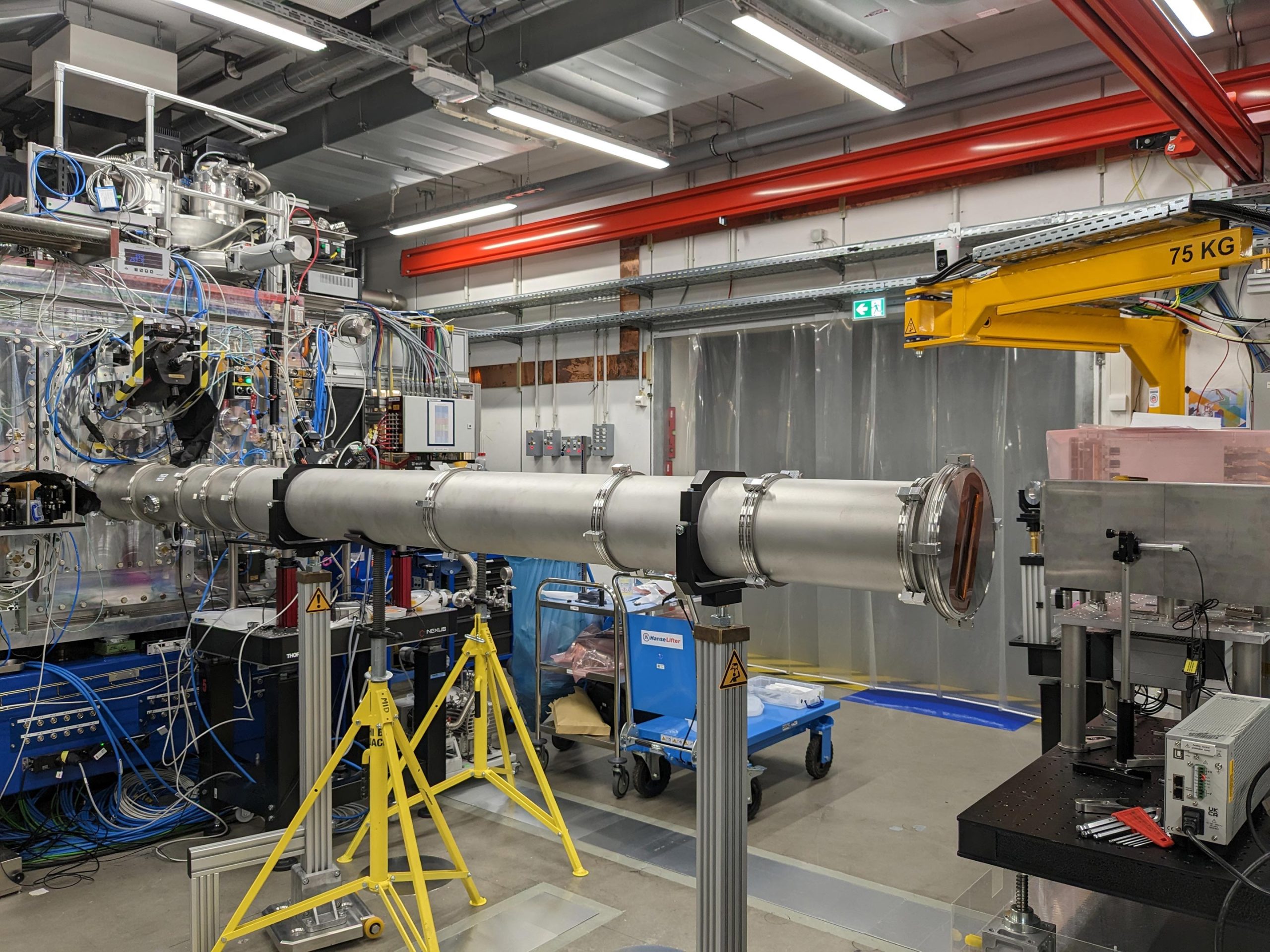
To conduct their search, the team used the world’s most powerful X-ray laser, the European XFEL, located in Schenefeld near Hamburg, Germany. This cutting-edge facility features a 3.4-kilometer-long tunnel with a superconducting linear accelerator and photon beamlines, capable of producing ultrashort X-ray flashes at an astonishing rate of 27,000 per second.
These are directed through thin slabs of precisely oriented germanium crystals, which have an intense internal electric field. To moving particles, the electric field appears as a strong magnetic field (~103 Tesla), enabling photons to convert into axions, and back again.
A ‘Light-Shining-Through-Walls’ Breakthrough
An opaque titanium sheet inserted between the crystals acts as a barrier to photons, allowing only the axions being searched for to pass through. These are then detected when they convert back into photons in the crystal on the other side – known as the ‘light-shining-through-walls’ technique.
In this proof-of-principle study, the researchers demonstrated that their setup has sensitivity to axions that is already competitive with other experiments using particle accelerators. It paves the way for future experiments in which researchers will focus on axions in the milli- to kilo-electron volt mass range. They aim to improve the sensitivity by a factor of several hundred so as to be able to detect axions with properties predicted by the theory of Quantum Chromodynamics.
A Collaborative Effort in Cutting-Edge Physics
Lead author Dr. Jack Halliday, an experimental plasma physicist at STFC, says, “This experiment underscores the versatility of XFEL technology in addressing some of the most challenging questions in fundamental physics and pushing the boundaries of our understanding of the universe.”
Principal Investigator Professor Gianluca Gregori says, “This study is the culmination of a long-standing collaboration in the Department of Physics at Oxford between myself (Atomic and Laser Physics), Professor Subir Sarkar (Theoretical Physics), and the late Professor Ian Shipsey (Particle Physics). This experiment required a difficult interpretation of a non-standard measurement, and it was thanks to the wide expertise brought together by such a team that we were able to address it successfully.”
Reference: “Bounds on Heavy Axions with an X-Ray Free Electron Laser” by Jack W. D. Halliday, Giacomo Marocco, Konstantin A. Beyer, Charles Heaton, Motoaki Nakatsutsumi, Thomas R. Preston, Charles D. Arrowsmith, Carsten Baehtz, Sebastian Goede, Oliver Humphries, Alejandro Laso Garcia, Richard Plackett, Pontus Svensson, Georgios Vacalis, Justin Wark, Daniel Wood, Ulf Zastrau, Robert Bingham, Ian Shipsey, Subir Sarkar and Gianluca Gregori, 6 February 2025, Physical Review Letters.
DOI: 10.1103/PhysRevLett.134.055001
Leave a Reply