
Tanya Weaver Thu 20 Feb 2025
Collected at: https://eandt.theiet.org/2025/02/20/microsoft-launches-new-chip-offers-breakthrough-quantum-computing
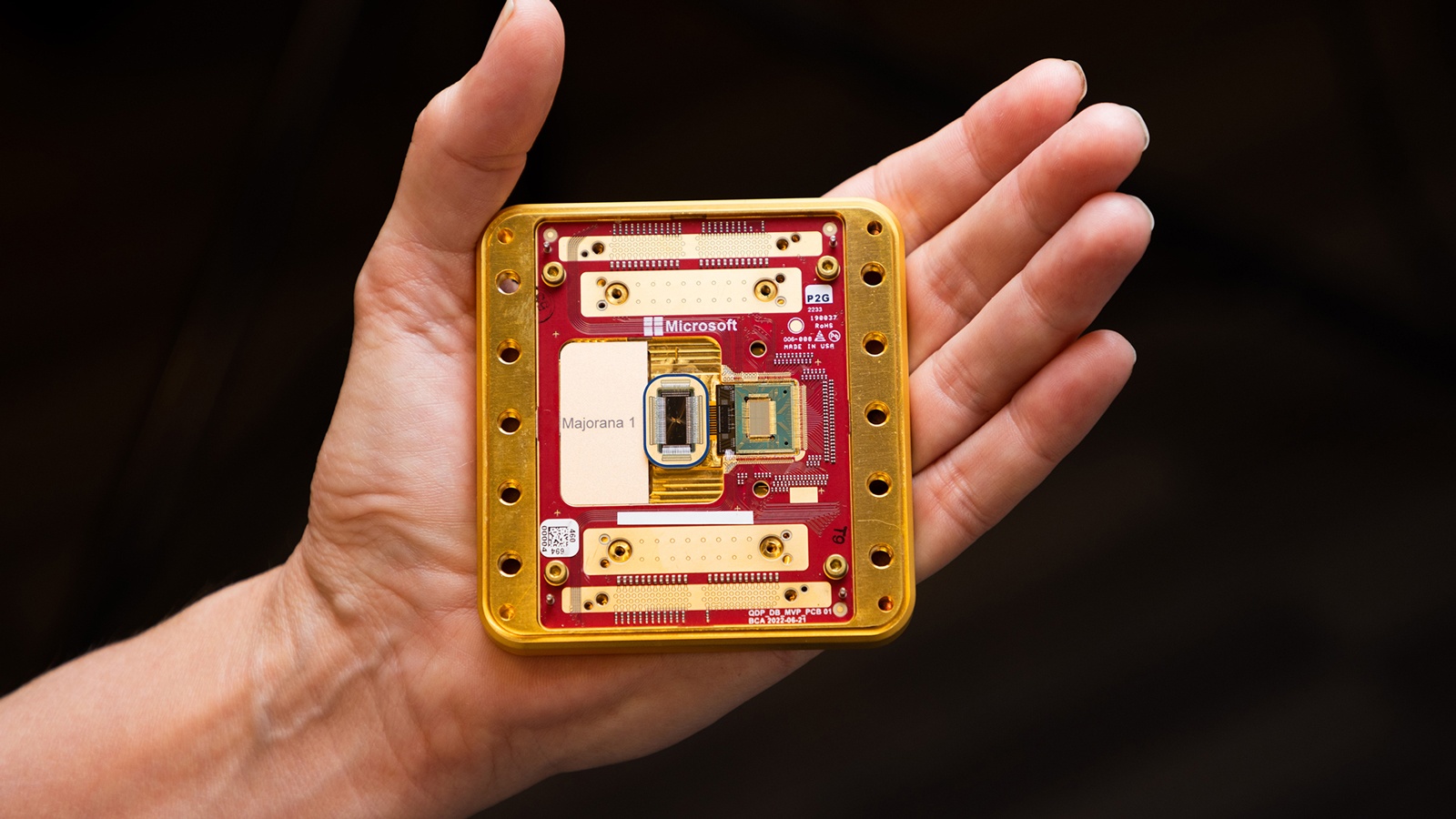
Microsoft claims its new Majorana 1 chip shows that quantum computers capable of solving meaningful, industrial-scale problems are just years away, not decades.
Quantum computing is heralded as the next frontier of computing technology. While it is still in its infancy, scientists believe that with its ability to solve problems that are unsolvable on classic computers, the technology could help power innovation in a range of fields, from drug discovery and smarter encryption software to manufacturing and AI.
The race to develop quantum computing chips is on. IBM launched the IBM Heron quantum chip over a year ago, and in December 2024 Google launched its 105-qubit Willow quantum chip that it claims demonstrates “state-of-the-art performance across a number of metrics”.
The biggest challenge with quantum computers is that qubits, the fundamental building blocks of quantum computing, are incredibly fast, but also extremely difficult to control and sensitive to system imperfections. As such, they are prone to errors.
Microsoft’s ‘breakthrough’ is to leverage what it calls the world’s first topoconductor, a superconducting nanowire that can observe and control Majorana particles to produce more reliable and scalable qubits.
The Majorana 1 chip has far fewer qubits than rival chips from Google and IBM, but Microsoft claims that far fewer of its Majorana-based qubits will be needed to make useful computers because the error rates are lower.
Chetan Nayak, Microsoft technical fellow, said: “We took a step back and said, ‘OK, let’s invent the transistor for the quantum age. What properties does it need to have?’
“And that’s really how we got here – it’s the particular combination, the quality and the important details in our new materials stack that have enabled a new kind of qubit and ultimately our entire architecture.”
Microsoft did not give a timeline for when the chip would be scaled up to create quantum computers, but in a blog post on the company’s website it claims the developments would shake up conventional thinking about the future of quantum computers.
Nayak said: ”Many people have said that quantum computing, that is to say useful quantum computers, is decades away. I think that this brings us into years rather than decades.”
In an interview with Reuters, Jason Zander, Microsoft’s executive vice president, said: “The hardest part has been solving the physics. There is no textbook for this, and we had to invent it. We literally have invented the ability to go create this thing, atom by atom, layer by layer.”
Microsoft is to publish a scientific paper in the academic journal Nature. While Microsoft has published intermediate results in this paper, it has not published the proof of the existence of topological qubits.
The announcement has caused ripples among the science and research communities. While some are critical of Microsoft’s choice to publicly announce the creation of a qubit without releasing detailed evidence, others think it is cause to be optimistic.
Georgios Katsaros, a physicist at the Institute of Science and Technology Austria in Klosterneuburg, told Nature: “Without seeing the extra data from the qubit operation, there is not much one can comment.”
Paul Stevenson, a professor of physics at the University of Surrey, said Microsoft could be “very serious competitors” in the quantum computing race, but there are challenges ahead. He told The Guardian: “The new papers are a significant step, but as with much promising work in quantum computing, the next steps are difficult. Until the next steps have been achieved, it is too soon to be anything more than cautiously optimistic.”
Meanwhile Chris Heunen, professor of quantum programming at the University of Edinburgh, told the BBC he felt Microsoft’s plans were “credible”.
“This is promising progress after more than a decade of challenges, and the next few years will see whether this exciting roadmap pans out,” he said.
The September/October 2024 issue of E+T features an article on quantum computing that explores how far away quantum computers are from achieving their potential.
Leave a Reply