

February 13, 2025 by Jeff Shepard
Collected at: https://www.eeworldonline.com/what-is-the-mathematics-behind-artificial-intelligence/
The mathematics behind artificial intelligence (AI) and machine learning (ML) rely on linear algebra, calculus, probability, and statistics. These provide the foundation for developing the needed models and algorithms, which process data, learn patterns, and optimize predictions.
In some regards, AI and ML are extensions of data science. They use similar math tools, but the relative importance of specific tools varies between the disciplines (Figure 1).

AI and ML use linear equations, vectors, and matrices to transform and analyze data and efficiently arrive at estimated solutions. Linear algebra is a key tool in neural networks. Some common linear algebra tools include covariance matrices and general matrix operations.
Matrix manipulation, plus eigenvectors and eigenvalues from linear algebra, support principle component analysis (PCA), which reduces the dimensionality of data sets and makes them more manageable.
PCA is based on singular value decomposition, which uses combinations of linear rotation and scaling transformations to break down matrixes into a product or three simpler matrices. Linear regression analysis combines concepts from linear algebra and probability.
Optimization and imperfect data
Calculus, probability, and statistics are key tools for optimization and dealing with imperfect data inputs in AI/ML models. Multivariate calculus can be especially useful for identifying local optimums. For example, gradient descent is an iterative process that can train models by minimizing errors between predicted and actual values.
Probability and statistics tools are essential. Noise and imperfect data sources are common challenges when developing AI/ML models. One tool is Bayesian networks. They handle noise by incorporating probabilistic relationships between variables, allowing them to model uncertainty and make inferences even when using noisy data.
Understanding the probability distributions of the data is crucial for modeling results. This knowledge can be incorporated into supervised and unsupervised learning algorithms using techniques like decision trees, which enable developers to analyze different options and determine the best approach based on various factors and probabilities (Figure 2).
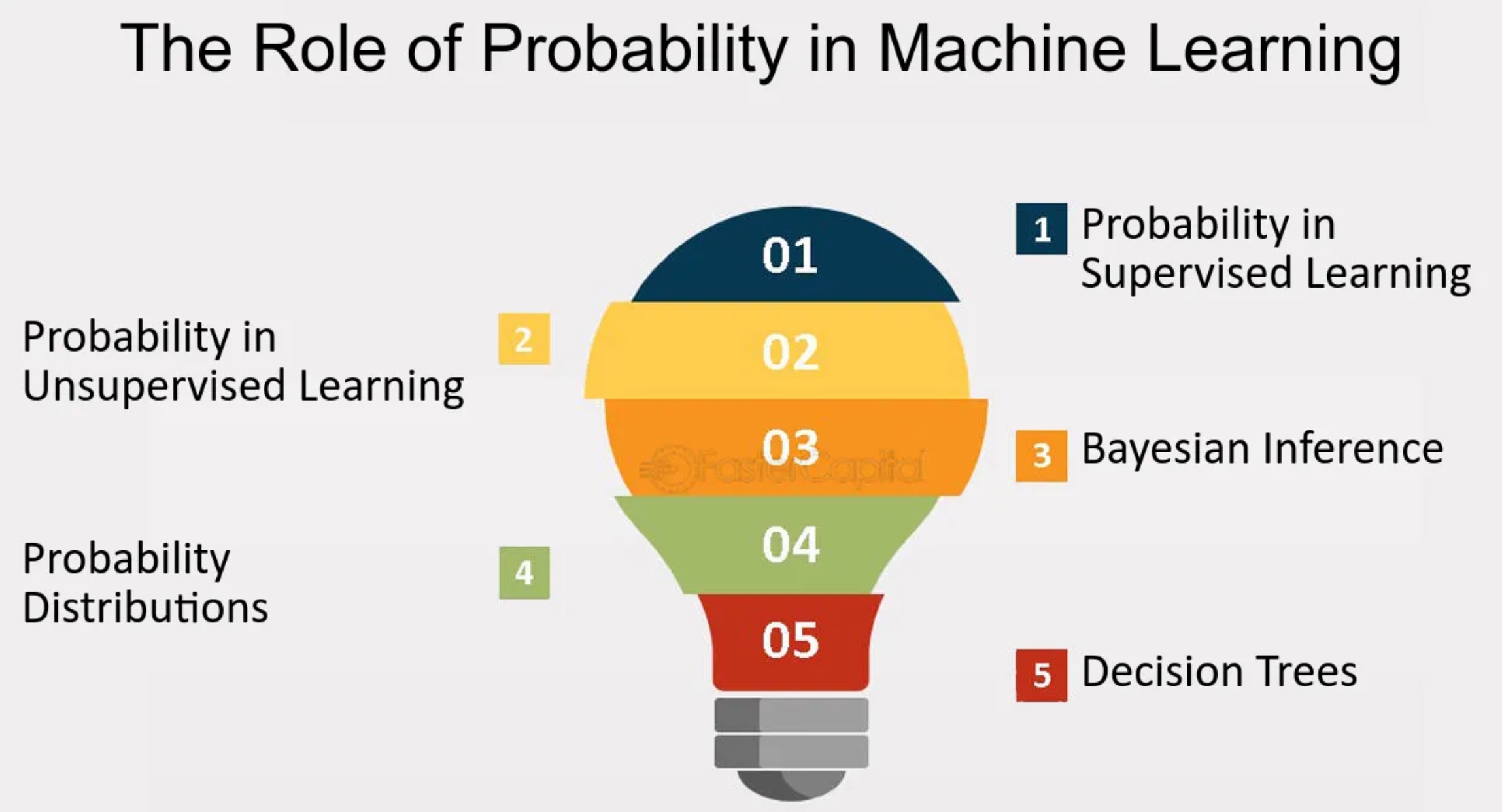
Statistical techniques, such as Bayesian analysis, hidden Markov Models (HMMs), and Gaussian Mixture Models (GMMs), are used in applications that involve uncertainty and variability, such as speech and natural language processing and image recognition.
In addition to Bayesian analysis, HMMs and GMMs, maximum likelihood estimators are commonly used in training algorithms to improve model accuracy.
Correlation analysis and PCA are among the tools used to isolate the most relevant features. This can reduce model complexity and improve efficiency without compromising performance. Confidence intervals, cross-validation, and hypothesis testing are also used for model validation.
Graph theory and discrete math
Graph theory and discrete math are also used to develop and implement AI/ML algorithms.
Graph theory is powerful for algorithms like convolutional neural networks (CNNs) and recurrent neural networks (RNNs). In graph theory, information and its connections are described as vertices (also called points or nodes) and edges (links or lines), respectively. Graph theory is used in computer vision, pattern recognition, and natural language processing algorithms.
Discrete math deals with non-continuous numbers like integers. It’s often used in scheduling algorithms. For example, scheduling a fraction of an aircraft to fly to a destination is impossible. It also relates to NNs since they have a discrete number of nodes and links, and no fractional nodes are used.
Summary
This article has provided a brief overview of some of the important math concepts behind AI and ML. Regardless of the specific tools used for model development, optimization relies on various probabilistic and statistical tools. Absolute answers are generally impossible, and the goal is usually to optimize the likelihood that the derived answer is sufficiently close to the real answer.
Leave a Reply