
February 10, 2025 by University of Glasgow
Collected at: https://techxplore.com/news/2025-02-recyclable-artificial-vision-honey-electrolyte.html
A new form of energy-efficient artificial vision system inspired by the human brain and made in part using honey could help reduce the impact of electronic waste.
Engineers from the University of Glasgow partnered with researchers from São Paulo State University (UNESP) and Hong Kong Metropolitan University to develop the system, which uses organic, biodegradable and recyclable parts to ‘see’ and ‘remember’ colors while drawing a tiny amount of power.
The team’s system, known as an Electrolyte-Gated Organic Field-Effect Transistor (EGOFET), combines three crucial functions—sensing light, processing the information, and storing it in memory—all in a single unit capable of mimicking the human visual system. Even when powered off, it can retain stored information, a property known as non-volatility.
In the future, this could make it particularly efficient for real-world applications where fast processing of visual information is required, like autonomous aerial vehicles or smart security systems.
The team’s EGOFET improves on some aspects of the performance of previous attempts to build artificial vision systems using silicon-based CMOS sensors, which require significant computing and energy resources.
Theodoros Serghiou of the University of Glasgow’s James Watt School of Engineering led the development of the EGOFET. He said, “In conventional computing, there’s an inherent latency from having to fetch and transfer data in CMOS-based systems due to the physical separation between the processing and memory units.
“Our new memory-based device, however, performs these functions simultaneously in-memory, similar to how synapses in the human brain work, helping to overcome the bottlenecks of conventional systems.
“Our device’s ultra-low power consumption and sustainable materials could pave the way for eco-friendly, scalable artificial vision systems in the years to come.”
The team’s paper, titled “Sustainable and Tunable Synaptic Electrolyte-Gated Organic Field-Effect Transistors (EGOFETs) for Light Adaptive Visual Perceptive Systems,” is published in Advanced Functional Materials.
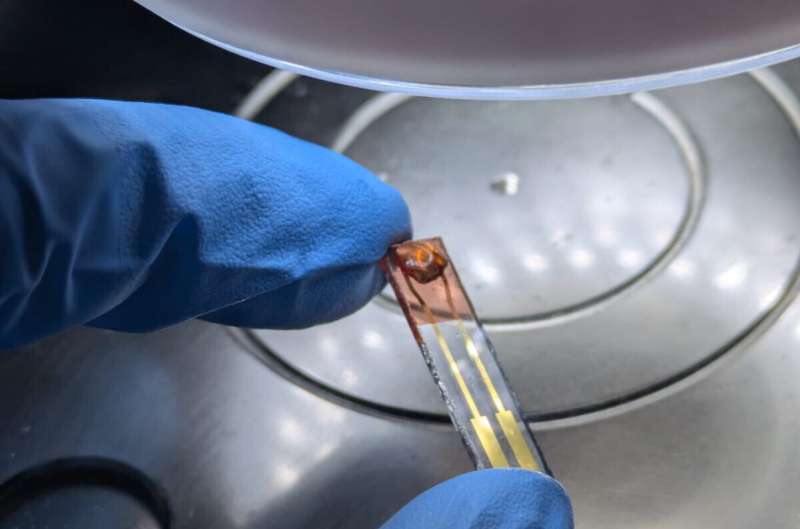
In the paper, the team describe how they built their prototype EGOFET on a glass substrate using gold electrodes, a layer of organic, photosensitive perylene, and a layer of honey to act as an electrolyte.
The system acts as a photodetector, producing ‘spikes’ of current which vary in response to different wavelengths and intensities of light, allowing the programming of memory states which can be remembered by the system even when it is switched off.
The EGOFET achieves some of the highest performances measured to date, requiring only 2.4 picojoules of energy per spiking event—making it one of the most energy-efficient devices of its kind. Conventional CMOS imaging systems often require millions of times more power due to their clock-driven response.
The James Watt School of Engineering’s Professor Jeff Kettle is the paper’s corresponding author. He said, “Our device is able to emulate key synaptic behaviors such as short-term and long-term plasticity, spike-time dependent plasticity and paired-pulse facilitation with high fidelity.
“The implications of this research, which brings together experts from around the globe, extend beyond artificial vision to broader applications in sustainable neuromorphic computing, image processing and energy-efficient bio-inspired electronics.
“We plan to scale this single-device prototype into arrays for enhanced image recognition capabilities, which could provide enhanced performance for artificial vision systems before being more sustainably disposed of at the end of their lifecycle.”
Once the device’s useful lifespan is complete, the team expect that the glass and gold elements could be recycled and reused, while the organic elements could simply be left to biodegrade naturally.
More information: Theodoros Serghiou et al, Sustainable and Tunable Synaptic Electrolyte‐Gated Organic Field‐Effect Transistors (EGOFETs) for Light Adaptive Visual Perceptive Systems, Advanced Functional Materials (2025). DOI: 10.1002/adfm.202417355
Journal information: Advanced Functional Materials


Leave a Reply