

By University of Göttingen February 4, 2025
Collected at: https://scitechdaily.com/unlocking-the-secret-world-of-dark-excitons-for-next-gen-energy/
Scientists have unlocked the secret world of dark excitons — tiny energy carriers crucial for the future of solar power and LEDs.
Using an advanced microscopy technique, researchers have mapped their formation in unprecedented detail, opening new doors for improving energy efficiency in cutting-edge materials.
Tracking Invisible Energy Carriers in Next-Gen Technology
How can advanced technologies like solar cells be made more efficient? A research team led by the University of Göttingen has taken a major step toward answering this question with a groundbreaking technique.
For the first time, scientists can precisely track the movement of dark excitons — tiny, elusive energy carriers — in both time and space. These previously undetectable particles could play a crucial role in the future development of solar cells, LEDs, and sensors. The team’s findings were published in Nature Photonics.
What Are Dark Excitons and Why Do They Matter?
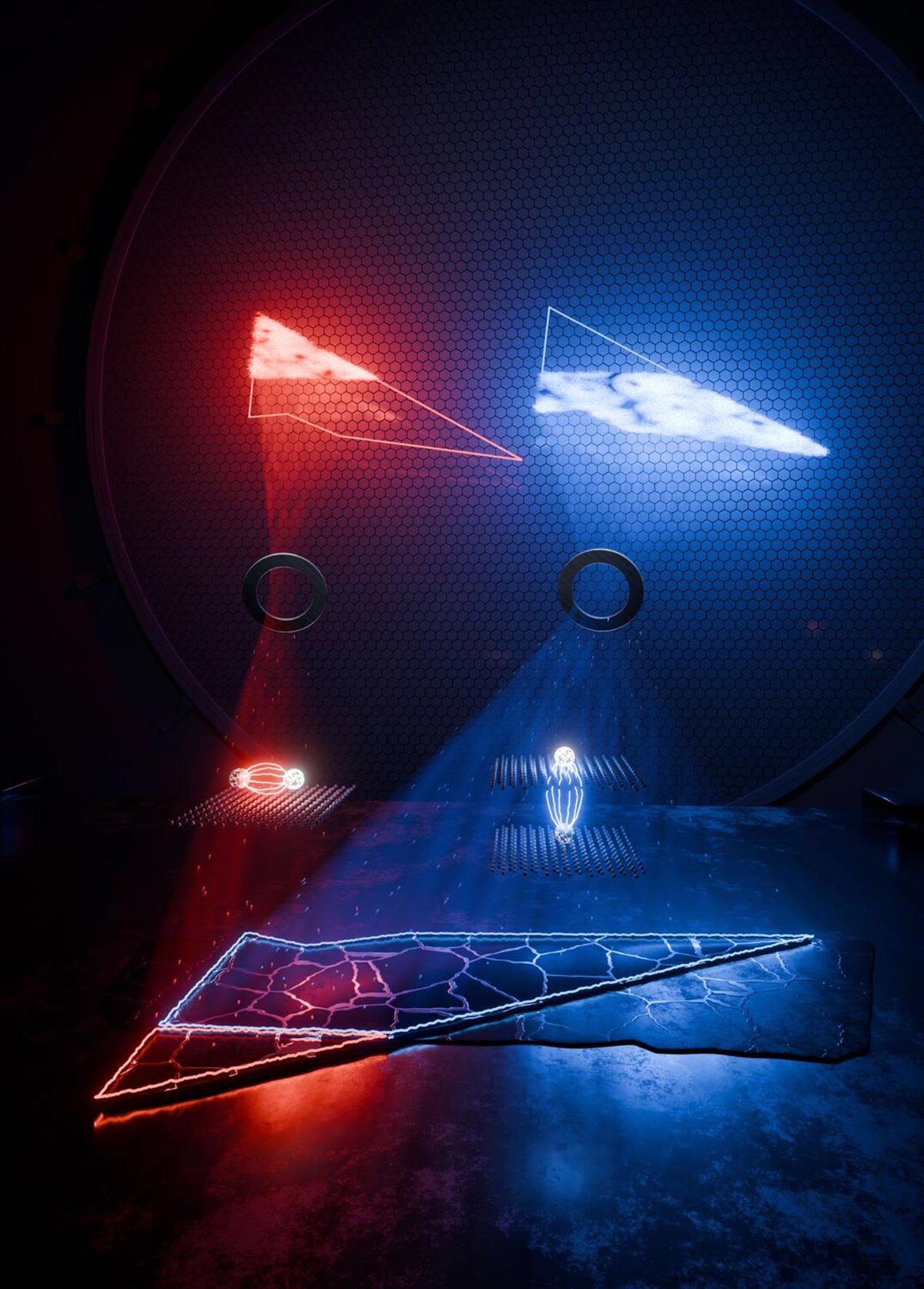
Dark excitons are formed when an electron is excited and leaves behind a “hole,” creating a bound pair that carries energy but does not emit light — hence the term “dark.” A useful way to visualize this is to imagine a balloon (the electron) drifting away, leaving an empty space (the hole) to which it remains tethered by an invisible force called Coulomb interaction.
While these particle states are difficult to detect, they are particularly significant in ultra-thin, two-dimensional semiconductor materials. Understanding their behavior could pave the way for major advancements in energy-efficient technology.
A Breakthrough in Understanding Dark Excitons
In an earlier publication, the research group led by Professor Stefan Mathias from the Faculty of Physics at the University of Göttingen was able to show how these dark excitons are created in an unimaginably short time and describe their dynamics with the help of quantum mechanical theory.
In the current study, the team has now developed a new technique known as “Ultrafast Dark-field Momentum Microscopy,” and used it for the first time. This enabled them to show how dark excitons are formed in a special material made of tungsten diselenide (WSe₂) and molybdenum disulfide (MoS₂) – and in an astonishing time, lasting just 55 femtoseconds (0.000000000000055 seconds) measured with a precise resolution of 480 nanometres (0.00000048 meters).
Revolutionizing Solar Cells and Material Science
“This method enabled us to measure the dynamics of charge carriers very precisely,” explains first author Dr. David Schmitt, also from Göttingen University’s Faculty of Physics. “The results provide a fundamental insight into how the properties of the sample influence the movement of the charge carriers. This means that this technique can be used in the future to specifically improve the quality and therefore also the efficiency of solar cells, for example.”
Dr. Marcel Reutzel, Junior Research Group Leader in Mathias’ research group, adds: “This means that this technique can be used not only for these specially designed systems, but also for research into new types of materials.”
Reference: “Ultrafast nano-imaging of dark excitons” by David Schmitt, Jan Philipp Bange, Wiebke Bennecke, Giuseppe Meneghini, AbdulAziz AlMutairi, Marco Merboldt, Jonas Pöhls, Kenji Watanabe, Takashi Taniguchi, Sabine Steil, Daniel Steil, R. Thomas Weitz, Stephan Hofmann, Samuel Brem, G. S. Matthijs Jansen, Ermin Malic, Stefan Mathias and Marcel Reutzel, 3 January 2025, Nature Photonics.
DOI: 10.1038/s41566-024-01568-y
The research was supported by the DFG-funded Collaborative Research Centres “Control of Energy Conversion on Atomic Scales” and “Mathematics of Experimentation” in Göttingen and the Collaborative Research Centre “Structure and Dynamics of Inner Interfaces” in Marburg.
Leave a Reply