
February 6, 2025 by Tohoku University
Collected at: https://phys.org/news/2025-02-advance-opto-magnetic-technology-torque.html
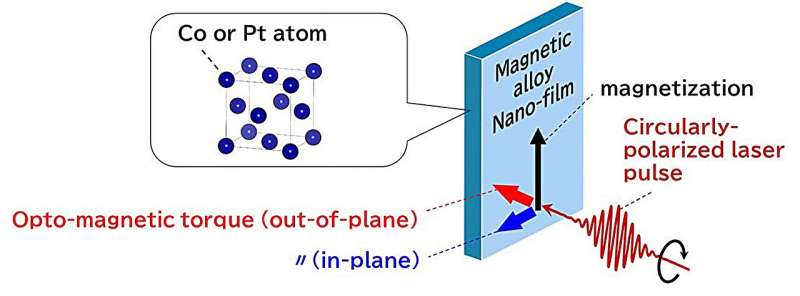
Researchers at Tohoku University have achieved a significant advancement in opto-magnetic technology, observing an opto-magnetic torque approximately five times more efficient than in conventional magnets. This breakthrough, led by Koki Nukui, Assistant Professor Satoshi Iihama, and Professor Shigemi Mizukami, has far-reaching implications for the development of light-based spin memory and storage technologies.
Opto-magnetic torque is a method which can generate force on magnets. This can be used to change the direction of magnets by light more efficiently. By creating alloy nanofilms with up to 70% platinum dissolved in cobalt, the team discovered that the unique relativistic quantum mechanical effects of platinum significantly boost the magnetic torque.
The study revealed that the enhancement of opto-magnetic torque was attributed to the electron orbital angular momentum generated by circularly polarized light and relativistic quantum mechanical effects. The findings are published in Physical Review Letters.
This achievement allows for the same opto-magnetic effect to be produced with only one-fifth of the previous light intensity, paving the way for more energy-efficient opto-magnetic devices.

The findings not only provide new insights into the physics of electron orbital angular momentum in metallic magnetic materials but also contribute to the development of high-efficiency spin memory and storage technologies that use light to write information.
“These improvements could result in faster and more energy-efficient devices in the future,” explains Mizukami.
The research aligns with the growing interest in opto-electronic fusion technologies, combining electronic and optical technologies for next-generation applications. This discovery marks a significant step forward in controlling nanomagnetic materials using light and magnetism.
More information: Koki Nukui et al, Light-Induced Torque in Ferromagnetic Metals via Orbital Angular Momentum Generated by Photon Helicity, Physical Review Letters (2025). DOI: 10.1103/PhysRevLett.134.016701. On arXiv: DOI: 10.48550/arxiv.2405.07405
Journal information: Physical Review Letters , arXiv
Leave a Reply