
By University of Warwick January 30, 2025
Collected at: https://scitechdaily.com/astronomers-stunned-by-wasp-132s-bizarre-planetary-system/
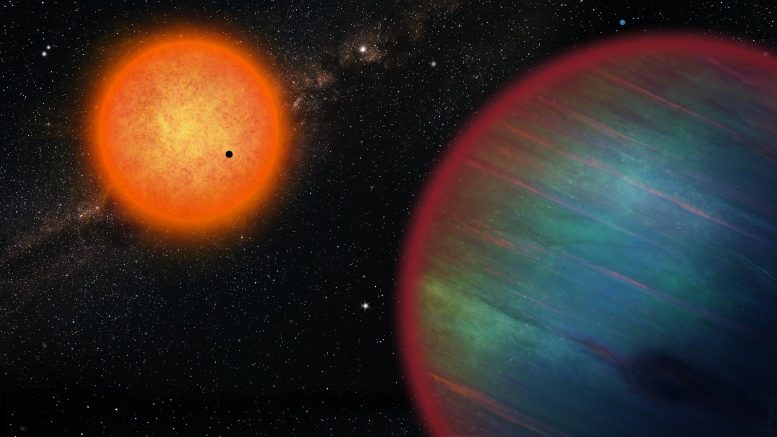
Astronomers have made a groundbreaking discovery in the WASP-132 system, finding two new planets that defy previous understandings of planetary systems.
This includes a super-Earth close to a hot Jupiter and a distant icy giant, challenging the lone orbit theory of hot Jupiters and suggesting a complex, multi-planetary dynamic.
Discovery of New Planetary Systems
Astronomers from the University of Warwick and the University of Geneva (UNIGE) have discovered two new planets beyond our solar system, challenging current scientific theories about how planetary systems form.
These two exoplanets — an inner super-Earth and an outer icy giant — are located in the WASP-132 system and are reshaping our understanding of how ‘hot Jupiter’ planetary systems develop and evolve.
Hot Jupiters are massive planets, similar in size to Jupiter, but they orbit their stars much closer than Mercury orbits the Sun. Since there isn’t enough gas and dust in these close regions for such large planets to form, scientists have long believed that hot Jupiters originate farther from their star and gradually migrate inward over time.
Dynamics of Planetary Migration
Until now, it was widely thought that hot Jupiters exist alone in their systems, as their inward migration would push out any nearby planets. However, the discovery of two additional planets in the WASP-132 system challenges this idea and suggests a more complex planetary evolution than previously assumed.
David Armstrong, Associate Professor of Physics, The University of Warwick said, “The detection of the inner super-Earth was exciting as it’s particularly rare to find planets interior to hot Jupiters. We carried out an intensive campaign with state-of-the-art instruments to characterize its mass, density, and composition, revealing a planet with a density similar to that of the Earth.”
Implications for Planetary Formation Theories
This planetary discovery adds a layer of complexity to the WASP-132 system as migration of a hot Jupiter towards its star through dynamical perturbation would destabilize the orbits of the other two planets. This suggests a more stable ‘cool’ migration path for the hot Jupiter in a proto-planetary disc that surrounds a young star and is the site of planet formation.
“The WASP-132 system is a remarkable laboratory for studying the formation and evolution of multi-planetary systems. The discovery of a hot Jupiter alongside an inner super-Earth and a distant giant calls into question our understanding of the formation and evolution of these systems. This is the first time we have observed such a configuration,” says François Bouchy, Associate Professor, Department of Astronomy, UNIGE Faculty of Science.
Detailed Observations and Future Research
The hot Jupiter orbits its star in seven days and three hours; the super-Earth (a rocky planet six times the mass of the Earth) orbits the star in just 24 hours and 17 minutes; and the icy giant (five times the mass of Jupiter) orbits the host star in five years. The precise measurements of radius and mass have also made it possible to determine the density and internal composition of the planets. The super-Earth composition is dominated by metals and silicates, similar to that of Earth.
Observations of WASP-132 continue, with the ESA’s Gaia satellite measuring minute variations in the positions of stars since 2014, with a view to revealing their planetary companions and outer brown dwarfs.
Reference: “Discovery of a cold giant planet and mass measurement of a hot super-Earth in the multi-planetary system WASP-132” by Nolan Grieves, François Bouchy, David J. Armstrong, Babatunde Akinsanmi, Angelica Psaridi, Solène Ulmer-Moll, Yolanda G. C. Frensch, Ravit Helled, Simon Müller, Henrik Knierim, Nuno C. Santos, Vardan Adibekyan, Léna Parc, Monika Lendl, Matthew P. Battley, Nicolas Unger, Guillaume Chaverot, Daniel Bayliss, Xavier Dumusque, Faith Hawthorn, Pedro Figueira, Marcelo Aron Fetzner Keniger, Jorge Lillo-Box, Louise Dyregaard Nielsen, Ares Osborn, Sérgio G. Sousa, Paul Strøm and Stéphane Udry, 15 January 2025, Astronomy & Astrophysics.
DOI: 10.1051/0004-6361/202348177
Leave a Reply