
By NASA January 31, 2025
Collected at: https://scitechdaily.com/from-earth-to-mars-in-two-years-nasas-nuclear-solution/
NASA is working on a groundbreaking nuclear electric propulsion system that could dramatically speed up trips to Mars.
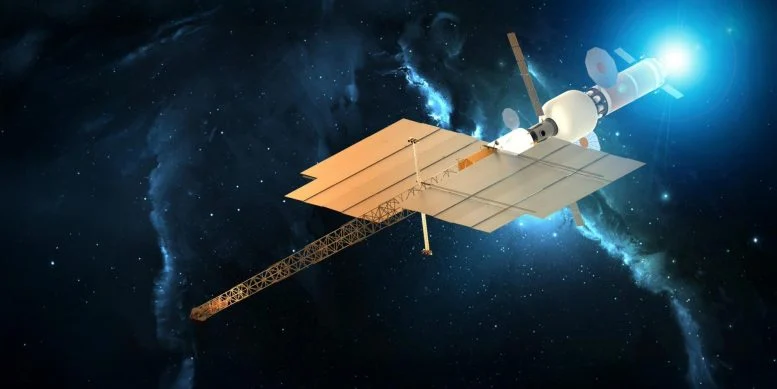
The MARVL project aims to revolutionize space travel by breaking down massive radiator systems into smaller, robotically assembled components in space. This approach offers flexibility, eliminates payload constraints, and introduces a whole new way of designing spacecraft.
Exploring Nuclear Electric Propulsion
Traveling to Mars and back is a daunting challenge, requiring far more than just days, weeks, or even months. However, emerging technologies could make the round-trip journey possible in about two years.
One promising solution NASA is investigating is nuclear electric propulsion (NEP). This technology uses a nuclear reactor to generate electricity, which then ionizes — meaning positively charges — and accelerates gaseous propellants to create thrust for the spacecraft.
A Step Closer to Reality with MARVL
At NASA’s Langley Research Center in Hampton, Virginia, researchers are developing a system that could bring nuclear electric propulsion a major step closer to practical use.
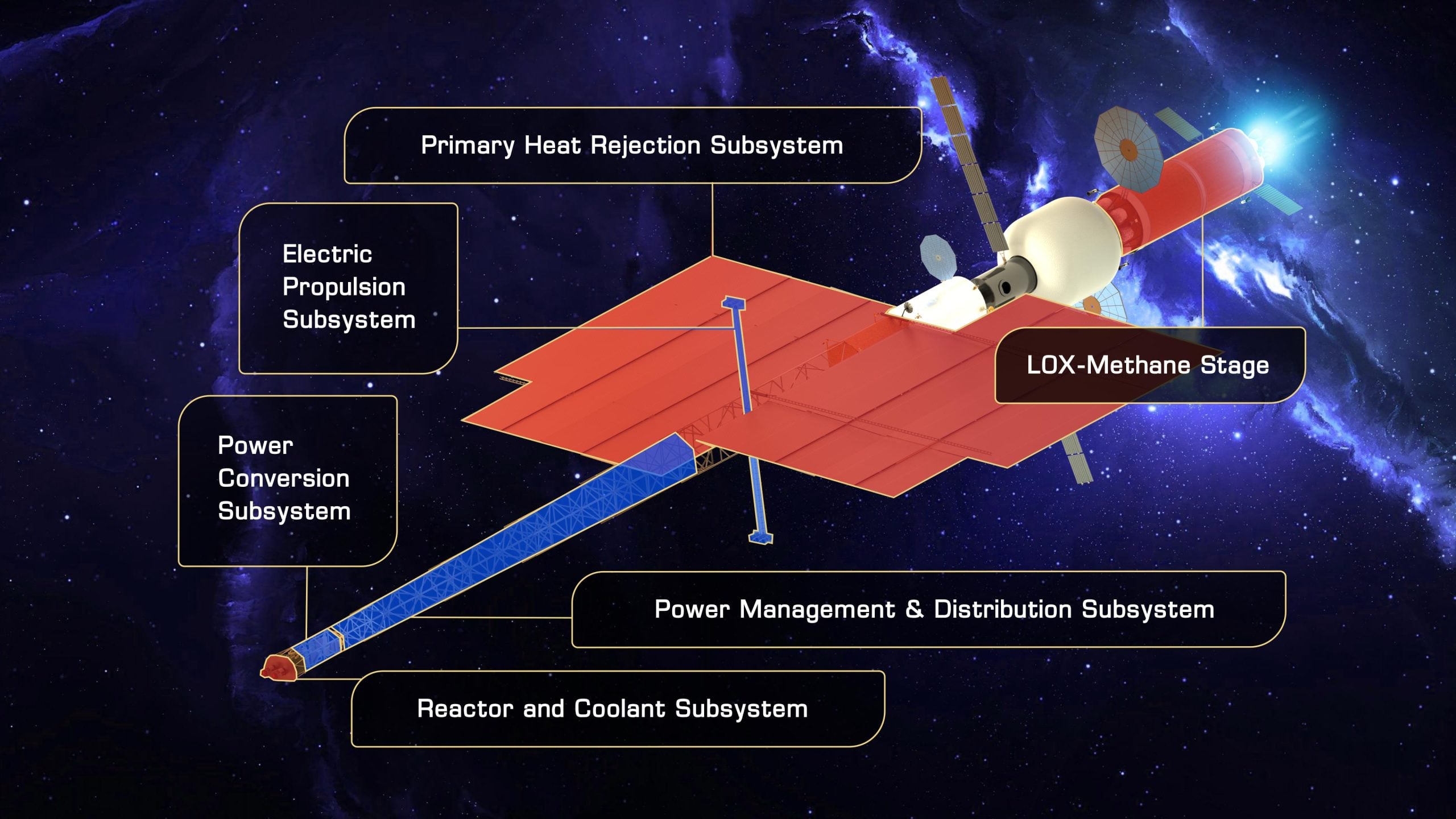
Their project, called Modular Assembled Radiators for Nuclear Electric Propulsion Vehicles (MARVL), focuses on a key challenge of NEP — heat dissipation. Instead of relying on a single, large radiator system, MARVL divides it into smaller, modular components that can be autonomously assembled in space by robotic systems.
“By doing that, we eliminate trying to fit the whole system into one rocket fairing,” said Amanda Stark, a heat transfer engineer at NASA Langley and the principal investigator for MARVL. “In turn, that allows us to loosen up the design a little bit and really optimize it.”
Loosening up the design is key, because as Stark mentioned, previous ideas called for fitting the entire nuclear electric radiator system under a rocket fairing, or nose cone, which covers and protects a payload. Fully deployed, the heat-dissipating radiator array would be roughly the size of a football field. You can imagine the challenge engineers would face in getting such a massive system folded up neatly inside the tip of a rocket.
Revolutionizing In-Space Assembly
The MARVL technology opens a world of possibilities. Rather than cram the whole system into an existing rocket, this would allow researchers the flexibility to send pieces of the system to space in whatever way would make the most sense, then have it all assembled off the planet.
Once in space, robots would connect the nuclear electric propulsion system’s radiator panels, through which a liquid metal coolant, such as a sodium-potassium alloy, would flow.
While this is still an engineering challenge, it is exactly the kind of engineering challenge in-space-assembly experts at NASA Langley have been working on for decades. The MARVL technology could mark a significant first milestone. Rather than being an add-on to an existing technology, the in-space assembly component will benefit and influence the design of the very spacecraft it would serve.
A New Mindset for Space Missions
“Existing vehicles have not previously considered in-space assembly during the design process, so we have the opportunity here to say, ‘We’re going to build this vehicle in space. How do we do it? And what does the vehicle look like if we do that?’ I think it’s going to expand what we think of when it comes to nuclear propulsion,” said Julia Cline, a mentor for the project in NASA Langley’s Research Directorate, who led the center’s participation in the Nuclear Electric Propulsion tech maturation plan development as a precursor to MARVL. That tech maturation plan was run out of the agency’s Space Nuclear Propulsion project at Marshall Space Flight Center in Huntsville, Alabama.
NASA’s Space Technology Mission Directorate awarded the MARVL project through the Early Career Initiative, giving the team two years to advance the concept. Stark and her teammates are working with an external partner, Boyd Lancaster, Inc., to develop the thermal management system. The team also includes radiator design engineers from NASA’s Glenn Research Center in Cleveland and fluid engineers from NASA’s Kennedy Space Center in Florida. After two years, the team hopes to move the MARVL design to a small-scale ground demonstration.
Inspiring the Next Generation
The idea of robotically building a nuclear propulsion system in space is sparking imaginations.
“One of our mentors remarked, ‘This is why I wanted to work at NASA, for projects like this,’” said Stark, “which is awesome because I am so happy to be involved with it, and I feel the same way.”
Additional support for MARVL comes from the agency’s Space Nuclear Propulsion project. The project’s ongoing effort is maturing technologies for operations around the Moon and near-Earth exploration, deep space science missions, and human exploration using nuclear electric propulsion and nuclear thermal propulsion.
Leave a Reply