
By Space Telescope Science Institute January 22, 2025
Collected at: https://scitechdaily.com/secrets-of-andromeda-revealed-in-hubbles-epic-2-5-billion-pixel-image/
Panorama of Nearest Galaxy Unveils Hundreds of Millions of Stars
On a crisp, clear autumn night, you can see the most distant object visible to the naked eye — the stunning Andromeda Galaxy, our Milky Way’s closest major neighbor. Located just northeast of the Great Square of Pegasus, it appears as a faint, spindle-shaped patch of light with a bright center. The light reaching your eyes tonight began its journey 2.5 million years ago, crossing the vast expanse of intergalactic space to Earth. At that time, one of humanity’s earliest ancestors, Homo habilis, was roaming the planet, crafting the first known stone tools — earning the nickname “handy man.”
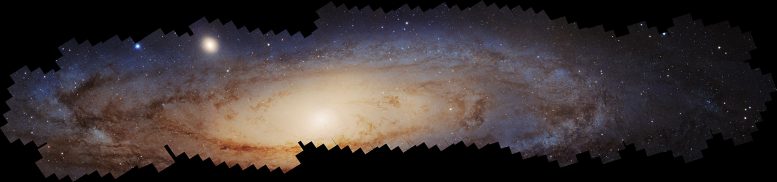
Fast forward to the early 21st century, when the Hubble Space Telescope — one of humanity’s most powerful scientific instruments — spent over a decade capturing an extraordinary photomosaic of Andromeda’s ancient light. This monumental effort required more than 600 individual snapshots. Why such an extensive project? Andromeda is so close and expansive that it spans an area in the sky six times the apparent diameter of the full Moon. Hubble’s high-resolution imaging had to meticulously cover this vast celestial landscape.
The result is a breathtaking mosaic that reveals the glow of 200 million stars — just a fraction of Andromeda’s immense stellar population. The combined images contain an astonishing 2.5 billion pixels, making it an unparalleled cosmic portrait. This detailed survey of Andromeda’s stars provides crucial insights into the galaxy’s history, including past mergers with smaller satellite galaxies, helping astronomers piece together its evolutionary journey.
Hubble Space Telescope Traces Hidden History of Andromeda Galaxy
Since the launch of NASA’s Hubble Space Telescope, astronomers have identified more than a trillion galaxies across the universe. Yet, one galaxy holds special significance as our Milky Way’s closest major neighbor — the breathtaking Andromeda Galaxy (Messier 31). On a clear autumn night, it appears to the naked eye as a faint, elongated shape, roughly the same apparent size as the Moon in the sky.
A hundred years ago, astronomer Edwin Hubble made a groundbreaking discovery by proving that what was once thought to be a “spiral nebula” was actually a separate galaxy, located about 2.5 million light-years away — roughly 25 times the diameter of the Milky Way. Before this revelation, scientists believed our galaxy was the entirety of the universe. Hubble’s discovery revolutionized our understanding of the cosmos, revealing a universe far larger and more complex than previously imagined.
Andromeda Through Hubble’s Lens
Now, a century later, the space telescope named for Hubble has accomplished the most comprehensive survey of this enticing empire of stars. The Hubble telescope is yielding new clues to the evolutionary history of Andromeda, and it looks markedly different from the Milky Way’s history.
Without Andromeda as a proxy for spiral galaxies in the universe at large, astronomers would know much less about the structure and evolution of our own Milky Way. That’s because we are embedded inside the Milky Way. This is like trying to understand the layout of New York City by standing in the middle of Central Park.
A Stellar Close-up: Andromeda’s Star Population
“With Hubble we can get into enormous detail about what’s happening on a holistic scale across the entire disk of the galaxy. You can’t do that with any other large galaxy,” said principal investigator Ben Williams of the University of Washington. Hubble’s sharp imaging capabilities can resolve more than 200 million stars in the Andromeda galaxy, detecting only stars brighter than our Sun. They look like grains of sand across the beach. But that’s just the tip of the iceberg. Andromeda’s total population is estimated to be 1 trillion stars, with many less massive stars falling below Hubble’s sensitivity limit.
Photographing Andromeda was a herculean task because the galaxy is a much bigger target on the sky than the galaxies Hubble routinely observes, which are often billions of light-years away. The full mosaic was carried out under two Hubble programs. In total it required over 1,000 Hubble orbits, spanning more than a decade.
https://www.youtube.com/embed/oa3EmyicgEE?feature=oembed
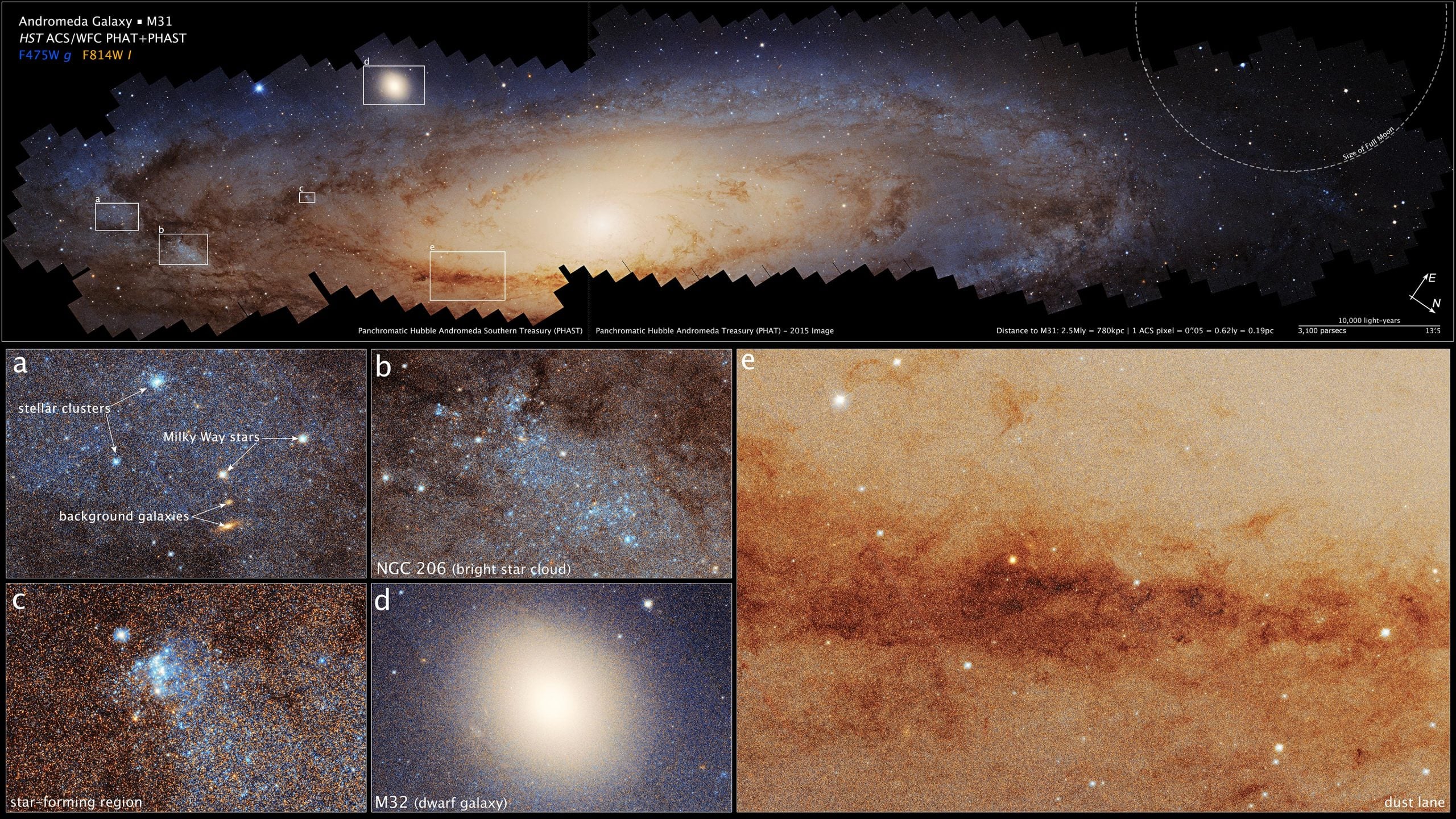
This video opens with the largest photomosaic ever assembled from Hubble Space Telescope observations. It is a panoramic view of the neighboring Andromeda galaxy, located 2.5 million light-years away. It took over 10 years to make this vast and colorful portrait of the galaxy, requiring over 600 Hubble snapshots. This stunning mosaic captures the glow of 200 million stars. The camera zooms into the central portion of the galaxy, resolving a sea of myriad older stars. The camera pans along the galaxy’s vast disk which is over 200,000 light-years across. The view is etched with dark dust clouds. The stellar population looks bluer as we move toward the galaxy’s outer rim, rich in bright blue star clusters. A spindle-shaped background galaxy briefly comes into view.
The Mosaic of a Galaxy: Unveiling Andromeda’s Full Image
This panorama started with the Panchromatic Hubble Andromeda Treasury (PHAT) program about a decade ago. Images were obtained at near-ultraviolet, visible, and near-infrared wavelengths using the Advanced Camera for Surveys and the Wide Field Camera 3 aboard Hubble to photograph the northern half of Andromeda.
This program was followed up by the Panchromatic Hubble Andromeda Southern Treasury (PHAST), recently published in The Astrophysical Journal and led by Zhuo Chen at the University of Washington, which added images of approximately 100 million stars in the southern half of Andromeda. This region is structurally unique and more sensitive to the galaxy’s merger history than the northern disk mapped by the PHAT survey.
The combined programs collectively cover the entire disk of Andromeda, which is seen almost edge-on — tilted by 77 degrees relative to Earth’s view. The galaxy is so large that the mosaic is assembled from approximately 600 separate fields of view. The mosaic image is made up of at least 2.5 billion pixels.
The complementary Hubble survey programs provide information about the age, heavy-element abundance and stellar masses inside Andromeda. This will allow astronomers to distinguish between competing scenarios where Andromeda merged with one or more galaxies. Hubble’s detailed measurements constrain models of Andromeda’s merger history and disk evolution.
A Galactic ‘Train Wreck’
Though the Milky Way and Andromeda formed presumably around the same time many billions of years ago, observational evidence shows that they have very different evolutionary histories, despite growing up in the same cosmological neighborhood. Andromeda seems to be more highly populated with younger stars and unusual features like coherent streams of stars, say researchers. This implies it has a more active recent star-formation and interaction history than the Milky Way.
“Andromeda’s a train wreck. It looks like it has been through some kind of event that caused it to form a lot of stars and then just shut down,” said Daniel Weisz at the University of California, Berkeley. “This was probably due to a collision with another galaxy in the neighborhood.”
A possible culprit is the compact satellite galaxy Messier 32, which resembles the stripped-down core of a once-spiral galaxy that may have interacted with Andromeda in the past. Computer simulations suggest that when a close encounter with another galaxy uses up all the available interstellar gas, star formation subsides.
“Andromeda looks like a transitional type of galaxy that’s between a star-forming spiral and a sort of elliptical galaxy dominated by aging red stars,” said Weisz. “We can tell it’s got this big central bulge of older stars and a star-forming disk that’s not as active as you might expect given the galaxy’s mass.”
“This detailed look at the resolved stars will help us to piece together the galaxy’s past merger and interaction history,” added Williams.
Hubble’s new findings will support future observations by NASA’s James Webb Space Telescope and the upcoming Nancy Grace Roman Space Telescope. Essentially a wide-angle version of Hubble (with the same sized mirror), Roman will capture the equivalent of at least 100 high-resolution Hubble images in a single exposure. These observations will complement and extend Hubble’s huge dataset.
Reference: “PHAST. The Panchromatic Hubble Andromeda Southern Treasury. I. Ultraviolet and Optical Photometry of over 90 Million Stars in M31” by Zhuo Chen, Benjamin Williams, Dustin Lang, Andrew Dolphin, Meredith Durbin, Julianne J. Dalcanton, Adam Smercina, Léo Girardi, Claire E. Murray, Eric F. Bell, Martha L. Boyer, Richard D’Souza, Karoline Gilbert, Karl Gordon, Puragra Guhathakurta, Francois Hammer, L. Clifton Johnson, Tod R. Lauer, Margaret Lazzarini, Jeremiah W. Murphy, Ekta Patel, Amanda Quirk, Mariangelly Díaz Rodríguez, Julia Christine Roman-Duval, Robyn E. Sanderson, Anil Seth, Tobin M. Wainer and Daniel R. Weisz, 16 January 2025, The Astrophysical Journal.
DOI: 10.3847/1538-4357/ad7e2b
The Hubble Space Telescope has been operating for over three decades and continues to make ground-breaking discoveries that shape our fundamental understanding of the universe. Hubble is a project of international cooperation between NASA and ESA (European Space Agency). NASA’s Goddard Space Flight Center in Greenbelt, Maryland, manages the telescope and mission operations. Lockheed Martin Space, based in Denver, also supports mission operations at Goddard. The Space Telescope Science Institute in Baltimore, which is operated by the Association of Universities for Research in Astronomy, conducts Hubble science operations for NASA.
Leave a Reply