

By Daniel Strain, University of Colorado at Boulder January 24, 2025
Collected at: https://scitechdaily.com/quantum-squeezing-unlocks-lightning-fast-gas-sensors/
Researchers have dramatically improved the detection speed and sensitivity of gas sensors by applying quantum squeezing to optical frequency comb lasers.
This innovative approach, which squeezes light to fine-tune its properties, has doubled the speed at which these devices can identify gases like methane and signs of viruses in the atmosphere. The technique not only speeds up detection but also reduces errors, promising significant advancements in safety and health monitoring.
Quantum Squeezing in Sensing
The trick to creating a better quantum sensor? Just give it a little squeeze.
Scientists have achieved a breakthrough in quantum sensing by using a technique called “quantum squeezing” to enhance the performance of optical frequency comb lasers—devices that act like fingerprint scanners for gas molecules. These highly precise sensors have already been used to detect methane leaks from oil and gas operations and to identify signs of COVID-19 in human breath samples.
Enhancing Gas Detection Speed with New Technology
Now, through a series of laboratory experiments, researchers have demonstrated a way to make these sensors even more sensitive and significantly faster. Their approach has doubled the detection speed of frequency comb lasers, paving the way for quicker and more accurate gas measurements.
This groundbreaking research is a collaboration between Scott Diddams from the University of Colorado Boulder and Jérôme Genest from Université Laval in Canada.
“Say you were in a situation where you needed to detect minute quantities of a dangerous gas leak in a factory setting,” said Diddams, professor in the Department of Electrical, Computer and Energy Engineering. “Requiring only 10 minutes versus 20 minutes can make a big difference in keeping people safe.”
He and his colleagues published their findings on January 16 in the journal Science. Daniel Herman, a postdoctoral researcher in ECEE, led the study.
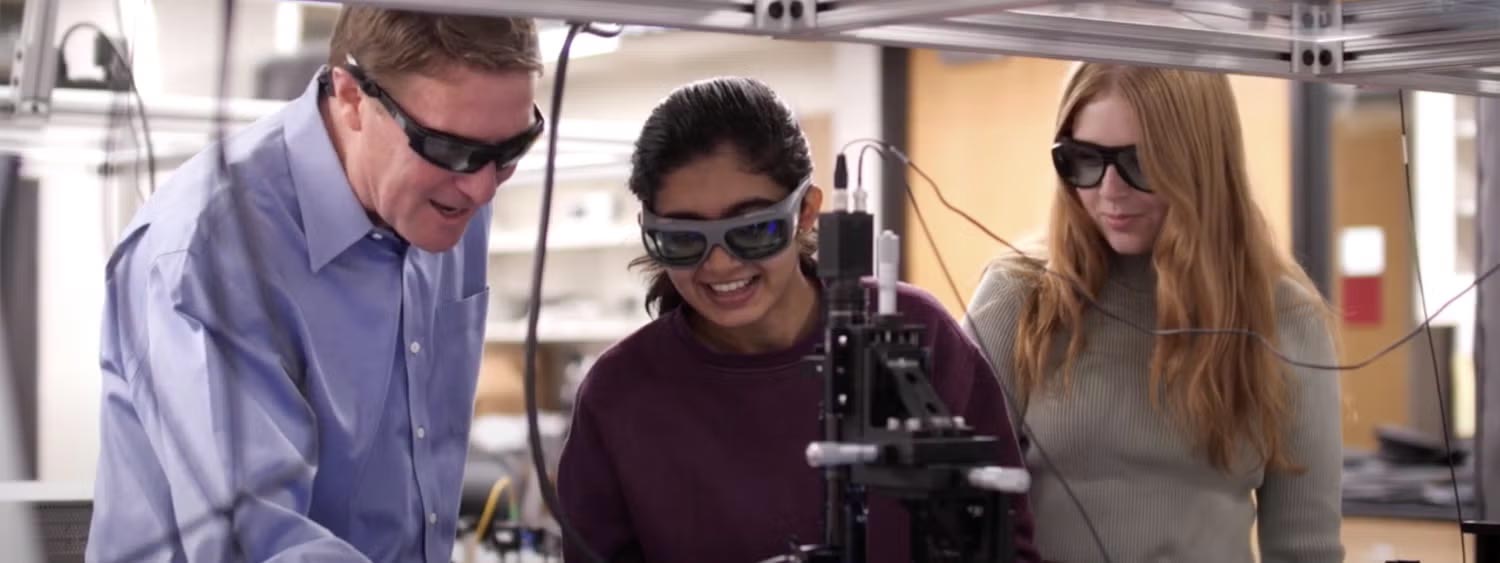
Pioneering Steps in Frequency Comb Technology
While normal lasers emit light in just one color, frequency comb lasers send out pulses of thousands to millions of colors—all at the same time. In the new study, the researchers used common optical fibers to precisely manipulate the pulses coming from those lasers. They were able to “squeeze” that light, making some of its properties more precise and others a little more random.
The research, in other words, represents a victory over some of the natural randomness and fluctuations that exist in the universe at very small scales.
“Beating quantum uncertainty is hard, and it doesn’t come for free,” he said. “But this is a really important step for a powerful new type of quantum sensors.”
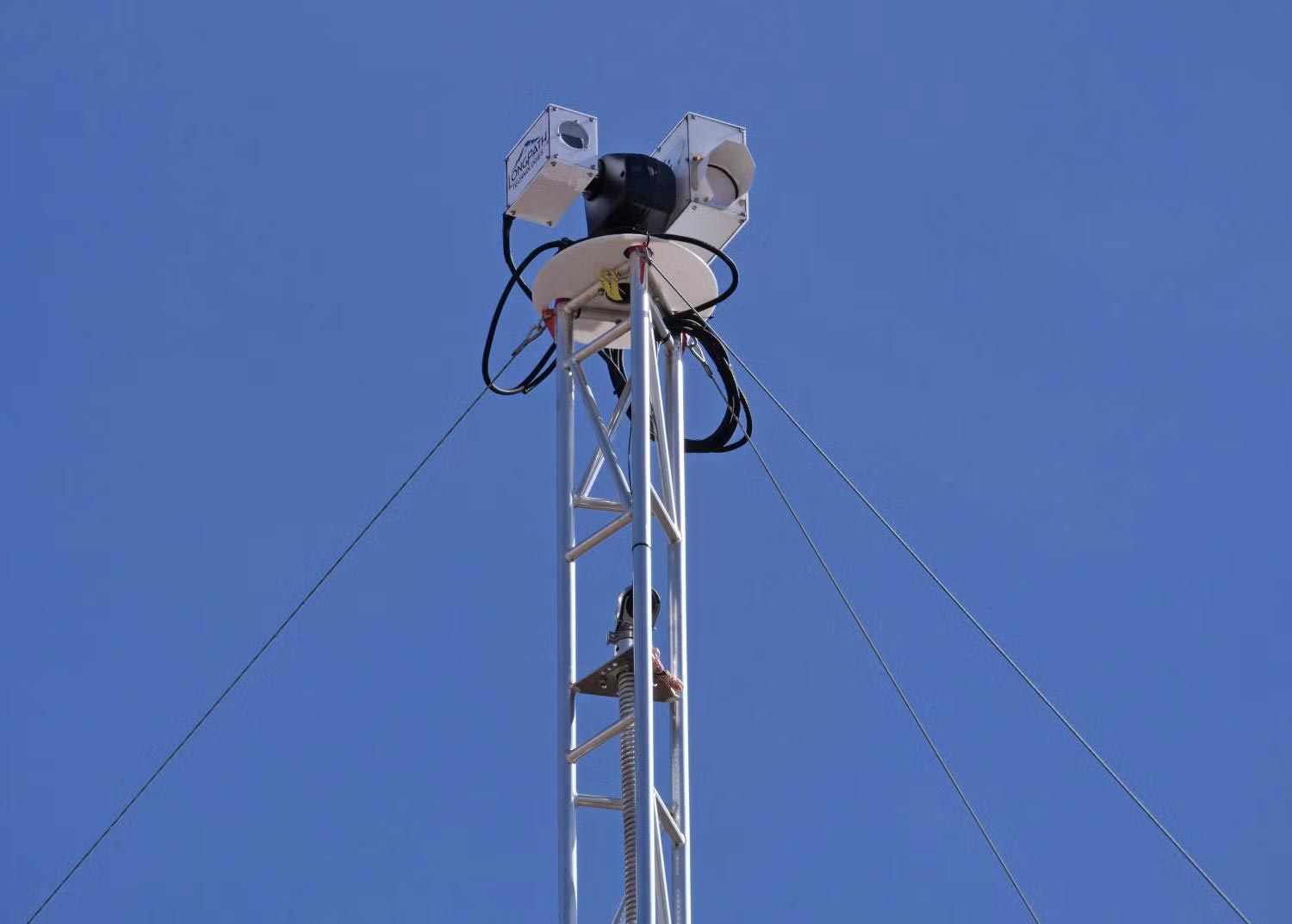
Overcoming Quantum Uncertainty with Squeezed Light
The results represent the latest step in the evolution of frequency combs, a technology born at JILA, a joint research institute between CU Boulder and the National Institute of Standards and Technology (NIST). Diddams was part of a team led by JILA’s Jan Hall that first pioneered frequency comb lasers in the late 1990s. Hall would go on to win a Nobel Prize in Physics for this work in 2005.
As these laser pulses travel through the atmosphere, for example, molecules in the way will absorb certain colors of light, but not others. Scientists can then identify what’s in the air based on what colors go missing from their laser light. Picture it a bit like a hair comb that’s lost a few of its teeth—hence, the name.
But those measurements also come with intrinsic uncertainties, Diddams said.
Light, he noted, is made up of tiny packets called photons. While lasers may look orderly from the outside, their individual photons are anything but.
“If you’re detecting these photons, they don’t arrive at a perfectly uniform rate like one per nanosecond,” Diddams said. “Instead, they arrive at random times.”
Which, in turn, creates what he calls “fuzziness” in the data coming back from a frequency comb sensor.
Enter quantum squeezing.
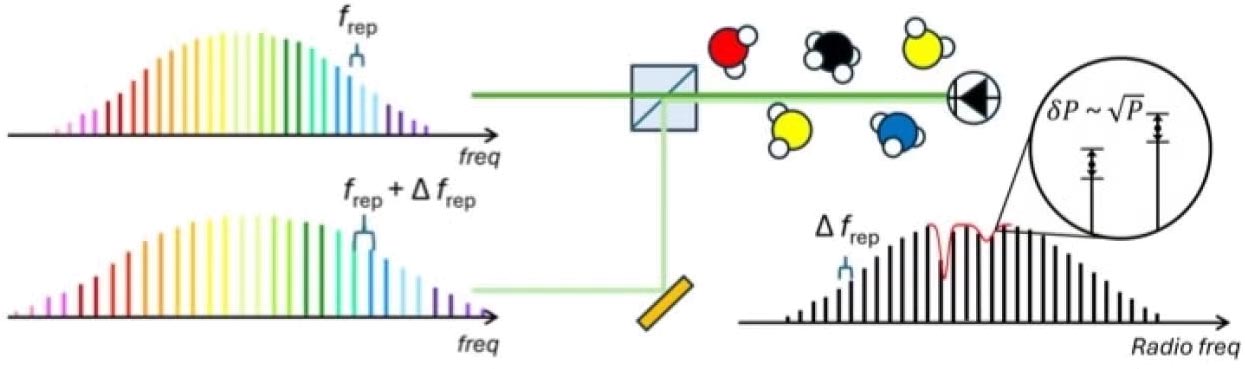
Illustration of how frequency comb gas sensors work: Lasers emit pulses of light in many different colors, left, and molecules in the air absorb some of those colors, right. Scientists can then identify what molecules are present based on what colors go missing. Credit: Scott Diddams
Quantum Squeezing Applied to Photon Timing
In quantum physics, certain properties are interconnected, meaning that measuring one with high precision makes it harder to measure the other accurately. A well-known example is an electron’s speed and position—you can determine where it is or how fast it’s moving, but not both at the same time. Quantum squeezing is a technique that enhances the precision of one property while sacrificing accuracy in the other, allowing scientists to make more focused and useful measurements.
In a series of lab experiments, Diddams and his colleagues achieved that feat in a surprisingly simple way: They sent their pulses of frequency comb light through a normal optical fiber, not so different from what delivers internet to your home.
The structure of the fiber altered the light in just the right way so that photons from the lasers now arrived at a more regular interval. But that increase in orderliness came at a price. It became a little harder to measure the frequency of the light, or how the photons oscillated to produce specific colors.
That trade-off, however, allowed the researchers to detect molecules of gas with a lot fewer errors than before.
They tested the approach out in the lab using samples of hydrogen sulfide, a molecule that is common in volcanic eruptions and smells like rotten eggs. The team reported that it could detect those molecules around twice as fast with its squeezed frequency comb than with a traditional device. The researchers were also able to achieve this effect over a range of infrared light around 1,000 times greater than what scientists had previously accomplished.
The group still has work to do before it can bring its new sensor out into the field.
“But our findings show that we are closer than ever to applying quantum frequency combs in real-world scenarios,” Herman said.
Diddams agreed: “Scientists call this a ‘quantum speedup,’” he said. “We’ve been able to manipulate the fundamental uncertainty relationships in quantum mechanics to measure something faster and better.”
Reference: “Squeezed dual-comb spectroscopy” by Daniel I. Herman, Mathieu Walsh, Molly Kate Kreider, Noah Lordi, Eugene J. Tsao, Alexander J. Lind, Matthew Heyrich, Joshua Combes, Jérôme Genest and Scott A. Diddams, 16 January 2025, Science.
DOI: 10.1126/science.ads6292
Other CU Boulder co-authors of the new study included Professor Joshua Combes; graduate students Molly Kate Kreider, Noah Lordi, Eugene Tsao and Matthew Heyrich; and postdoctoral researcher Alexander Lind. Mathieu Walsh, a graduate student at Université Laval, was also a co-author.
The work at CU Boulder was supported by the U.S. National Science Foundation through the Quantum Systems through Entangled Science and Engineering (Q-SEnSE) Quantum Leap Challenge Institute and by the Office of Naval Research.
Leave a Reply