
By Kenna Hughes-Castleberry, JILA January 26, 2025
Collected at: https://scitechdaily.com/deep-uv-laser-breakthrough-is-transforming-the-future-of-diamond-tech/
Researchers have built a deep-ultraviolet microscope to study hard-to-analyze materials like diamond, offering a new way to probe their electronic and thermal properties at the nanoscale.
This innovation, sparked by an industry challenge, creates nanoscale heat patterns using high-energy laser light, revealing transport behaviors critical for advanced electronics.
Ultrawide-Bandgap Semiconductors and Their Potential
Ultrawide-bandgap semiconductors like diamond are paving the way for the next generation of electronics. Their wider energy gap between the valence and conduction bands allows them to handle higher voltages, operate at faster speeds, and achieve greater efficiency compared to traditional materials such as silicon. However, studying how charge and heat move through these materials at very small scales—ranging from nanometers to microns—has been challenging. Visible light, commonly used in material studies, falls short in this case because it cannot probe nanoscale properties effectively. Additionally, since diamond does not absorb visible light, it cannot be used to generate electrical currents or rapid heating.
To overcome these challenges, a team of researchers at JILA, led by University of Colorado physics professors Margaret Murnane and Henry Kapteyn, has developed a groundbreaking microscope that enables the study of ultrawide-bandgap materials at an unprecedented scale. The team, which includes graduate students Emma Nelson, Theodore Culman, Brendan McBennett, and former postdoctoral researchers Albert Beardo and Joshua Knobloch, recently published their findings in Physical Review Applied. Their innovative tabletop deep-ultraviolet (DUV) laser microscope can excite and analyze nanoscale transport processes in materials like diamond.
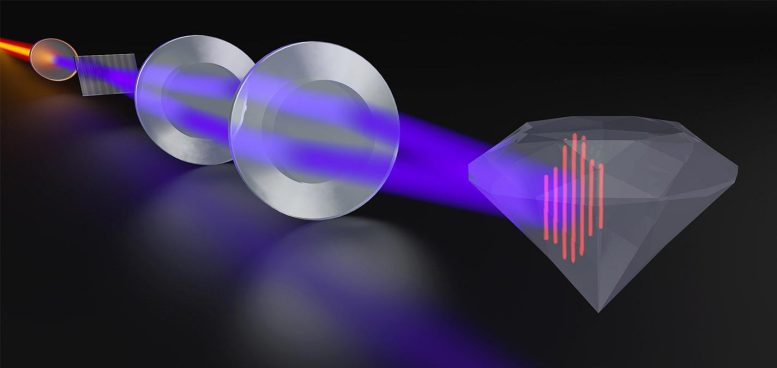
This microscope works by using high-energy DUV laser light to create a nanoscale interference pattern on the surface of the material. The pattern heats the material in a controlled, periodic way, allowing researchers to monitor how the heat dissipates over time. These observations provide crucial insights into the material’s electronic, thermal, and mechanical properties with spatial resolutions as fine as 287 nanometers—far beyond what is possible with visible light.
Murnane states that this new probe capability is important for future power electronics, high-frequency communication, and computational devices based on diamond or nitrides rather than silicon. Only by understanding a material’s behavior can scientists address the challenge of short lifetimes observed in many nanodevices incorporating ultrawide-bandgap materials.
A Challenge From an Industry Partner
For Nelson and the other JILA researchers, this project began with an unexpected challenge from materials scientists from one of their industry collaborators: 3M.
“3M approached us to study an ultrawide material sample that wasn’t compatible with our existing microscopes,” Nelson says. The team then collaborated with 3M scientists Matthew Frey and Matthew Atkinson to build a microscope that could image transport in this material.
Traditional imaging methods rely on visible light to see the microscopic composition and transport behaviors in semiconductors and other materials, which is effective for studying materials with smaller bandgaps.
However, materials like diamond, often used in electronic components, have a much larger energy gap between their valence and conduction bands—typically exceeding 4 electron volts (eV)—making them transparent to lower-energy visible and infrared light. Higher-energy photons in the ultraviolet (UV) range or beyond are required to interact with and excite electrons in these materials.
Visible-light setups also struggle with spatial resolution, as their longer wavelengths limit theability to probe the nanoscale dimensions relevant to modern devices.
These limitations inspired the team to think outside the box for their imaging setup.
“We brainstormed a new experiment to expand what our lab could study,” says Nelson.
The result was a multi-year effort to develop a compact microscope that uses DUV light to generate nanoscale heat patterns on a material’s surface without altering the material itself.
Diving Into the Deep Ultraviolet Regime
To generate the DUV light, the team first started with a laser emitting pulses at an 800-nanometer wavelength. Then, by passing laser light through nonlinear crystals and manipulating its energy, the team converted it step-by-step into shorter and shorter wavelengths, ultimately producing a powerful deep-ultraviolet light source at around 200 nanometers wavelength.
Each step required precise alignment of laser pulses in space and time within the crystals to achieve the desired wavelength efficiently.
“It took a few years to get the experiment working during the pandemic,” says Nelson, describing the trial-and-error process of aligning light through three successive crystals. “But once we had the setup, we could create patterns on a scale never before achieved on a tabletop.”
The Intricate Process of Creating Nanoscale Patterns
To produce the periodic pattern, called a transient grating, the researchers split the DUV light into two identical beams using a diffraction grating. These beams were directed onto the material’s surface at slightly different angles, where they overlapped and interfered with each other, forming a precise sinusoidal pattern of alternating high and low energy. This interference pattern acted as a nanoscale “grating,” temporarily heating the material in a controlled way and generating localized energy variations.
This process allowed the team to study how heat, electrons, or mechanical waves—depending on the material—spread and interacted across the nanoscale grating. The periodicity of the grating, which defined the distance between these high-energy peaks, was closely related to the wavelength of the light source, allowing researchers to get shorter periods by using higher energy (and shorter wavelength) light. The periodicity could be tuned by adjusting the angles of the beams, enabling detailed studies of transport phenomena at microscopic scales. For example, in this experiment, the team achieved grating patterns as delicate as 287 nanometers, a record for laser tabletop setups.
Testing the New DUV Microscope
Once the DUV transient grating system was operational, the team focused on validating its accuracy and exploring its capabilities. Their first test involved thin gold films, which served as a benchmark material due to their well-understood properties. The researchers used their system to generate nanoscale heat patterns, launching acoustic waves at the film’s surface. By analyzing the frequency and behavior of these waves, they extracted material properties such as density and elasticity.
To confirm their results, Nelson developed computer models simulating how the gold film would behave under similar conditions. The experimental data matched her predictions closely, providing a strong validation of the system’s precision.
“Seeing the experiment work and align with the models we created was a relief and an exciting milestone,” Nelson says.
Unlocking New Insights into Diamond’s Properties
Next, the team used their new DUV microscope to look at diamond, a material prized for its exceptional electronic and thermal properties. Previous techniques for studying diamond often required physical alterations, such as adding nanostructures or coatings, which inadvertently changed its properties. The DUV system eliminated this need, enabling the team to study diamond in its pristine state.
Using their new setup, the researchers observed how charge carriers—electrons and holes—diffused across the diamond after being excited by the DUV light. This process revealed new insights into the nanoscale transport dynamics of diamonds, particularly at nanometer scales.
The Broader Impact on Future Technologies
Beyond validating the system and exploring diamond’s properties, the team’s findings shed light on broader questions of nanoscale heat transport. At such small scales, heat doesn’t always behave as predicted by traditional physical models, which assume a smooth, continuous flow. Instead, nanoscale transport can involve ballistic and hydrodynamic effects, where energy carriers like phonons can travel in a straight line without scattering or can spread like water flowing through channels.
As researchers continue to refine these techniques and explore new materials, this advancement could play a crucial role in the development of high-performance power electronics, efficient communication systems, and quantum technologies. In the quest to push the boundaries of modern devices, diamonds may not last forever—but their impact on nanoscience certainly will.
Reference: “Tabletop deep-ultraviolet transient grating for ultrafast nanoscale carrier-transport measurements in ultrawide-band-gap materials” by Emma E. Nelson, Brendan McBennett, Theodore H. Culman, Albert Beardo, Henry C. Kapteyn, Matthew H. Frey, Matthew R. Atkinson, Margaret M. Murnane and Joshua L. Knobloch, 4 November 2024, Physical Review Applied.
DOI: 10.1103/PhysRevApplied.22.054007
This research was supported by the STROBE Science and Technology Center and 3M.
Leave a Reply