
By Space Telescope Science Institute January 19, 2025
Astronomers compile a large sample of an unusual class of objects in an effort to connect the dots to the early universe.
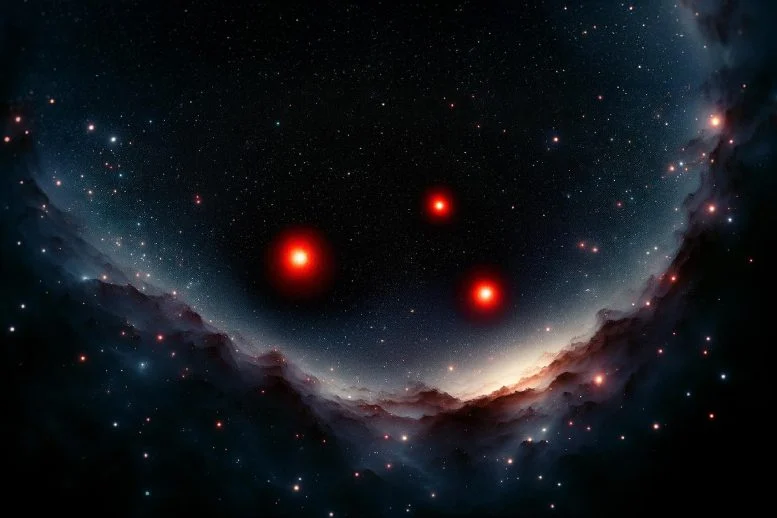
Shortly after NASA’s James Webb Space Telescope began its science operations, astronomers encountered an unexpected discovery in the data: small, red objects scattered across the distant, early universe. These intriguing phenomena, now referred to as “little red dots” (LRDs), remain poorly understood, raising fresh questions and inspiring new theories about the processes shaping the universe’s infancy.
By analyzing publicly available Webb data, a team of astronomers recently compiled one of the largest samples of LRDs to date. Nearly all of these objects are believed to have existed within the first 1.5 billion years after the Big Bang. The researchers concluded that a significant portion of the LRDs are likely galaxies hosting growing black holes at their centers.

Credit: NASA, ESA, CSA, STScI, Dale Kocevski (Colby College)
Webb Finds Newfound Galaxy Class May Indicate Early Black Hole Growth
In December 2022, less than six months after beginning its science mission, NASA’s James Webb Space Telescope made an unprecedented discovery: countless tiny, red-hued objects scattered across the sky. Dubbed “little red dots” (LRDs) by scientists, these mysterious objects are abundant yet puzzling, with their distinct colors and origins raising questions about the early universe.
A group of astronomers has now assembled one of the largest collections of LRDs ever studied, focusing on those that existed within the first 1.5 billion years after the Big Bang. Their findings suggest that many of these enigmatic objects may harbor growing supermassive black holes.
“We’re confounded by this new population of objects that Webb has found. We don’t see analogs of them at lower redshifts, which is why we haven’t seen them prior to Webb,” said Dale Kocevski of Colby College in Waterville, Maine, and lead author of the study. “There’s a substantial amount of work being done to try to determine the nature of these little red dots and whether their light is dominated by accreting black holes.”
Unveiling Early Universe Phenomena
A significant contributing factor to the team’s large sample size of LRDs was their use of publicly available Webb data. To start, the team searched for these red sources in the Cosmic Evolution Early Release Science (CEERS) survey before widening their scope to other extragalactic legacy fields, including the JWST Advanced Deep Extragalactic Survey (JADES) and the Next Generation Deep Extragalactic Exploratory Public (NGDEEP) survey.
The methodology used to identify these objects also differed from previous studies, resulting in the census spanning a wide redshift range. The distribution they discovered is intriguing: LRDs emerge in large numbers around 600 million years after the Big Bang and undergo a rapid decline in quantity around 1.5 billion years after the Big Bang.
The team looked toward the Red Unknowns: Bright Infrared Extragalactic Survey (RUBIES) for spectroscopic data on some of the LRDs in their sample. They found that about 70 percent of the targets showed evidence for gas rapidly orbiting 2 million miles per hour (1,000 kilometers per second) – a sign of an accretion disk around a supermassive black hole. This suggests that many LRDs are accreting black holes, also known as active galactic nuclei (AGN).
“The most exciting thing for me is the redshift distributions. These really red, high-redshift sources basically stop existing at a certain point after the big bang,” said Steven Finkelstein, a co-author of the study at the University of Texas at Austin. “If they are growing black holes, and we think at least 70 percent of them are, this hints at an era of obscured black hole growth in the early universe.”
Debunking Cosmological Myths
When LRDs were first discovered, some suggested that cosmology was “broken.” If all of the light coming from these objects was from stars, it implied that some galaxies had grown so big, so fast, that theories could not account for them.
The team’s research supports the argument that much of the light coming from these objects is from accreting black holes and not from stars. Fewer stars means smaller, more lightweight galaxies that can be understood by existing theories.
“This is how you solve the universe-breaking problem,” said Anthony Taylor, a co-author of the study at the University of Texas at Austin.
Exploring the Enigmatic Little Red Dots
There is still a lot up for debate as LRDs seem to evoke even more questions. For example, it is still an open question as to why LRDs do not appear at lower redshifts. One possible answer is inside-out growth: As star formation within a galaxy expands outward from the nucleus, less gas is being deposited by supernovas near the accreting black hole, and it becomes less obscured. In this case, the black hole sheds its gas cocoon, becomes bluer and less red, and loses its LRD status.
Additionally, LRDs are not bright in X-ray light, which contrasts with most black holes at lower redshifts. However, astronomers know that at certain gas densities, X-ray photons can become trapped, reducing the amount of X-ray emission. Therefore, this quality of LRDs could support the theory that these are heavily obscured black holes.
The team is taking multiple approaches to understand the nature of LRDs, including examining the mid-infrared properties of their sample, and looking broadly for accreting black holes to see how many fit LRD criteria. Obtaining deeper spectroscopy and select follow-up observations will also be beneficial for solving this currently “open case” about LRDs.
“There’s always two or more potential ways to explain the confounding properties of little red dots,” said Kocevski. “It’s a continuous exchange between models and observations, finding a balance between what aligns well between the two and what conflicts.”
These results were presented in a press conference at the 245th meeting of the American Astronomical Society in National Harbor, Maryland, and have been accepted for publication in The Astrophysical Journal.
The James Webb Space Telescope (JWST) is the most advanced space science observatory ever built, designed to explore the universe in unprecedented detail. Operated through a global partnership led by NASA, with contributions from the European Space Agency (ESA) and the Canadian Space Agency (CSA), Webb is addressing some of humanity’s biggest questions. It studies mysteries within our solar system, examines distant exoplanets, and investigates the origins and structures of the cosmos.
Leave a Reply