
By Royal Astronomical Society January 1, 2025
Collected at: https://scitechdaily.com/dark-energy-may-be-an-illusion-scientists-uncover-a-lumpy-universe/
Scientists are challenging the existence of dark energy with a new model called “timescape,” which suggests the Universe’s expansion might be influenced by its uneven structure rather than an invisible force.
This theory could resolve ongoing cosmological debates, with upcoming satellite data playing a key role in confirming its validity.
Questioning Dark Energy’s Existence
Dark energy, long considered one of science’s greatest mysteries, may not exist after all, according to researchers investigating how the Universe is expanding.
For the past century, physicists have generally believed that the cosmos grows uniformly in all directions. To account for unexplained phenomena, they introduced the concept of dark energy — a theoretical placeholder. However, this idea has faced persistent challenges and inconsistencies.
The Timescape Model: A New Perspective on Cosmic Expansion
Now, a team of physicists and astronomers from the University of Canterbury in Christchurch, New Zealand, is rethinking this approach. By analyzing supernovae light curves with greater precision, they suggest the Universe’s expansion is not uniform but instead occurs in a more irregular, “lumpier” manner.
The new evidence supports the “timescape” model of cosmic expansion, which doesn’t have a need for dark energy because the differences in stretching light aren’t the result of an accelerating Universe but instead a consequence of how we calibrate time and distance.
Implications of the Timescape Model
It takes into account that gravity slows time, so an ideal clock in empty space ticks faster than inside a galaxy.
The model suggests that a clock in the Milky Way would be about 35 percent slower than the same one at an average position in large cosmic voids, meaning billions more years would have passed in voids. This would in turn allow more expansion of space, making it seem like the expansion is getting faster when such vast empty voids grow to dominate the Universe.
Professor David Wiltshire, who led the study, said: “Our findings show that we do not need dark energy to explain why the Universe appears to expand at an accelerating rate.
“Dark energy is a misidentification of variations in the kinetic energy of expansion, which is not uniform in a Universe as lumpy as the one we actually live in.”
He added: “The research provides compelling evidence that may resolve some of the key questions around the quirks of our expanding cosmos.
“With new data, the Universe’s biggest mystery could be settled by the end of the decade.”
The new analysis has been published in the journal Monthly Notices of the Royal Astronomical Society Letters.
Conventional Dark Energy Theory Versus Timescape
Dark energy is commonly thought to be a weak anti-gravity force which acts independently of matter and makes up around two thirds of the mass-energy density of the Universe.
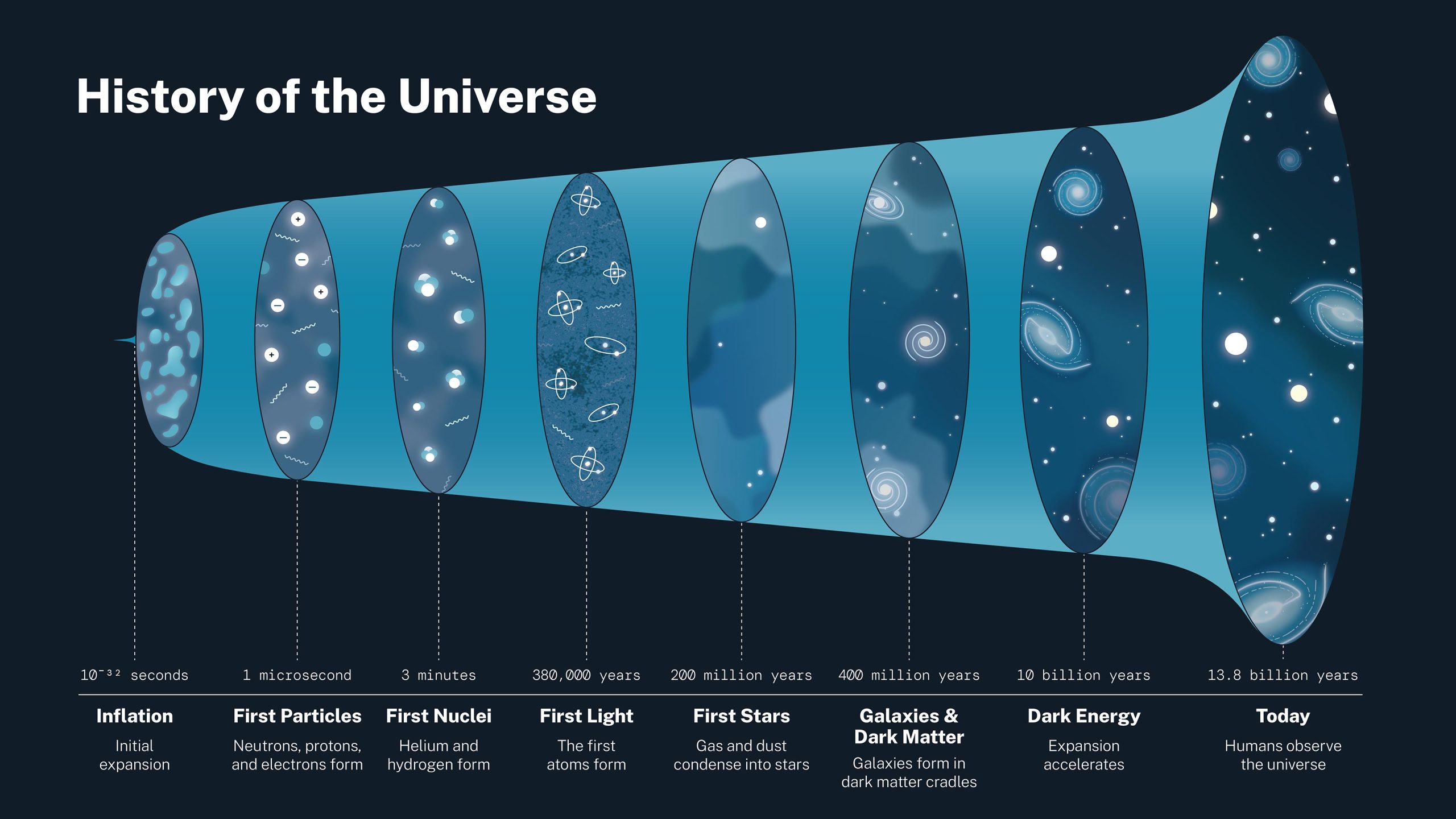
The standard Lambda Cold Dark Matter (ΛCDM) model of the Universe requires dark energy to explain the observed acceleration in the rate at which the cosmos is expanding.
Scientists base this conclusion on measurements of the distances to supernova explosions in distant galaxies, which appear to be farther away than they should be if the Universe’s expansion were not accelerating.
Current Challenges to the Standard Model
However, the present expansion rate of the Universe is increasingly being challenged by new observations.
Firstly, evidence from the afterglow of the Big Bang – known as the Cosmic Microwave Background (CMB) – shows the expansion of the early Universe is at odds with current expansion, an anomaly known as the “Hubble tension.”
In addition, recent analysis of new high-precision data by the Dark Energy Spectroscopic Instrument (DESI) has found that the ΛCDM model does not fit as well as models in which dark energy is “evolving” over time, rather than remaining constant.
Both the Hubble tension and the surprises revealed by DESI are difficult to resolve in models which use a simplified 100-year-old cosmic expansion law – Friedmann’s equation.
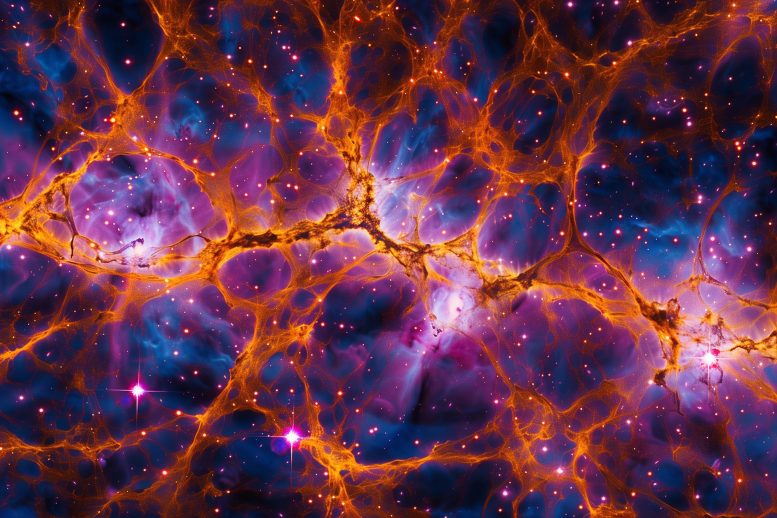
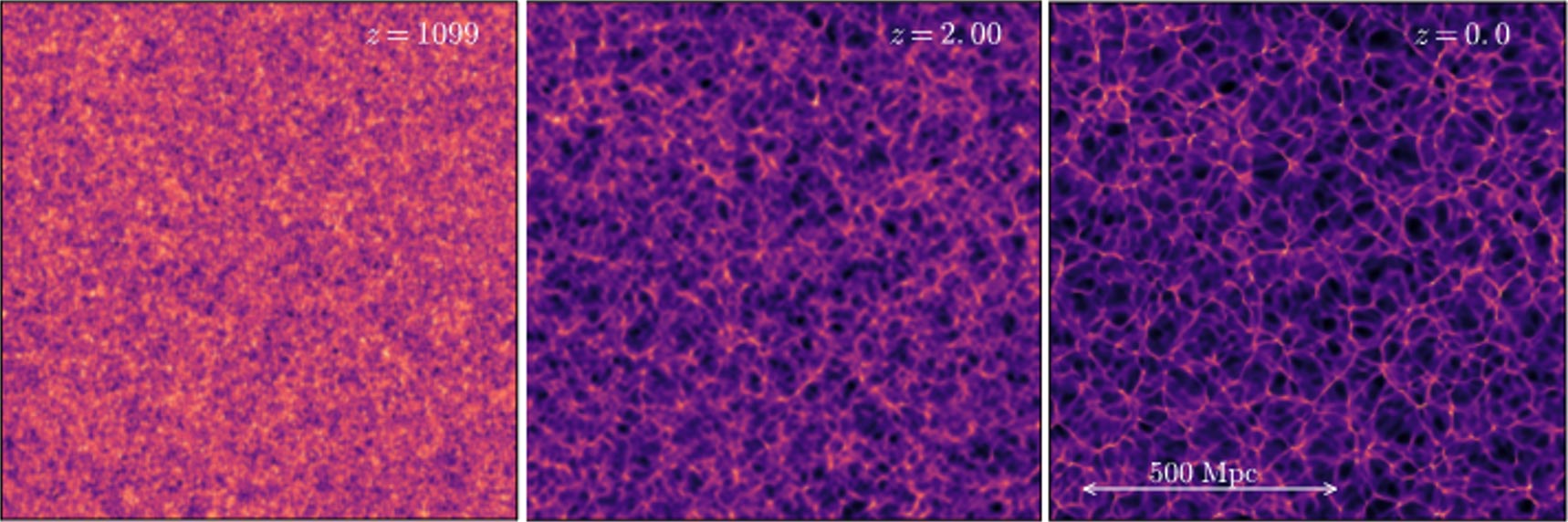
This assumes that, on average, the Universe expands uniformly – as if all cosmic structures could be put through a blender to make a featureless soup, with no complicating structure. However, the present Universe actually contains a complex cosmic web of galaxy clusters in sheets and filaments that surround and thread vast empty voids.
Professor Wiltshire added: “We now have so much data that in the 21st century we can finally answer the question – how and why does a simple average expansion law emerge from complexity?
“A simple expansion law consistent with Einstein’s general relativity does not have to obey Friedmann’s equation.”
Future Research Directions and Conclusions
The researchers say that the European Space Agency’s Euclid satellite, which was launched in July 2023, has the power to test and distinguish the Friedmann equation from the timescape alternative. However, this will require at least 1,000 independent high quality supernovae observations.
When the proposed timescape model was last tested in 2017 the analysis suggested it was only a slightly better fit than the ΛCDM as an explanation for cosmic expansion, so the Christchurch team worked closely with the Pantheon+ collaboration team who had painstakingly produced a catalog of 1,535 distinct supernovae.
They say the new data now provides “very strong evidence” for timescape. It may also point to a compelling resolution of the Hubble tension and other anomalies related to the expansion of the Universe.
Further observations from Euclid and the Nancy Grace Roman Space Telescope are needed to bolster support for the timescape model, the researchers say, with the race now on to use this wealth of new data to reveal the true nature of cosmic expansion and dark energy.
Reference: “Cosmological foundations revisited with Pantheon+” by Zachary G Lane, Antonia Seifert, Ryan Ridden-Harper and David L Wiltshire, 19 December 2024, Monthly Notices of the Royal Astronomical Society.
DOI: 10.1093/mnras/stae2437
The timescape cosmology was proposed by David Wiltshire in 2007, using the mathematical formalism of Thomas Buchert in general relativity, as a viable alternative to dark energy. In the intervening 17 years, the timescape model has been further developed and tested against a variety of cosmological data by David Wiltshire and his students. Zachary Lane and Antonia Seifert jointly developed the codes used in the new analysis.
Leave a Reply