
By Max Planck Institute for Astrophysics January 5, 2025
Collected at: https://scitechdaily.com/silent-giants-how-a-star-became-a-black-hole-without-exploding/
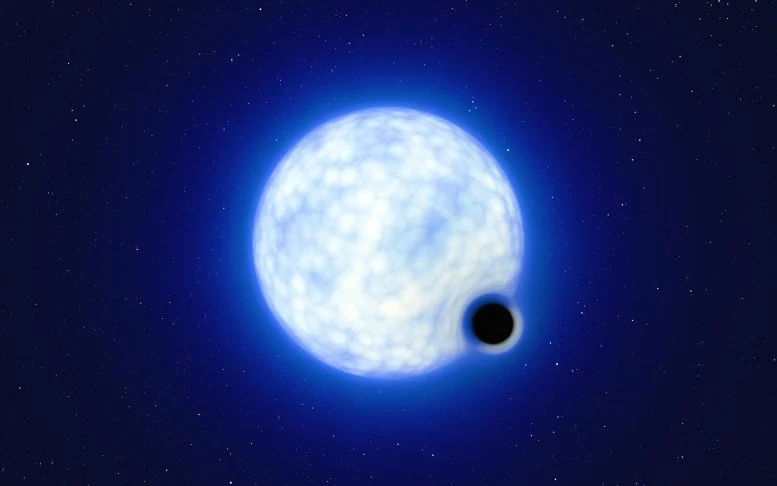
Observations of VFTS 243 provide evidence that black holes can form directly from the collapse of massive stars, without a preceding supernova explosion.
A newly discovered binary star system, combined with cutting-edge models of stellar collapse, has shed light on how stellar-mass black holes form. An international team of researchers from the Max Planck Institute for Astrophysics and the Niels Bohr Institute (NBI) at the University of Copenhagen has found evidence that massive black holes can form without the dramatic supernova explosions traditionally associated with star death. Instead, the energy from the collapse is primarily carried away by lightweight neutrino particles, with minimal asymmetry. This results in only a small “natal kick” for the newly formed black hole.
Black Hole Binary Systems
For years, astronomers have known about binary star systems in the Milky Way where one star is paired with a black hole. “The discovery of black-hole binary VFTS 243 in our neighboring Large Magellanic Cloud was extraordinary, and the system itself is remarkable,” says Alejandro Vigna-Gómez, formerly a postdoctoral researcher at the Niels Bohr Institute (NBI) and now at the Max Planck Institute for Astrophysics (MPA). VFTS 243 consists of a massive star, 25 times the Sun’s mass, paired with a black hole about 10 times the Sun’s mass.
Supernova Explosions and Their Impact
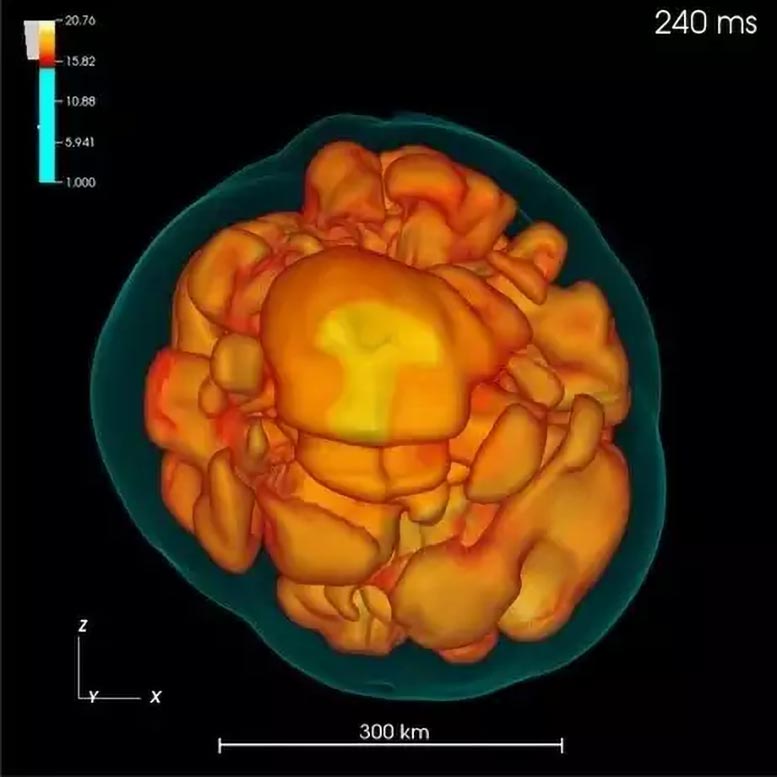
Stars that are several times more massive than the Sun often end their lives in dramatic explosions called supernovae. During these events, the dense metal core of the star collapses, releasing immense energy, mostly in the form of neutrinos. The star’s outer layers are then violently ejected into space at speeds of hundreds to thousands of kilometers per second. This expelled material, which can equal several times the Sun’s mass, creates large-scale asymmetries in the explosion remnants, observable even long after the supernova occurs.
These asymmetries and mass ejecta directly affect the very dense remnant at the core, the newly formed neutron star, which experiences a recoil – a natal kick – that can abruptly change its velocity. There is plenty of evidence of these natal kicks for neutron stars, as we observe them moving at large speeds throughout the Milky Way. However, for the most massive compact objects known, black holes, these natal kicks are not well understood. Such stellar black holes form in the collapse of massive stars, in particular when the explosion does not succeed and the in-falling matter collapses onto itself.
Exploring Black Hole Formation Without Explosions
The recent discovery of “disappearing” stars suggests that a large fraction of collapsing massive stars form black holes without any explosion, which unlike the bright supernovae we cannot observe. However, it is unclear how much mass these stars lose during black hole formation, or how large their natal kicks are. If the massive star directly collapses into a black hole, no baryonic matter is ejected, and energy is predominantly lost via neutrinos. “VFTS 243 has allowed us to test this scenario,” says Vigna-Gómez.
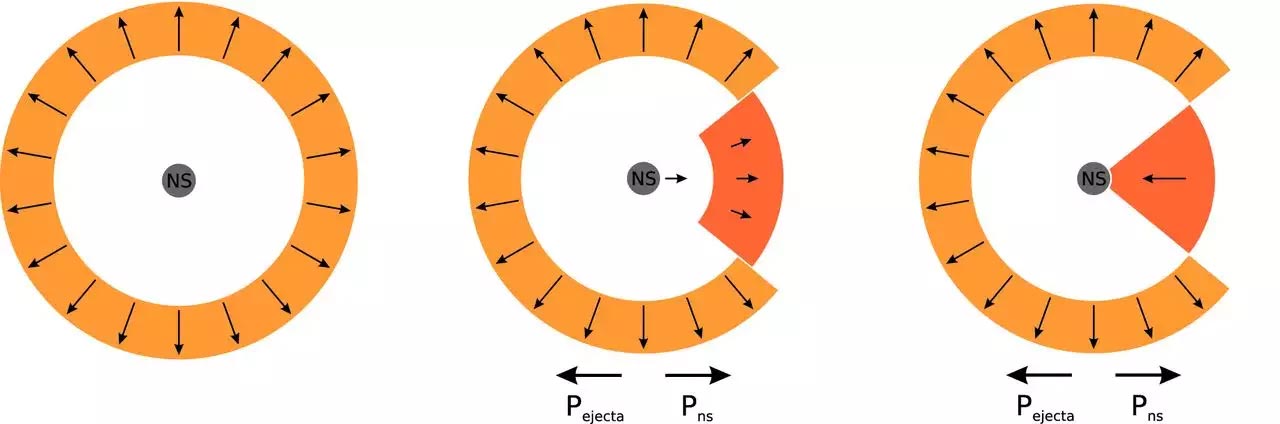
Sketch of the asymmetric ejection of matter resulting in a natal kick on the newly born neutron star. Credit: Figure 1 from Janka 2013
Insights from the VFTS 243 Binary System
The team explored the complete collapse scenario for the black hole binary VFTS 243, where a star ten times more massive than the Sun in its final stage had concluded its life cycle via an implosion. With state-of-the-art models of stellar collapse developed at MPA, they calculated the effects on the orbit of a binary star system during the black hole formation. In the complete collapse scenario, the huge gravitational binding energy released during black hole formation is exclusively carried away by the weakly interacting, neutral, and lightweight particles known as neutrinos.
Conclusion of the Study on Black Hole Formation
“Probing the physical processes that take place in the deepest interior of collapsing stars is extremely difficult and only possible under special circumstances,” says H.-Thomas Janka, supernova theorist at MPA. “The black hole observed in the binary system VFTS 243 is such a special case,” adds Daniel Kresse, postdoctoral researcher in Janka’s group. “It allowed us to conclude, for the first time, that neutrinos are emitted nearly equally in all directions when the massive progenitor collapsed to form the black hole.”
“Our study is a prime example of the synergy between theory and observations,” concludes Vigna Gómez. “Combining advanced numerical models of stellar collapse with the principles of supernovae in binary star systems, allowed us to obtain crucial insights into the complete collapse scenario, in particular proving that massive black holes can form without an explosion.”
Reference: “Constraints on Neutrino Natal Kicks from Black-Hole Binary VFTS 243” by Alejandro Vigna-Gómez, Reinhold Willcox, Irene Tamborra, Ilya Mandel, Mathieu Renzo, Tom Wagg, Hans-Thomas Janka, Daniel Kresse, Julia Bodensteiner, Tomer Shenar and Thomas M. Tauris, 9 May 2024, Physical Review Letters.
DOI: 10.1103/PhysRevLett.132.191403
Leave a Reply