

By SPIE–International Society for Optics and Photonics January 1, 2025
Collected at: https://scitechdaily.com/revealing-hidden-spin-patterns-how-lasers-unlock-the-quantum-world/
A groundbreaking technique using time-resolved electron microscopy and multi-polarization lasers has allowed scientists to analyze plasmonic waves with great precision.
This method helped uncover the stable and dynamic nature of meron pairs’ spin textures, opening new avenues in nanoscale technology.
Advancing Plasmonics with Multi-Polarization Laser Techniques
Plasmons are the collective vibrations of electrons in a solid, playing a key role in various applications such as sensing, catalysis, and light harvesting. A specific type of plasmonic wave, known as surface plasmon polaritons, travels along metal surfaces and is known for its ability to enhance electromagnetic fields. One cutting-edge tool for studying these waves is time-resolved electron microscopy, which employs ultrashort laser pulses to reveal their behavior. Recently, an international team of researchers made significant advancements in this technique.
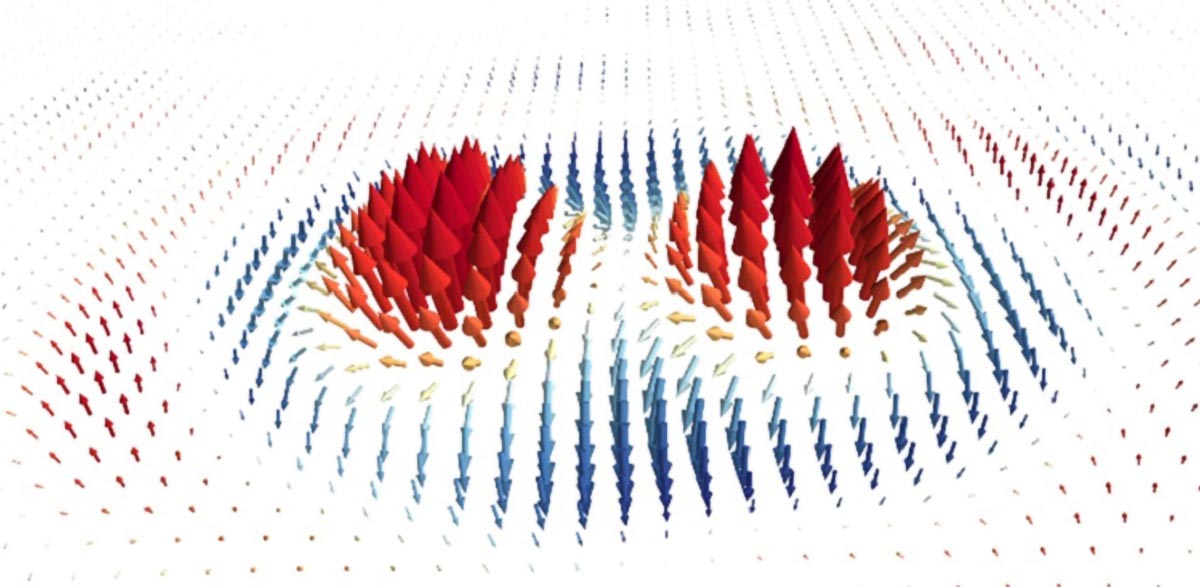
According to a report in Advanced Photonics, the team used multiple time-delayed laser pulses with four different polarizations to capture the complete electric field of the waves. This innovative approach achieved a level of precision that was previously unattainable. To put their method to the test, the researchers studied a specific spin texture called a meron pair. A meron is a topological structure where the spin direction covers only half of a sphere, unlike similar structures such as skyrmions, which cover an entire sphere.
Spin Texture Analysis and Topological Insights
To reconstruct the spin texture from the experiment, the researchers needed the electric and magnetic field vectors of the surface plasmon polaritons. While the electric field vectors could be directly measured, the magnetic field vectors had to be calculated based on the electric field’s behavior over time and space. By using their precise method, the researchers were able to reconstruct the spin texture and determine its topological properties, such as the Chern number, which describes the number of times the spin texture maps onto a sphere. In this case, the Chern number was found to be one, indicating the presence of a meron pair.
Broader Implications and Future Applications
The study also demonstrated that the spin texture remains stable throughout the duration of the plasmonic pulse, despite the fast rotation of the electric and magnetic field vectors. This new approach is not limited to meron pairs and can be applied to other complex surface plasmon polariton fields. Understanding these fields and their topological properties is important, especially at the nanoscale, where topological protection can help maintain the stability of materials and devices.
This research shows that it is now possible to study complex spin textures with high precision on extremely short timescales. The ability to accurately reconstruct the full electric and magnetic fields of surface plasmon polaritons opens new possibilities for exploring the topological properties of electromagnetic near fields, which may have important implications for future technologies at the nanoscale.
Reference: “Spatiotemporal topology of plasmonic spin meron pairs revealed by polarimetric photo-emission microscopy” by Pascal Dreher, Alexander Neuhaus, David Janoschka, Alexandra Rödl, Tim Colin Meiler, Bettina Frank, Timothy J. Davis, Harald Giessen and Frank Meyer zu Heringdorf, 17 December 2024, Advanced Photonics.
DOI: 10.1117/1.AP.6.6.066007
Leave a Reply