
By SciTechDaily.com November 7, 2024
Collected at: https://scitechdaily.com/suns-rage-massive-x2-3-solar-flare-spotted-by-nasa/
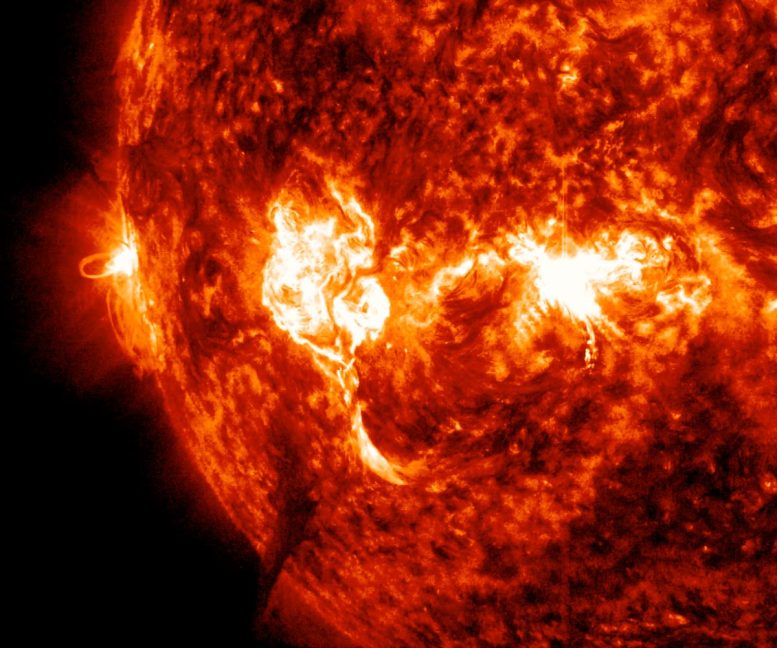
On November 6, 2024, NASA’s Solar Dynamics Observatory recorded a powerful solar flare, peaking at 8:40 a.m. ET. This flare, classified as an X2.3, is intense enough to potentially disrupt radio signals, navigation systems, and power grids on Earth. It also poses significant risks to astronauts and spacecraft operating in orbit.

Solar flares are sudden bursts of energy and light that erupt from the Sun’s surface. They occur when powerful magnetic fields within the Sun become twisted and release their energy, sending out intense radiation across space. This radiation spans a wide spectrum, including visible light, X-rays, and ultraviolet light, and can travel across the solar system at nearly the speed of light. Solar flares are often associated with sunspots, which are cooler, dark regions on the Sun’s surface where magnetic fields are particularly strong.
Solar flares are classified by their intensity, with the most intense types being X-class flares, followed by M-class, C-class, and B-class flares. X-class flares are the strongest and can have significant effects on Earth. When an X-class flare is directed toward Earth, it can interfere with our planet’s upper atmosphere, creating disruptions to radio communications, GPS signals, and even power grids. High-energy solar particles can also pose dangers to astronauts and satellites in orbit, potentially damaging sensitive electronics.
Solar flares are part of the broader phenomenon of space weather, which includes solar wind and coronal mass ejections (CMEs)—huge clouds of charged particles ejected from the Sun that often accompany strong solar flares. Scientists closely monitor solar activity to predict solar flares and mitigate their effects on Earth and in space. NASA’s Solar Dynamics Observatory and other solar telescopes around the world help track these eruptions, providing crucial data for understanding and responding to solar activity that could impact modern technology and space exploration.
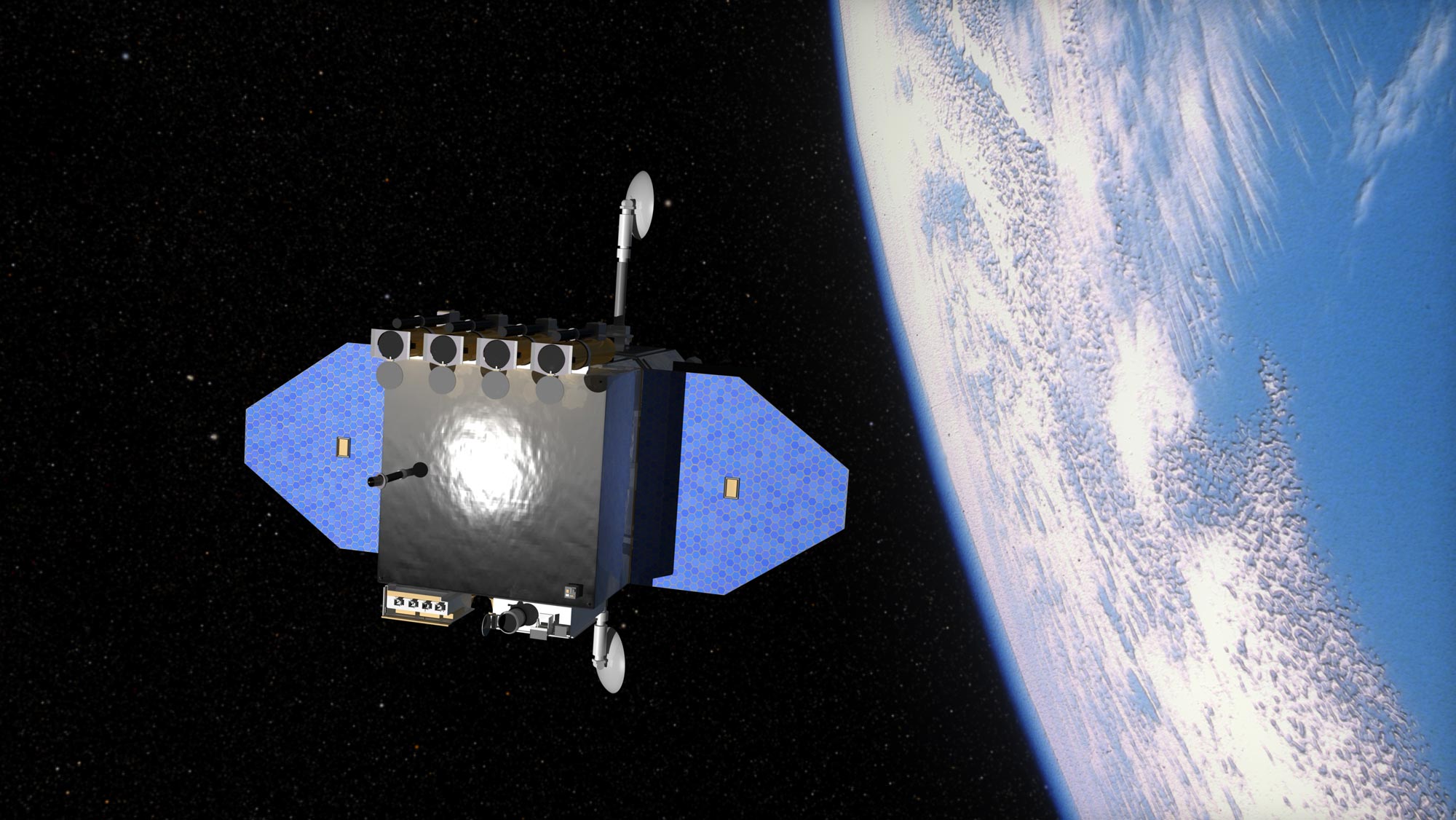
NASA’s Solar Dynamics Observatory (SDO) is a spacecraft dedicated to studying the Sun’s atmosphere and magnetic activity. Launched in 2010, SDO provides high-resolution images and data, capturing solar activity in unprecedented detail. This mission plays a vital role in NASA’s efforts to understand space weather, specifically focusing on solar phenomena like solar flares, sunspots, and coronal mass ejections (CMEs), which can affect Earth’s communication systems, satellites, and power grids.
Equipped with three main instruments—the Atmospheric Imaging Assembly (AIA), the Helioseismic and Magnetic Imager (HMI), and the Extreme Ultraviolet Variability Experiment (EVE)—SDO measures the Sun’s magnetic field, images the Sun’s atmosphere in various wavelengths, and monitors its energy output. This combination of tools allows SDO to track changes in the Sun’s magnetic fields, temperature, and atmospheric composition, revealing how these factors drive solar activity.
SDO orbits Earth at a vantage point that gives it a continuous view of the Sun, transmitting real-time data 24/7. The information it collects helps scientists make accurate forecasts of space weather events, which are crucial for protecting Earth’s technology and astronauts in space.
Leave a Reply