
March 31, 2026 by Hande Cater, Monash University
Collected at: https://phys.org/news/2026-03-scientists-capture-atoms-motion-generation.html
Monash University researchers have captured the exact atomic movements that write data to next-generation memory devices, which could pave the way for smaller, faster and more energy-efficient electronics. Published in Nature Communications, the study was led by Dr. Kousuke Ooe, a Japan Society for the Promotion of Science (JSPS) postdoctoral fellow in the School of Physics and Astronomy at Monash University who is first author of the paper, in collaboration with Australian Laureate Professor Joanne Etheridge and researchers from the Japan Fine Ceramics Center, Kyoto University, and the University of Osaka.
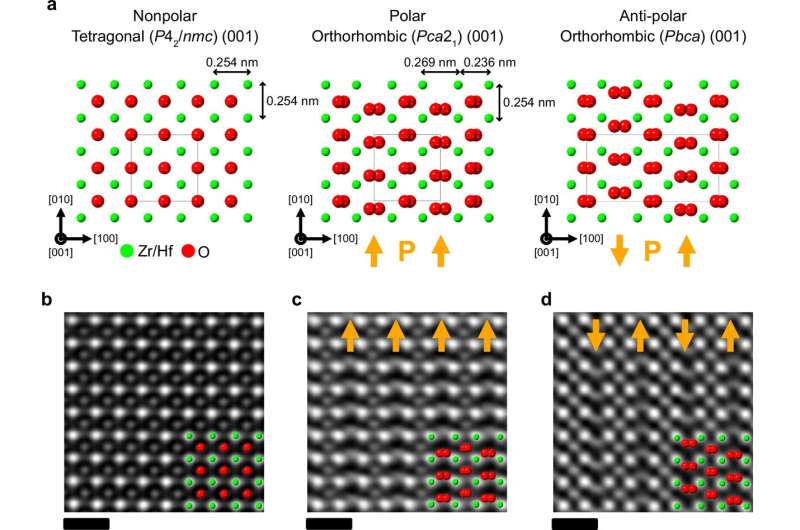
Using advanced electron microscopy at the Monash Center for Electron Microscopy (MCEM), the team captured atomic-scale movements inside promising memory materials, known as fluorite-type ferroelectrics, that could overcome current limits to how small and efficient memory devices can become.
Everyday technologies, such as smartphones, medical devices, wearable electronics and contactless IC cards used in public transport, store data as billions of digital 1s and 0s. In these materials, the physical position of an atom acts like a “switch”—and moving an atom just a fraction of a nanometer is what flips a data bit from a 0 to a 1.
This research shows exactly how that physical movement happens in real time. Until now, scientists couldn’t directly see how this switching actually happened, in fractions of a second.
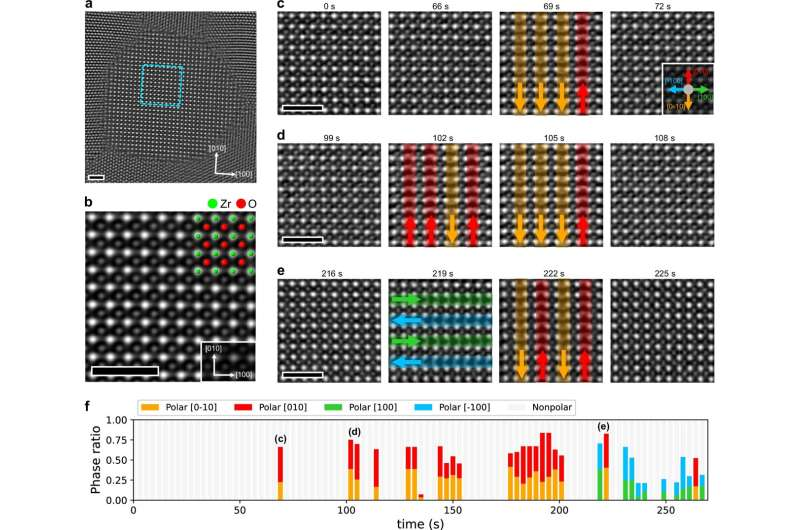
Direct observation of reversible phase transition and polarization switching in ZrO2. Credit: Nature Communications (2026). DOI: 10.1038/s41467-026-70593-y
They discovered that switching doesn’t happen in a single step, but through previously unseen intermediate atomic structures, and that the process can be controlled by changing the material’s composition.
“Using state-of-the-art electron microscopy, we’ve been able to directly watch atoms move during the switching process that underpins how memory devices store information,” said Dr. Ooe. “This gives us a completely new level of understanding, not just that switching happens, but exactly how it happens at the atomic scale.
“What’s exciting is that we can now see pathways to control this behavior. That opens the door to designing materials that are faster, more stable and far more energy efficient.”
Professor Etheridge, also from the School of Physics and Astronomy, and Science Advisor at the Monash Center for Electron Microscopy, explains, “Modern technologies demand ever smaller and more energy-efficient memory. These materials are exciting because they continue to function even at dimensions where conventional materials fail.
“By revealing the pathways atoms take during switching, this work provides atomic-scale maps for engineering the next generation of memory devices.”
The findings provide key design insights for next-generation ferroelectric materials, particularly how different elements influence atomic motion and switching behavior. This opens new possibilities for tailoring materials at the atomic level, improving durability and efficiency, and accelerating the development of advanced memory technologies.
Publication details
Kousuke Ooe et al, Direct observation of cation-dependent polarisation switching dynamics in fluorite ferroelectrics, Nature Communications (2026). DOI: 10.1038/s41467-026-70593-y
Journal information: Nature Communications
Leave a Reply