
March 30, 2026 by Krystal Kasal, Phys.org
Collected at: https://phys.org/news/2026-03-silicon-quantum-logical.html
Silicon is ubiquitous in modern electronics, and now it is becoming increasingly useful in quantum computing. In particular, silicon’s compatibility with existing chip technology and its long coherence times in silicon-based spin qubits make it a promising material for scalable quantum computing. A new study, published in Nature Nanotechnology, has demonstrated silicon’s use in a logical quantum processor, representing the first of its kind.
A logical quantum processor in silicon
Quantum computers are highly sensitive to errors from environmental noise, creating hurdles for practical quantum computation. To help suppress these errors, information can be encoded in logical qubits using fault-tolerant quantum computation (FTQC). Prior to this study, silicon had not been used for logical operations in FTQC.
“In silicon-based quantum processors, frequency crowding and cross-talk further exacerbate the errors as the system scales. To address these errors, logical encoding stands as the only viable solution by redundantly storing quantum information across multiple physical qubits. While logical qubits and operations have been successfully demonstrated in platforms such as superconducting circuits, neutral atoms, nitrogen-vacancy centers and trapped ions, their implementation in silicon-based spin qubits poses notable technical challenges,” the study authors write.
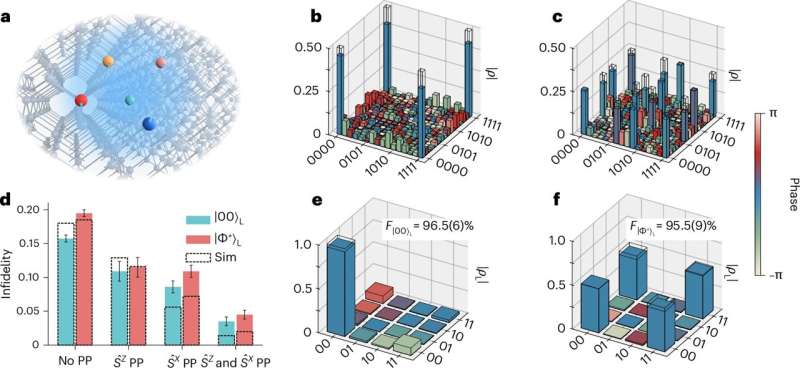
However, the team was capable of overcoming these challenges. To create the logical quantum processor, the research team used five phosphorus nuclear spins in a silicon donor cluster as qubits. They used the [[4, 2, 2]] code—a quantum error-detecting code that encodes two logical qubits into four physical qubits and has minimal resource requirements for demonstrating quantum fault tolerance (FT). Logical gates were implemented using a combination of nuclear magnetic resonance and electron spin resonance. The resulting device was able to process quantum information while checking for errors and reducing signal interference, or crosstalk, a major source of error in quantum systems.
Successful simulations
The team tested out their silicon quantum computer on a task involving calculating the ground state energy of a water molecule. To do this, they ran the quantum algorithm called variational quantum eigensolver (VQE) to simulate the ground state of a water molecule using logical qubits.
The study authors write, “In the experiment, we employ an integration of three error mitigation techniques, including parity checks to ensure the data are maintained in the code space, Clifford fitting to mitigate errors using a precalibrated fitting function fCF and symmetry verification to project the density matrix onto the Hamiltonian constrained symmetry subspace.”
Results showed that these error mitigation techniques substantially improved the experimental precision. Importantly, the team says that the VQE experimental results show “remarkable agreement with the theoretical values.”
Next steps
The successful implementation of the logical quantum processor in silicon represents a major milestone for more scalable quantum computing. The team says they have plans to further improve donor placement and hope to reduce crosstalk even more to boost performance. They also hope to scale up to more logical qubits and larger donor arrays in future projects.
The researchers conclude with more of their future plans, “Donor cluster arrays will be fabricated to scale this system up and realize the FTQC architecture, where the donor cluster arrays can be flexibly reconfigured to accommodate different FT encodings. We envision tailored FTQC schemes for the system by using the features demonstrated in this work, including high-connectivity Toffoli gates, strongly biased noise and logical states encoded in clusters. This work marks a transition from physical qubit operation to FT logical encoding in silicon quantum computing.”
Publication details
Chunhui Zhang et al, Universal logical operations in a silicon quantum processor, Nature Nanotechnology (2026). DOI: 10.1038/s41565-026-02140-1
Journal information: Nature Nanotechnology
Leave a Reply