
By Penn State March 24, 2026
Collected at: https://scitechdaily.com/scientists-reinvent-a-classic-material-to-help-power-the-future-of-quantum-tech/
A reengineered version of a classic crystal reveals unexpected behavior, hinting at new possibilities for faster, more efficient information transfer.
A new twist on a long-known material could help push quantum computing forward and cut energy use in modern data centers, according to a team led by Penn State researchers.
Barium titanate, first identified in 1941, is valued for its strong electro-optic properties in bulk, or three-dimensional, crystals. Materials like this connect electricity and light by converting signals carried by electrons into signals carried by photons, the particles of light.
Despite these advantages, barium titanate never became the standard material for electro-optic devices such as modulators, switches, and sensors. Instead, lithium niobate took its place because it is more stable and easier to manufacture, even though its performance is not as strong.
According to Venkat Gopalan, a Penn State professor of materials science and engineering and co-author of the study published in Advanced Materials, reshaping barium titanate into ultrathin, strained films could change that.
“Barium titanate is known in the materials science community as a champion material for electro-optics, at least on paper,” Gopalan said. “It has one of the largest electro-optic property values known in its bulk, single crystal form at room temperature. But when it comes to commercialization, it never made the leap. What we have done is show that when you take this classic material and strain it in just the right way, it can do things no one thought possible.”
Performance Gains and Practical Applications
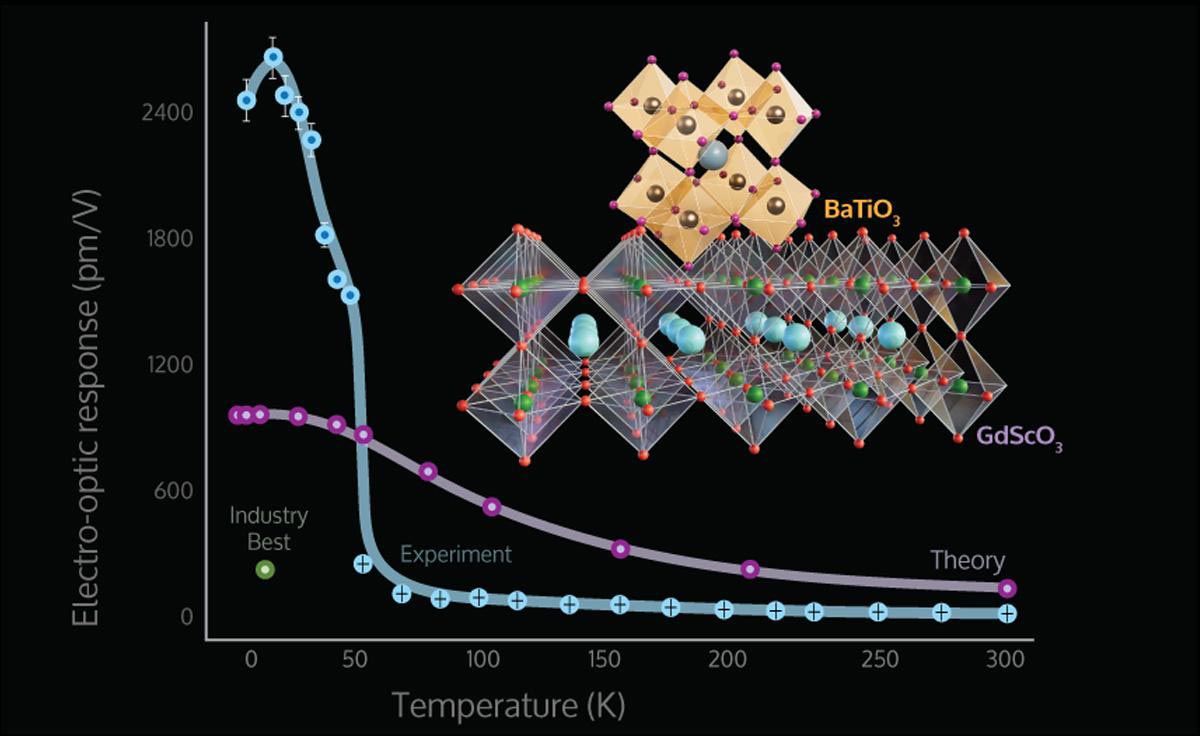
Gopalan explained that the redesigned material increases the efficiency of converting electron-based signals into light-based signals by more than ten times compared to previous results at cryogenic temperatures. Such low temperature conditions are required for quantum systems that rely on superconducting circuits.
For quantum networks, information must be converted into light so it can travel long distances through fiber optic systems at room temperature. This type of conversion is also important for data centers that handle artificial intelligence (AI) and online services. These facilities use large amounts of energy, much of it for cooling, and optical connections could help reduce that demand.
Because photons carry information without producing as much heat as electrons moving through wires, they offer a more energy-efficient option for transmitting data.
“Integrated photonic technologies as a whole are becoming increasingly attractive to companies that use large data centers to process and communicate large data volumes, especially with the accelerating adoption of AI tools,” said Aiden Ross, co-lead author of the study and graduate research assistant at Penn State. “The basic idea is that we could send information throughout these centers using photons rather than electrons, letting us send many streams of information in parallel, and do so without having to worry about our electronics heating up, the sheer infrastructure needed to keep such centers cool, and so on.”
Engineering a Metastable Phase
To achieve this, the researchers created films of barium titanate about 40 nanometers thick (about 0.0000016 inches), which is thousands of times thinner than a human hair. Growing the film on another crystal forced the atoms into a different arrangement, forming what is known as a metastable phase, a structure that does not naturally appear in bulk material.
“Metastable phases can have properties the stable version may not,” Gopalan said. “In this case, the stable phase of barium titanate loses much of its electro-optic performance at low temperatures, which is a big problem for quantum applications that require superconducting qubits. But the metastable phase we created not only avoided that drop, it also showed a response that was exceptional.”
Albert Suceava, co-lead author of the study and a doctoral candidate in materials science and engineering, explained the idea using a simple analogy.
“What we call a metastable phase refers to a crystal structure that is not the lowest energy arrangement of atoms that that material wants to take on,” Suceava said. “Everything in nature wants to exist in its lowest energy state. Think of a ball on a hill, it will naturally roll to the foot of the hill. But if you cradle the ball in your arms, you’ve given it a new place it can rest until someone comes along and gives you a push, knocking that ball out of your hands so it can roll down the hill. The metastable phase is like holding the ball, it only exists because we’ve done something to the material that makes it okay with taking on this new structure, at least until it’s disturbed.”
Implications for Quantum Networks
In addition to improving data center efficiency, the work could help solve a major challenge in quantum computing: transferring information between machines. Current systems rely on microwave signals, which weaken quickly and are not suitable for long-distance communication.
“Microwave signals work for qubits on a chip, but they are terrible for long-distance transmission,” Suceava said. “To go from individual quantum computers to quantum networks spread over multiple computers, information needs to be converted into a kind of light that we’re already very good at sending long distances, such as the infrared light used for fiber optic internet.”
Sankalpa Hazra, another co-lead author and doctoral candidate in materials science and engineering, noted that this thin film approach could be applied to many other materials.
The team now plans to extend the method beyond barium titanate.
“Achieving this result with barium titanate was a case of taking a new material design approach to a very classic and well-studied material system,” Gopalan said. “Now that we understand this design strategy better, we have some less well-studied material systems that we want to apply this same approach to. We are very optimistic that some of these systems will exceed even the incredible performance that came out of barium titanate.”
Reference: “Colossal Cryogenic Electro-Optic Response Through Metastability in Strained BaTiO3 Thin Films” by Albert Suceava, Sankalpa Hazra, Aiden Ross, Ian Reed Philippi, Dylan Sotir, Brynn Brower, Lei Ding, Yingxin Zhu, Zhiyu Zhang, Himirkanti Sarkar, Saugata Sarker, Yang Yang, Suchismita Sarker, Vladimir A. Stoica, Darrell G. Schlom, Long-Qing Chen and Venkatraman Gopalan, 11 October 2025, Advanced Materials.
DOI: 10.1002/adma.202507564
The U.S. National Science Foundation and the U.S. Department of Energy supported this research.
Leave a Reply